


Photo: Gage Skidmore / Flickr
My Logbook: Coffee, Laneways, and the Southern Wind
I stepped off the gangway at Station Pier on a February morning when the sky could not decide what it wanted to be. The sun blazed for ten minutes, then clouds rolled in from the south, a cool breeze cut through the warmth, and within the hour the sun returned as though nothing had happened. A deckhand beside me shook his head and laughed. "Melbourne," he said, as if that single word explained everything. It did.
My taxi wound through the quiet streets of Port Melbourne and dropped me at Federation Square, where the angular glass-and-steel architecture of the cultural complex jutted against the grey stone of Flinders Street Station across the road. I stood there for a moment, feeling the city pulse around me. Trams rattled past on their tracks. A busker played a battered guitar beneath the station clocks. I watched a young couple pause to photograph the facade of the Ian Potter Centre, the national gallery of Australian art that anchors Federation Square's eastern edge, and I felt the familiar pull that Melbourne exerts on anyone who values art and conversation over spectacle. This is not a city that shouts. It whispers, and you lean in to listen.
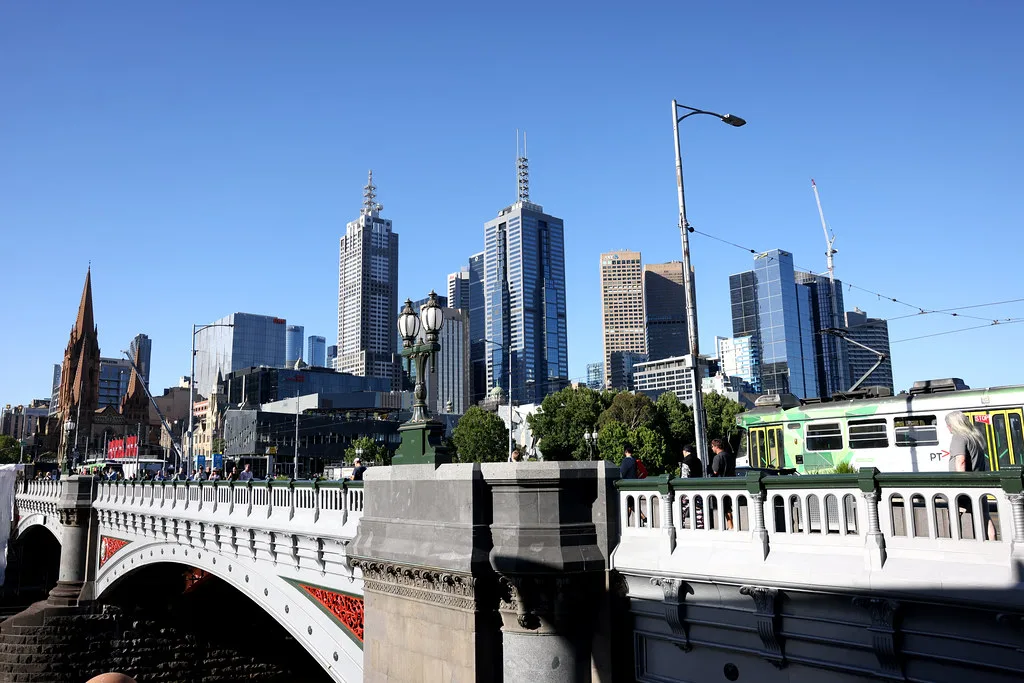
I walked south from the square, following the Yarra River toward the Royal Botanic Gardens. The path traced the riverbank through stands of eucalyptus and plane trees, and I noticed kookaburras perched on branches overhead, their laughing calls echoing across the water. The gardens themselves spread across thirty-eight hectares of rolling lawns and curated plantings, and I spent over an hour moving through them at a slow, grateful pace. I sat on a bench beside the ornamental lake, watching black swans glide through reflections of clouds, and I thought about how rare it is to find stillness like this so close to a city centre. However, what surprised me was not the beauty of the gardens but how few other cruise passengers I encountered there. Most had gone straight to the laneways. I was glad to have chosen the quieter path first.
The laneways found me eventually. After leaving the gardens, I caught a tram back toward Flinders Street and ducked into Hosier Lane, where every surface from pavement to roofline was covered in spray paint, stencils, wheat-paste portraits, and tags layered so thick the original brickwork had vanished entirely. A young artist in a paint-speckled apron was adding a new piece to a wall — a woman's face rendered in blues and golds, her eyes closed as though dreaming. I watched her work for fifteen minutes, the hiss of the spray can and the sharp chemical smell of fresh paint mixing with coffee aromas drifting from a nearby laneway cafe. This is the heart of Melbourne's street art movement, a tradition that began in the 1980s, and the constant renewal means no two visits to Hosier Lane are the same. I had photographed this same wall three years earlier and could not find a single familiar image. Everything had been painted over, replaced, reimagined.
From Hosier Lane I wandered into Degraves Street, one of the city's narrowest and most atmospheric laneways, where tiny espresso bars and breakfast spots line both sides. I ordered a flat white — Melbourne's signature coffee — from a barista who treated each pour with the focus of a surgeon. The coffee cost $5 AUD and tasted like it had been made by someone who cared deeply about what they were doing. I sat at a small outdoor table on the bluestone pavement, watching the morning crowd of locals and visitors drift past, and I thought about how this laneway culture defines Melbourne more than any single landmark. Yet this was not the same city I had visited years earlier. New cafes had appeared, old ones had closed, and the murals on the overhead walls had changed. Melbourne does not stand still.
After lunch — a Vietnamese pho for $16 AUD from a hole-in-the-wall restaurant on Little Bourke Street — I took a taxi to the Melbourne Cricket Ground. The MCG is a cathedral of sport, a 100,000-seat colosseum where cricket and Australian Rules Football inspire devotion that borders on the religious. I joined a stadium tour for $30 AUD and walked through the Long Room, where portraits of sporting legends hung on wood-panelled walls. The guide told us about the 1956 Olympics, when Melbourne became the first Southern Hemisphere city to host the games, and I stood on the players' balcony overlooking the vast oval of green turf and felt the weight of all those decades of cheering crowds. Although the ground was empty that afternoon, I could almost hear them.
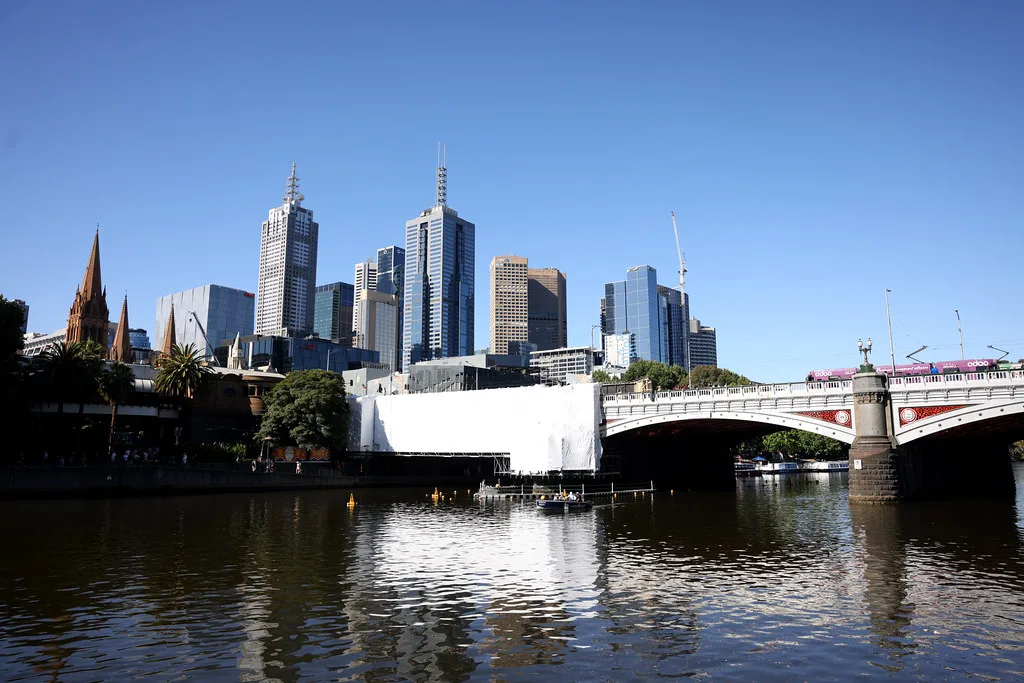
It was late afternoon when something shifted inside me. I had returned to the Yarra River, walking the Southbank Promenade as the light softened and the city's towers caught the last gold of the day. A man sat on a bench playing a cello, the deep notes rising and falling with the breeze off the water. I stopped to listen, and as the music wrapped around me I felt my eyes fill with tears. I could not explain it then and I cannot fully explain it now — only that the combination of this strange, beautiful, changeable city and the sound of that cello in the fading light touched something in me that I had not expected to be touched. I whispered a quiet prayer of gratitude — for the gift of travel, for the privilege of standing in this exact place at this exact moment, for the stranger whose music had opened a door I did not know was closed.
I made it back to Station Pier as the sun set behind the western suburbs, painting the sky in shades of apricot and violet. The ship's horn sounded a low note across the harbour. I stood at the rail as we pulled away from Melbourne, watching the city lights wink on one by one, and I thought about what this place had taught me. Melbourne does not hand you a postcard view and send you on your way. It asks you to slow down, to wander, to get lost in a laneway and find something you were not looking for. Despite all my planning and all my research, the moments I carry with me are the ones I never planned — the cello on the river, the artist in the alley, the flat white that tasted like someone had poured their whole self into a cup. That is the lesson Melbourne taught me, and I carry it with me still: the finest experiences are the ones that find you when you stop trying to find them.
Weather & Best Time to Visit
The Cruise Port
Ships dock at Station Pier in Port Melbourne, a historic pier that has served as Victoria's maritime gateway since 1854. The terminal building offers basic facilities including a covered waiting area, restrooms, and a taxi rank immediately outside the exit. There are no shops or restaurants within the terminal itself. Station Pier sits about 4 km from Melbourne's Central Business District. The most convenient transport is Tram Route 109, which departs from a stop near Middle Park, approximately a ten-minute walk from the pier. Taxis and ride-share vehicles queue at the pier exit and cost $15–20 AUD to the CBD. The terminal has level access at the ground floor for wheelchair users, though the pier surface can be uneven in places. Port security requires passengers to present their ship card when returning. Ships visiting Melbourne range from large vessels docking on longer Australian coastal voyages to expedition ships on routes toward New Zealand and the South Pacific.
Getting Around
Melbourne's public transport network is extensive and cruise-friendly. The city's iconic tram system is the largest in the world, and rides within the CBD Free Tram Zone are completely free — no ticket required. Outside the free zone, you need a Myki card, available from convenience stores and stations for $6 AUD plus loaded credit. A single tram or train journey within Zone 1 costs $5.30 AUD, while a full-day cap is $10.60 AUD. Tram Route 109 connects the port area to the CBD and is the most direct public transport option from Station Pier.
Taxis and ride-share services like Uber operate widely throughout Melbourne. A ride from the CBD to the Royal Botanic Gardens costs roughly $10–15 AUD, while a trip to the Melbourne Cricket Ground runs about $15–20 AUD. For the Great Ocean Road or Yarra Valley wine country, a full-day private driver with air-conditioned vehicle costs $300–500 AUD. Walking is pleasant in the CBD and inner suburbs, with flat terrain and generally good footpath surfaces. However, Melbourne's weather can change rapidly, so dress in layers and carry a compact umbrella. For visitors with mobility challenges, the newer low-floor trams are wheelchair accessible, though some older heritage trams on the City Circle tourist route have steps. Train stations vary in accessibility — check the PTV website for station-specific information before planning your route.
Excursions & Activities
Federation Square & Laneway Walking Tour
Federation Square is Melbourne's cultural heart, housing the Ian Potter Centre (free entry), ACMI (free general admission), and regular public events. From here, walk to Hosier Lane for street art, Degraves Street for coffee, and Centre Place for hidden espresso bars. A self-guided walk is free and takes 2–3 hours. Guided laneway walking tours cost $30–50 AUD per person and provide deeper context on the street art scene. This is a low-energy activity on flat terrain, suitable for most mobility levels. You can explore independently with no booking required, or join a ship excursion that typically includes laneway highlights for $60–90 AUD.
Royal Botanic Gardens
These world-renowned gardens spread across 38 hectares on the south bank of the Yarra River. Entry is free. The Aboriginal Heritage Walk ($40 AUD, book ahead through the gardens website) is a guided tour exploring indigenous plant use and cultural significance. Allow 1.5–2 hours for a leisurely visit. Paths are paved and mostly flat, making this accessible for wheelchair users and visitors with limited mobility. A taxi from the pier costs about $20 AUD. Visit independently — no ship excursion needed for this central attraction.
Melbourne Cricket Ground Stadium Tour
The MCG seats 100,000 spectators and is hallowed ground for cricket and Australian Rules Football fans. Stadium tours ($30 AUD adults, $15 AUD children) run daily and last about 75 minutes, taking visitors through the players' rooms, the Long Room, and the National Sports Museum. The tour involves moderate walking with some stairs, though an elevator is available for accessibility needs. Book ahead online for guaranteed entry, or visit independently by tram or taxi ($20–25 AUD from the pier).
Great Ocean Road Day Trip
The Great Ocean Road stretches 243 km along Victoria's southwestern coast, passing through rainforest, coastal cliffs, and the iconic Twelve Apostles limestone stacks. This is a full-day commitment — the drive to the Twelve Apostles takes approximately 3.5 hours each way. A ship excursion costs $150–250 AUD and guarantees your return to the vessel, which is important given the distance. Independent travelers can hire a car ($80–120 AUD per day) or arrange a private tour ($200–400 AUD per person). This is a high-energy excursion with significant driving time. Only feasible if your ship is in port for ten or more hours. Book ahead well in advance during peak season (December through March).
Queen Victoria Market
Operating since 1878, this open-air market covers two city blocks and offers fresh produce, gourmet food, clothing, and souvenirs. Entry is free. Come hungry — a meat pie costs $6–8 AUD, fresh oysters $3 AUD each, and a box of local strawberries about $5 AUD. The market operates Tuesday through Sunday (closed Monday and Wednesday). Wheelchair accessible on the main aisles, though some narrow stall areas can be crowded. A short tram ride from the CBD or a $15 AUD taxi from the pier. No need to book ahead.
Depth Soundings
Australia operates on the Australian Dollar (AUD). As of early 2026, $1 USD buys approximately $1.55–1.60 AUD. ATMs are plentiful throughout the CBD and accept international cards with typical withdrawal fees of $2–3 AUD. Credit cards are accepted almost everywhere, including small cafes and market stalls — Australia is largely cashless. Contactless payment via phone or card is the norm.
Tipping is not expected in Australia, though rounding up or leaving 10% at sit-down restaurants for exceptional service is appreciated. Taxi drivers do not expect tips. Melbourne's tap water is safe to drink and considered among the cleanest city water supplies in the world — refill your bottle freely. The city is extremely walkable within the CBD grid, but distances between attractions outside the centre can add up. Planning your route and budgeting time for tram travel will help you see more during a port day. Power outlets are Australian Type I (three-pin angled), so bring an adapter if you need to charge devices ashore. English is spoken universally, and Melburnians are famously willing to offer recommendations — ask any local for their favourite coffee spot and prepare for an enthusiastic answer.
Photo Gallery
Frequently Asked Questions
Where do cruise ships dock in Melbourne?
Ships dock at Station Pier in Port Melbourne, about 4 km from the CBD. Tram Route 109 from nearby Middle Park reaches the city centre in twenty minutes. Taxis and ride-share to the CBD cost $15-20 AUD.
Can I walk to Melbourne CBD from Station Pier?
It is about 4 km and takes 45-50 minutes on foot along a flat waterfront path. Most passengers prefer the tram or a quick taxi ride instead.
Is the Great Ocean Road feasible as a cruise day trip?
Only if your ship is in port for ten or more hours. The drive to the Twelve Apostles is about 3.5 hours each way. A ship excursion costing $150-250 AUD guarantees your return to the vessel.
How do I get from Melbourne Airport to Station Pier?
Take the SkyBus to Southern Cross Station ($22 AUD one way), then a tram or taxi to the pier. A direct taxi or ride-share from the airport costs $60-80 AUD and takes 35-45 minutes.
Are Melbourne's trams free?
Trams are free within the CBD Free Tram Zone covering the city centre. Outside this zone you need a Myki card, available from stations and convenience stores for $6 AUD plus loaded credit.
What's the best time to visit Melbourne?
The Australian summer (Dec-Feb) is warmest and the cruise season runs Oct-Apr. The page's own Catches note that Melbourne is famous for "four seasons in one day" — even peak summer can flip from 26°C sun to 16°C wind within hours. Spring (Sep-Nov) and autumn (Mar-May) are mild with thinner crowds. Winter (Jun-Aug) is the Low Crowds window — cool, wet, but with the Australian Football League (AFL) in full swing for sports tourists. The live weather widget in the seasonal panel above is the primary source for short-term conditions on a specific sailing date.
What's Melbourne's storm season?
Melbourne sits at ~37°S on Port Phillip Bay — south of the tropical-cyclone tracks that affect northern Australia (no cyclones reach Melbourne directly). The relevant heavy-weather pattern is the famous Melbourne weather variability — cold fronts off the Southern Ocean can drop temperatures 10°C within an hour year-round. Bass Strait storms (May-Sep) bring strong winds and rough seas that can affect cruise berthing schedules. The live weather widget in the seasonal panel above is the primary source for current conditions on a specific sailing date.
What should I pack for Melbourne?
Layers, layers, layers — Melbourne's reputation for "four seasons in one day" is real. Temperatures range 6-26°C depending on season. A windproof jacket year-round (the Bass Strait blows cold even in summer). Comfortable walking shoes for the laneways and the long Station Pier walk. Very high-SPF sunscreen — Australian UV at ~37°S is intense. A swimsuit for St Kilda Beach if visiting Dec-Feb.
Will rain ruin my Melbourne port day?
Melbourne's tram network, the laneway arcades (Block Arcade, Royal Arcade, Centre Place), the State Library reading room, NGV International, Queen Victoria Market's covered halls, and the dozens of indoor coffee shops and warehouses around Flinders Street all keep you dry. The Great Ocean Road day trip is more weather-sensitive — fog on the cliff stretches dims the Twelve Apostles. The driest months are Jan-Mar. The live weather widget in the seasonal panel above is the primary source for short-term forecasts on a specific sailing date.
Melbourne, Australia — Cruise Port Guide
Last reviewed: February 2026