


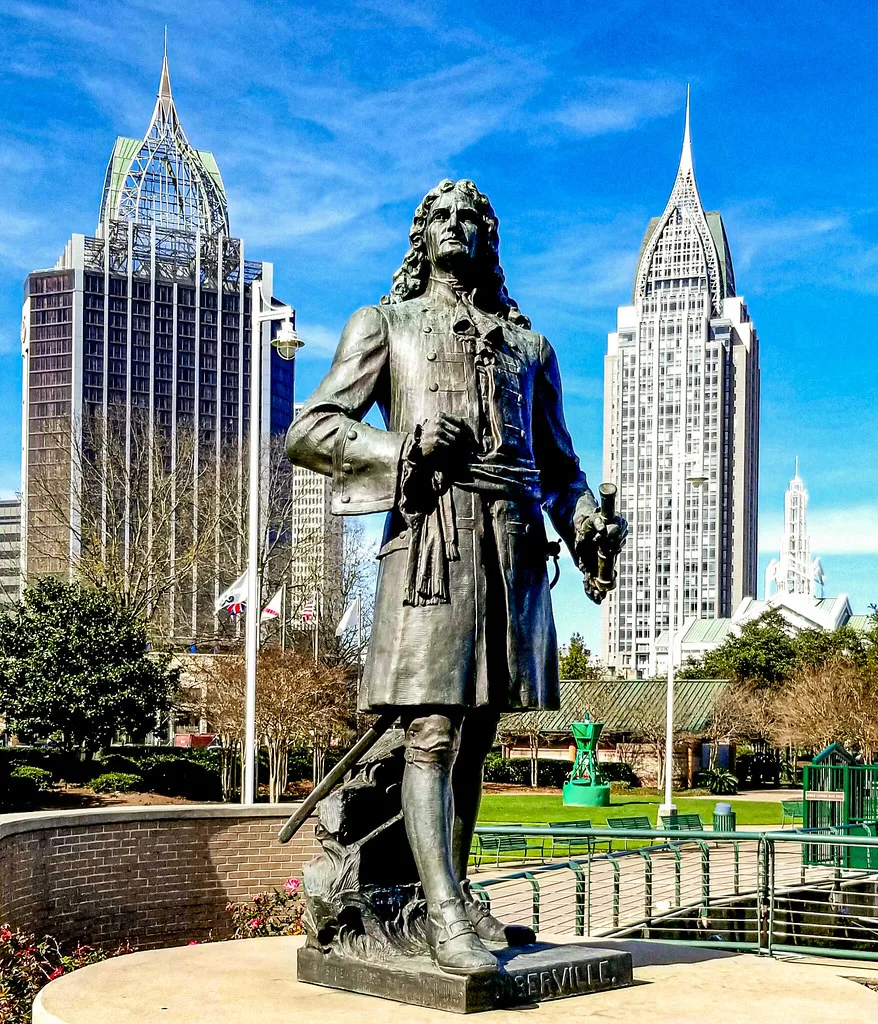
Photo: Wikimedia Commons
My Logbook: Where Southern Oaks Meet the Gulf Tide
I drove into Mobile on a Tuesday afternoon in late October, the kind of warm Gulf Coast day when the air smells of salt water and magnolia blossoms and the Spanish moss hangs from the live oaks so thick it looks like curtains drawn against the afternoon sun. My cruise was leaving the next morning, and I had given myself a full day to explore Alabama's oldest city before boarding. The terminal sat right on the Mobile River downtown, and I could see the ship's funnel rising above the warehouse roofline as I turned onto Water Street. I parked in the terminal lot for about $12 a day and walked into the historic district with my camera and a paper map I had picked up at the welcome center.
The historic district opened up before me in shaded blocks of antebellum architecture, wrought-iron balconies draped with ferns, and narrow streets canopied by live oaks so old their branches touched across the road. I walked past the Oakleigh Historic Complex and down through De Tonti Square, where elegant townhouses from the 1850s stood shoulder to shoulder in quiet dignity. A woman on a porch waved and called out, asking if I was heading to the Carnival Museum. I told her I was. She smiled and said I would learn something that would surprise me. She was right.
The Mobile Carnival Museum, housed in a restored warehouse on Government Street, told a story I had never heard before. Mobile held the first organized Mardi Gras celebration in the United States in 1703, a full fifteen years before New Orleans. The museum was filled with enormous floats, sequined costumes weighing forty pounds each, and hand-painted train panels that depicted decades of parades. I stood in front of a display case containing a king's crown from 1872, its gold leaf still bright, and felt a quiet sense of wonder at how a tradition could survive through wars and hurricanes and economic collapse, carried forward by people who believed that joy was something worth preserving. The entrance fee was around $8, and I spent nearly two hours inside, reading every placard, studying every photograph. I left with a new respect for this city and its stubborn refusal to let celebration die.
The next morning, before boarding, I took a taxi to the USS Alabama Battleship Memorial Park. The fare was about $15 from downtown. The park sits on Mobile Bay, and the battleship is enormous — over 680 feet long, a floating city of steel that served in the Atlantic and Pacific theaters during the Second World War. I climbed through the narrow passageways below deck, ducking under bulkheads and squeezing through hatches designed for men smaller than me. The crew quarters were cramped beyond what I had imagined, bunks stacked three high with less than eighteen inches of clearance between them. A volunteer guide, a retired Navy man named Earl, told me that 2,500 sailors lived aboard during active service. I tried to picture it and couldn't. Next to the battleship sat the submarine USS Drum, and I crawled through its even tighter compartments, the torpedo tubes still loaded with practice rounds, the periscope still turning when I gripped the handles. Admission for the park was $18 for adults. The paths around the outdoor exhibits were paved and wheelchair accessible, though the ship's interior required climbing steep ladders and was not suitable for visitors with limited mobility.
It was standing on the deck of the Alabama, looking out across Mobile Bay in the morning haze, that something broke open inside me. I thought about the young men who had stood on this same steel deck in 1944, barely old enough to vote, sailing toward battles they might not survive. A small plaque near the bow listed the names of the crew members who had died in service, and I read each one, slowly, the way you read a prayer. My eyes filled with tears. I whispered a thank-you to men I would never meet for a sacrifice I could never repay. The wind came off the bay, warm and steady, and I stood there for a long time, not wanting to leave. It was a holy moment — not religious in any formal sense, but holy in the way that gratitude can be when it catches you off guard and reminds you that the life you are living was bought at a cost you did not pay.
I drove south afterward to Bellingrath Gardens, about thirty minutes from the park. The gardens were founded by Walter Bellingrath, who made his fortune as the first Coca-Cola bottler in the region, and the 65-acre estate felt like walking through a painting. The azaleas were past their spring peak by October, but the chrysanthemums were blazing in gold and rust and burgundy, and the formal rose garden still held enough late blooms to fill the air with fragrance. Admission cost $23 for the gardens and an additional $20 if you wanted to tour the home. I walked the garden paths for two hours, past the Mirror Lake where the reflections of cypress trees trembled on the water's surface, through the Asian-American Garden with its bamboo groves and stone bridges, and down to the bayou boardwalk where I spotted an alligator sunning on the bank. A docent told me that the gardens planted over 250,000 azalea bushes across the property. The main garden paths were paved and accessible for wheelchair users, though some of the naturalized trails along the bayou were unpaved and uneven.
Back in downtown Mobile for my last hour before boarding, I ate at a small seafood restaurant near the terminal. I ordered a Gulf oyster po'boy and a bowl of West Indies salad — a local specialty of lump crabmeat marinated in oil and vinegar with sweet onion. The po'boy cost $14 and the salad was $12, and both were so fresh I could taste the bay in every bite. The waitress, a woman named Dee, told me that the crab had been caught that morning just down the coast. I asked her what she loved about living in Mobile, and she thought for a moment and said, simply, that the people here take care of each other. It was the kind of answer that no tourism board could write, and I believed her.
What Mobile taught me was something I had not expected to learn from a cruise homeport. I had thought of it as a departure point, a place to park my car and walk onto a ship. But the city had its own gravity, its own story, its own stubborn beauty. The lesson: sometimes the place you leave from is worth staying in. I carry the memory of those names on the battleship plaque, that crown in the Carnival Museum, and Dee's quiet pride in her hometown. Mobile did not shout for my attention. It simply stood there in its oak-shaded dignity and waited for me to notice. I am grateful that I did.
Weather & Best Time to Visit
The Cruise Port
Carnival Cruise Line operates from the Alabama Cruise Terminal at 201 S Water Street on the Mobile River in downtown Mobile. The terminal is a modern facility with covered walkways, security screening, and a comfortable air-conditioned waiting area. On-site parking costs approximately $10-15 per day and can be reserved through your cruise line booking. The terminal is compact and relatively uncrowded compared to larger homeports like Galveston or Miami, which means embarkation day tends to move quickly. The check-in area is wheelchair accessible with ramp access at ground level. Taxis queue outside the terminal, and rideshare services operate throughout downtown Mobile. The historic district begins about a ten-minute walk from the terminal entrance, making this one of the more walkable homeports in the Gulf region. Mobile Regional Airport (MOB) is approximately twenty minutes away by taxi, costing $25-30 for the ride.
Getting Around
Mobile's compact downtown makes walking the easiest way to explore the historic district, the Carnival Museum, and waterfront restaurants near the terminal. Sidewalks are generally well maintained in the core tourist areas, though some sections of older neighborhoods have uneven brick surfaces that may pose challenges for wheelchair users or visitors with limited mobility. For destinations beyond walking distance, taxis are readily available downtown and charge standard metered rates — expect $10-15 to reach most local attractions and $15-20 for the USS Alabama Battleship Memorial Park on the east side of the bay.
Rideshare services including Uber and Lyft operate throughout Mobile and are often slightly cheaper than traditional taxis. A rental car is helpful if you plan to visit Bellingrath Gardens, which sits about thirty minutes south of downtown, or if you are driving in from elsewhere in the Southeast. Free street parking is available throughout much of the historic district, and several paid lots charge $5-10 per day. The Wave Transit bus system runs local routes, but service is infrequent and not well suited to cruise visitors on a tight schedule. If your ship departs in the evening, budget extra time for afternoon traffic on I-10 during weekday rush hours. The downtown area near the terminal is flat and manageable for most visitors, and the shaded oak canopy keeps summer temperatures slightly more bearable along the main walking routes.
Mobile Port Map
Interactive map showing cruise terminal and Mobile attractions. Click any marker for details.
Excursions & Activities
USS Alabama Battleship Memorial Park
The premier attraction in Mobile and well worth the fifteen-minute taxi ride from the terminal. The park includes the WWII battleship USS Alabama, the submarine USS Drum, a collection of military aircraft, and a Medal of Honor aircraft pavilion. Admission is $18 for adults and $10 for children ages six to eleven. Allow two to three hours. The outdoor grounds are paved and wheelchair accessible, but the ship and submarine interiors require climbing steep ladders and navigating narrow passageways — not suitable for visitors with significant mobility limitations. You can visit independently by taxi or book a ship excursion that typically costs $55-70 and includes round-trip transport with guaranteed return to the vessel.
Bellingrath Gardens & Home
A stunning 65-acre estate located about thirty minutes south of downtown Mobile. The gardens feature seasonal plantings — azaleas in spring, roses in summer, chrysanthemums in fall, and camellia trails in winter. Admission is $23 for gardens only or $43 for the combined garden-and-home tour. Allow two to three hours for the gardens alone. The main garden paths are paved and accessible for wheelchairs and strollers. Ship excursions to Bellingrath run $75-95 and include transport. You can also visit independently by hiring a taxi or renting a car — book ahead if visiting during the spring azalea season when the gardens draw heavy crowds.
Mobile Carnival Museum & Mardi Gras Heritage
Learn the surprising history of America's original Mardi Gras at this downtown museum, a twelve-minute walk from the cruise terminal. Mobile celebrated its first organized Mardi Gras in 1703, fifteen years before New Orleans. The museum showcases elaborate floats, costumes, and interactive displays. Admission is approximately $8 for adults. Allow sixty to ninety minutes. The museum is on one accessible level and welcoming to all visitors. No need to book ahead — simply walk over from the terminal.
Historic Downtown Walking Tour
Mobile's historic district stretches for blocks around the terminal area and features antebellum mansions, wrought-iron balconies, and moss-draped live oaks. Self-guided walks are free and can cover De Tonti Square, Oakleigh Historic Complex ($10 admission for the house tour), and Cathedral Square. Guided walking tours cost approximately $15-25 per person. Allow one to two hours. The terrain is flat and mostly sidewalk, making this a low-energy activity suitable for most fitness levels. Visit independently — no reservation needed.
Gulf Seafood at Local Restaurants
Mobile's proximity to the Gulf of Mexico means fresh oysters, shrimp, crab, and local specialties like West Indies salad are widely available at restaurants near the terminal. Budget $12-20 per person for a casual seafood meal. Several restaurants sit within walking distance of the cruise terminal along Water Street and Dauphin Street. No booking required for most casual spots, though reservations help at upscale restaurants on weekend evenings.
Depth Soundings
Mobile operates on the US Dollar, and credit cards are accepted virtually everywhere — restaurants, attractions, taxis, and shops. ATMs are available throughout downtown and inside the cruise terminal. Tipping follows standard American practice: 15-20% at restaurants, $1-2 per drink at bars, and rounding up for taxi drivers. Mobile's cost of living is lower than most Gulf Coast cruise homeports, and visitors will find that meals, hotels, and transportation are noticeably less expensive than in places like Miami or Galveston.
The city has a deep sense of history and community pride. Locals are genuinely welcoming and happy to share recommendations — do not hesitate to ask for restaurant suggestions or directions. Mobile's Mardi Gras celebrations run for several weeks before Fat Tuesday, and if your cruise coincides with the season, expect colorful parades, street closures, and a festive atmosphere throughout downtown. The climate is humid subtropical, with temperatures that can feel oppressive in summer months. Spring (March through May) and fall (October through November) offer the most comfortable weather for exploring on foot.
Photo Gallery
Image Credits
Photographs on this page are used under Creative Commons or free-use licenses. Images sourced from Wikimedia Commons, Flickr, Unsplash, Pexels, and Pixabay.
Frequently Asked Questions
What cruise line sails from Mobile?
Carnival operates sailings from the Alabama Cruise Terminal at 201 S Water Street to Western Caribbean destinations. The terminal serves as a homeport, so cruises depart from and return to Mobile.
Is Mobile worth a pre-cruise day?
The historic district, USS Alabama Battleship Memorial Park, Mobile Carnival Museum, and Southern cuisine all make arriving a day early worthwhile. Hotels near downtown are affordable at $90-150 per night and within walking distance of the terminal.
How far is Mobile Airport from the cruise terminal?
Mobile Regional Airport (MOB) is approximately twenty minutes from the cruise terminal by taxi, costing roughly $25-30. The larger Pensacola International Airport (PNS) is about one hour east via Interstate 10.
Where can I park for a cruise from Mobile?
On-site parking at the cruise terminal costs approximately $10-15 per day. Reserve through your cruise line booking to guarantee availability. The lot is paved, lit, and monitored by security during sailing periods.
What is the weather like in Mobile?
Mobile has a humid subtropical climate with temperatures ranging from about 6 degrees Celsius in January to 33 degrees Celsius in July and August. Hurricane season runs from June through November. Spring and autumn provide the most comfortable conditions for sightseeing.
Is Mobile really the birthplace of Mardi Gras in America?
Yes. Mobile held the first organized Mardi Gras celebration in the United States in 1703, predating New Orleans by fifteen years. The Mobile Carnival Museum downtown tells the full story and displays original floats, costumes, and parade memorabilia.
Mobile, Alabama — Port Guide
Last reviewed: February 2026