

Last reviewed: February 2026
Weather & Best Time to Visit
Region: Nordfjord, Western Norway | Season: May – September | Tender: Yes (small pier)

Last reviewed: February 2026
Region: Nordfjord, Western Norway | Season: May – September | Tender: Yes (small pier)
Olden, Norway
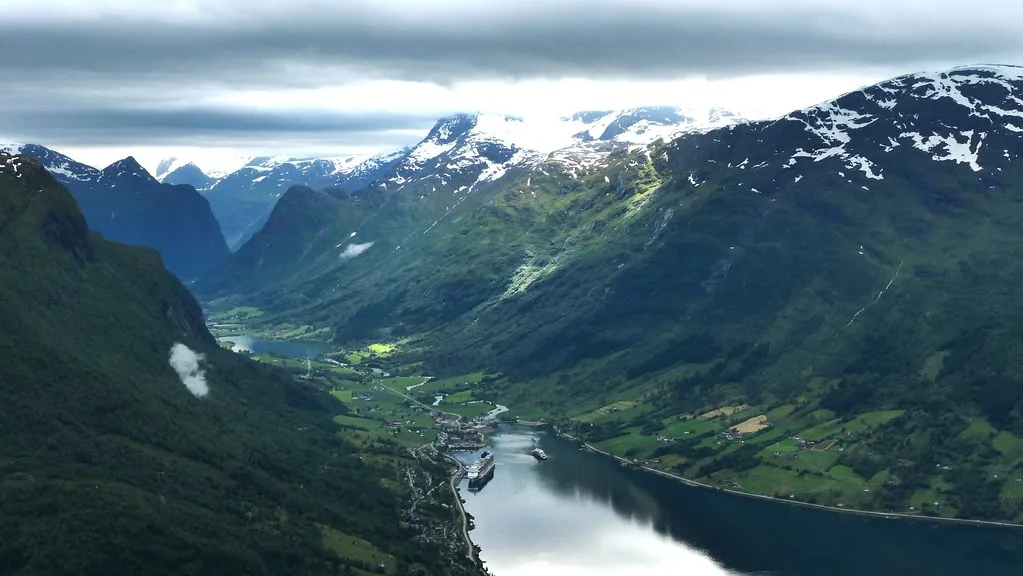
When our ship dropped anchor in Nordfjord that first morning and I boarded the tender for the fifteen-minute ride to shore, the profound quiet settled over me like a benediction. This isn't Bergen with its colorful wharf bustle or Flam with its railway crowds — Olden is a village of perhaps five hundred souls nestled at the very head of Nordfjord, one of Norway's longest and most magnificent fjords stretching some 106 kilometers from the open sea to these inland waters. The village sits completely dwarfed by mountains that rise straight from the water like cathedral walls, their slopes draped with waterfalls that plunge hundreds of meters through vertical stone. A scattering of painted wooden houses, a white church with its steeple pointing heavenward, and beyond it all — invisible but unmistakably present — the mass of Jostedalsbreen, continental Europe's largest glacier, waiting patient and ancient in the high country.
Olden has earned its place as one of Norway's most popular cruise destinations not through commercial development but through the raw authenticity of its landscape. There's no cruise terminal here, no souvenir gauntlet, no tour-bus staging chaos. Ships cannot dock — instead they anchor in the fjord's deep water, and we tender ashore to a modest wooden pier that opens directly into the village heart. The air smells of pine resin, cold stone, and the mineral freshness of glacial meltwater. The silence is broken only by the constant music of waterfalls threading down the mountainsides like silver ribbons, their mist catching rainbows in the slanting northern light.
I've returned to Olden three times now on Norwegian fjord itineraries, and each visit feels like stepping through a doorway into a quieter century. The village itself is simplicity incarnate — traditional Norwegian timber architecture, flower boxes bright with geraniums, the sound of the river rushing down from the mountains. But Olden's true gift lies not in the village itself but in what it guards: access to Briksdal Glacier, Briksdalsbreen in Norwegian, one of the most accessible arms of the vast Jostedalsbreen ice cap. This glacier complex, covering nearly 500 square kilometers of high plateau, represents the largest glacier on continental Europe — a frozen wilderness older than memory, carving valleys and shaping landscapes through millennia of patient, inexorable movement.
The journey to Briksdal is as much pilgrimage as excursion. You travel inland by bus for thirty minutes through the Oldedalen valley — a place so dramatically beautiful it defies casual description. Vertical rock walls squeeze the narrow road between cliff face and rushing river. Every bend reveals another waterfall cascading hundreds of feet into emerald pools, the water so cold and pure it seems to contain light within itself. The valley floor glows that impossibly vivid Norwegian green that exists nowhere else on earth — the product of glacial meltwater nourishing volcanic soil under the endless summer light that never quite surrenders to darkness. Ancient stone walls climb impossible slopes, marking boundaries farmers laid centuries ago, and scattered wooden farmsteads cling to patches of level ground as if placed there by a careful hand.
At the Briksdal parking area, about twenty-five kilometers from Olden village, you transfer into what locals call "troll cars" — small open-air electric vehicles that move with whispered silence up the final steep kilometer. They carry you on a gravel track too narrow and steep for buses, past old stone walls and grazing sheep whose bells chime soft and rhythmic, until you round a final bend and suddenly — there — Briksdal Glacier spills over the lip of the high valley like a frozen river arrested mid-cascade. The ice glows with that otherworldly blue that only ancient compressed glacier ice can achieve, reflecting wavelengths of light that seem to bypass the eyes and strike directly at something deeper in the soul.
The walk from where the troll cars deposit you to the glacier viewpoint takes roughly forty-five minutes each way — a gentle ascent along a well-maintained path through boulder fields and alpine meadows. With each step the glacier grows larger, more imposing, until you stand on the wooden viewing platform and comprehend the scale: a river of ice hundreds of meters wide, cascading dramatically between mountain peaks that rise like sentinels on either side. At its base lies a glacial lake the color of turquoise dreams — that milky, luminous water pregnant with rock flour, the finest sediment ground from living stone by the glacier's immense weight and patient movement. Icebergs the size of houses float serene in the lake, calved from the glacier face and drifting in slow rotation, catching the light in their fractured faces.
Back in Olden village, there's a lovely simplicity that feels almost sacramental after the grandeur of the glacier. The white wooden Olden Church dates to 1759 and sits in a mountain-ringed cemetery where the headstones lean gently with age and wildflowers grow thick between the graves. It's one of the most peaceful places I've ever stood. Inside, the walls are painted pale blue and cream, and soft northern light filters through tall windows onto simple wooden pews worn smooth by generations of worshipers. The air smells faintly of old wood and candle wax. It feels both humble and holy, the way a village church should — a place made sacred not by architectural ambition but by the quiet accumulation of centuries of prayer and presence.
For those seeking a different perspective on this dramatic landscape, the Loen Skylift offers what might be the most spectacular five minutes in Norway. Located about twenty minutes from Olden by road (and often combined on shore excursions), this cable car rises nearly vertically from the shore of Lake Lovatnet to the summit of Mount Hoven at 1,011 meters. The ascent is breathtaking in the literal sense — your stomach drops as the cable car climbs what feels like straight up the mountain face. At the summit, panoramic views stretch across the entire breadth of Nordfjord, with glaciers glinting white in the distance and the fjord spreading like polished silver toward the open sea. There's a restaurant with floor-to-ceiling windows, hiking trails that wind through alpine meadows where reindeer graze in summer, and for the genuinely adventurous, a Via Ferrata climbing route that follows the mountain's sheer face.
What Olden lacks in urban sophistication or tourist infrastructure, it more than compensates for with natural grandeur and profound authenticity. This is Norway as it has been for centuries — quiet, dramatic, pastoral in the truest sense. The landscape doesn't perform for visitors; it simply exists in its patient, timeless beauty, utterly indifferent to whether we notice or not. And perhaps that's what makes Olden so deeply affecting: in a world increasingly shaped for our consumption and entertainment, here is a place that remains fundamentally itself, offering its gifts freely to those willing to receive them in silence and gratitude.
Olden is a tender port with no commercial cruise dock. Ships anchor in Nordfjord and tender passengers to a small wooden pier directly in the village center. The tender ride takes approximately 10-15 minutes and offers stunning views of the surrounding mountains.
Olden is genuinely tiny — population approximately 500. The entire village can be walked in 15 minutes. Main features cluster within 500 meters of the pier: a small general store, handful of souvenir shops, café, and the Olden Church. The village serves primarily as a departure point into the surrounding glacier country rather than a destination in itself.
Currency is Norwegian Krone (NOK). Credit cards are universally accepted, even at the smallest establishments — Norway is one of Europe's most cashless societies. English is widely spoken, particularly in tourism-related businesses. ATMs are limited; the nearest reliable ATM is typically in Stryn, 20 kilometers away.
The village café offers Wi-Fi for customers. Mobile coverage (4G/5G) is generally excellent throughout the valley — Norwegian telecommunications infrastructure is superb even in remote areas.
Olden itself requires no transportation — it's a five-minute walk from one end to the other. The challenge is accessing the dramatic landscapes beyond the village.
The vast majority of visitors book ship-organized tours to Briksdal Glacier, Loen Skylift, or combination packages. This is genuinely the most practical option for cruise visitors on limited time. Transportation, troll car tickets, and timing are all coordinated, ensuring you won't miss the ship. Tours book up quickly — reserve as early as possible.
Taxis are available at the pier, though limited in number. Hiring a taxi to Briksdal and back costs approximately 1,500-2,000 NOK (roughly $140-$190 USD) depending on wait time. Agree on price before departing. Taxis can also be pre-booked through local companies if you prefer independent exploration with guaranteed return.
No car rental agencies operate in Olden itself. The nearest rental locations are in Stryn (20 km away), which is impractical for cruise visitors on tight schedules. If you've arranged a rental in advance (picking up in Bergen or another earlier port), the drive to Briksdal and Loen is straightforward and scenic, though parking can be limited at peak times.
The village and immediate surroundings offer pleasant short walks — to the church, along the river, and on minor trails into the lower valley. These provide lovely moments and a taste of Norwegian countryside, but won't reach the glacier or major viewpoints. Wheelchair access is manageable on the flat village paths but the glacier trail and troll car boarding present significant barriers.
Interactive map showing the tender pier, village center, church, and departure points. Click any marker for details and directions.
The signature Olden experience and the primary reason cruise ships call here. Briksdal is an accessible arm of Jostedalsbreen National Park, home to mainland Europe's largest glacier. The journey involves a scenic 30-minute bus ride through the dramatic Oldedalen valley, followed by an electric troll car ride up the final steep kilometer to the glacier viewpoint.
The glacier itself is a stunning mass of blue-white ice tumbling down from the high plateau, feeding a milky turquoise glacial lake. Wooden walkways allow close approach (though ice conditions vary by season). The round-trip takes approximately 3-4 hours. Note that the glacier has been retreating significantly due to climate change — it's measurably smaller than even a decade ago, adding poignancy to the visit.
The journey to Briksdal is itself spectacular. The narrow valley road threads between towering rock walls, past cascading waterfalls (Kleivafossen is particularly impressive), and through pockets of impossibly green farmland. Ancient stone walls, wooden farm buildings, and grazing sheep complete the pastoral Norwegian scene. Even if you're not hiking to the glacier, simply experiencing this valley is worthwhile.
Located about 20 minutes from Olden, the Loen Skylift is one of the world's steepest cable cars, ascending 1,011 meters from fjord level to the summit of Mount Hoven in just five minutes. The views from the top are genuinely breathtaking — panoramic vistas of Nordfjord, distant glaciers, and alpine peaks stretching to the horizon.
The summit features a restaurant with floor-to-ceiling windows, hiking trails through alpine meadows, and a Via Ferrata climbing route for adventurous visitors. The combination of Briksdal Glacier and Loen Skylift makes for a full, unforgettable day and is often packaged together on shore tours.
The white wooden Olden Church, dating to 1759, sits in a mountain-ringed cemetery that epitomizes Norwegian pastoral beauty. The interior is simple and serene — pale blue walls, wooden pews, and tall windows admitting soft northern light. It's a place that invites quiet contemplation.
The village itself rewards a gentle stroll. Norwegian timber architecture, flower boxes overflowing with geraniums, and the ever-present sound of mountain streams create an atmosphere of profound peace. There's a small local museum (hours vary) with exhibits on glacier farming and life in Nordfjord.
For those seeking deeper glacier experiences, guided glacier hikes are available through local outfitters. These expeditions outfit participants with crampons and ice axes for walking directly on Jostedalsbreen's surface. Expect 4-6 hour outings with moderate physical demands. The experience of standing on ancient ice, peering into blue crevasses, and understanding glacial geology firsthand is extraordinary.
The Norwegian Glacier Museum (Norsk Bremuseum) in Fjærland is about 90 minutes from Olden and can be reached via private car or organized tour. Interactive exhibits explain glaciology, climate change, and the unique ecology of glacier environments.
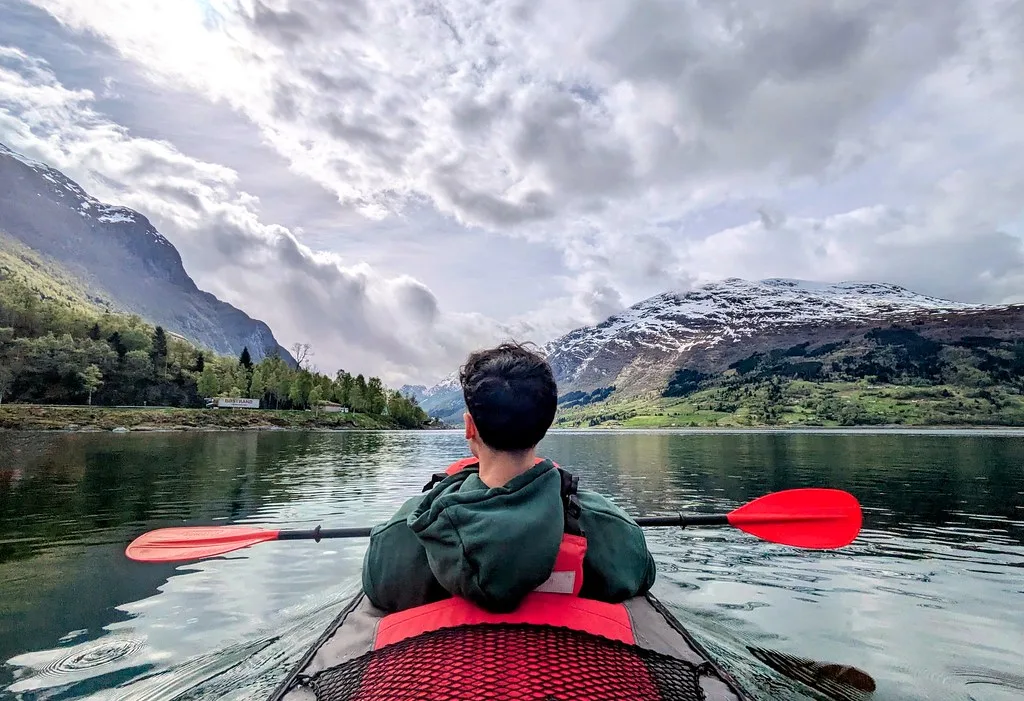
The calm waters of inner Nordfjord are ideal for kayaking. Guided tours paddle along the fjord shoreline, beneath waterfalls, and into narrow side arms inaccessible by land. The silence of kayak travel in these grand landscapes creates a meditative experience. Tours typically last 2-3 hours and require no previous kayaking experience.
Booking guidance: Compare the ship excursion with independent operators before deciding. Ship excursions offer guaranteed return to the ship and coordinate troll car reservations, but cost more. Independent taxis offer flexibility but carry timing risk. For Briksdal Glacier, book ahead through your cruise line's excursion desk or reserve directly with local operators — troll car capacity is limited and sells out quickly.
Olden's dining options are limited but authentic. Expectations should match the village's small size — this isn't Bergen's culinary scene, but rather honest Norwegian country fare.
Olden Café & Kiosk:
The primary dining option near the pier, serving traditional Norwegian dishes, sandwiches, waffles with brown cheese, and coffee. The outdoor seating offers fjord views. Expect simple, fresh food at reasonable (by Norwegian standards) prices. Try the fish soup if available — often made with local ingredients and rich with cream and root vegetables.
Briksdalsbre Fjellstove:
Located at the Briksdal parking area, this mountain lodge restaurant serves heartier fare — roasted lamb, grilled salmon, traditional fårikål (mutton and cabbage stew), and excellent berry desserts. The dining room has windows overlooking the valley. Open during cruise season, with both buffet and à la carte options.
Loen Skylift Summit Restaurant:
At the top of Mount Hoven, the panoramic restaurant serves Norwegian specialties with arguably the best dining view in the country. The menu emphasizes local ingredients — reindeer, lamb, Arctic char, and seasonal vegetables. Reservations recommended for table seating, though café service is available without booking.
Authentic Norwegian Specialties to Try:
Beverages:
Norwegian beer (especially local craft brews) pairs excellently with hearty mountain food. Coffee is universally excellent — Norwegians are among the world's highest per-capita coffee consumers. Aquavit (caraway-flavored spirit) is a classic pairing but an acquired taste.
Practical Notes:
Dining in Norway is expensive — budget accordingly. A café lunch easily runs 150-250 NOK ($15-25 USD), while restaurant meals can exceed 400 NOK per person. Water is safe to drink from taps and often provided free in restaurants. Tipping is not expected but appreciated for exceptional service (round up or add 5-10%).
Practical tips before you step off the ship.
Layer Your Clothing Like a Norwegian: Even in summer, mountain weather changes rapidly. I learned this the hard way on my first Briksdal visit when sunshine turned to sleet in twenty minutes. Bring a waterproof outer layer, warm fleece, and wear comfortable walking shoes with good traction — glacier viewpoint paths can be wet and rocky. The temperature at Briksdal is often 10°C (18°F) cooler than at sea level.
Book Briksdal Excursions Early: This is Olden's signature experience and capacity is limited by troll car availability. Ship excursions sell out quickly, sometimes before embarkation. If the ship's tour is full, independent operators exist but require advance booking and carry the risk of not coordinating with ship departure times.
Allow Time for the Glacier: Don't rush Briksdal. The round-trip takes 3-4 hours minimum, but the most meaningful moments come from sitting quietly by the glacial lake, absorbing the scale and age of the ice. Budget an extra 30 minutes for contemplation beyond the "get photo and leave" approach.
Respect the Quiet: Olden's greatest gift is its profound silence — a rarity in our loud world. The village and valley deserve quiet voices and mindful presence. This isn't entertainment; it's nature at its most patient and powerful.
Cash Is Rarely Needed: Norway is essentially cashless. Even the smallest village kiosk accepts cards. Your ship's credit card will work everywhere. However, verify your card has no foreign transaction fees before relying on it exclusively.
Photography Considerations: The light in Norwegian fjords is famously complex — soft and diffused even in summer due to northern latitude. Bring a polarizing filter to cut reflection on the fjord and glacial lake. The best light for photography is early morning or late evening, though cruise schedules rarely accommodate this.
Wildlife Awareness: The mountains around Olden are home to wild reindeer, eagles, and occasionally moose. Keep respectful distance from any wildlife encountered. Do not approach or feed animals.
Accessibility Challenges: The village itself is relatively flat and accessible, but both Briksdal and Loen Skylift involve uneven terrain, stairs, and potentially challenging walking surfaces. Visitors with mobility limitations should inquire about specific excursion accessibility before booking. The troll cars can accommodate some wheelchairs, but the glacier viewpoint path includes steps and steep grades.
Environmental Responsibility: You're visiting a fragile glacial environment under climate stress. Stay on marked paths, pack out all trash, and consider the carbon cost of cruise travel against the privilege of witnessing these landscapes. Small actions matter — choosing reef-safe sunscreen, refilling water bottles, and supporting local conservation efforts.
This guide reflects firsthand experience from a 2024 visit, supplemented by fellow travelers and maritime charts.
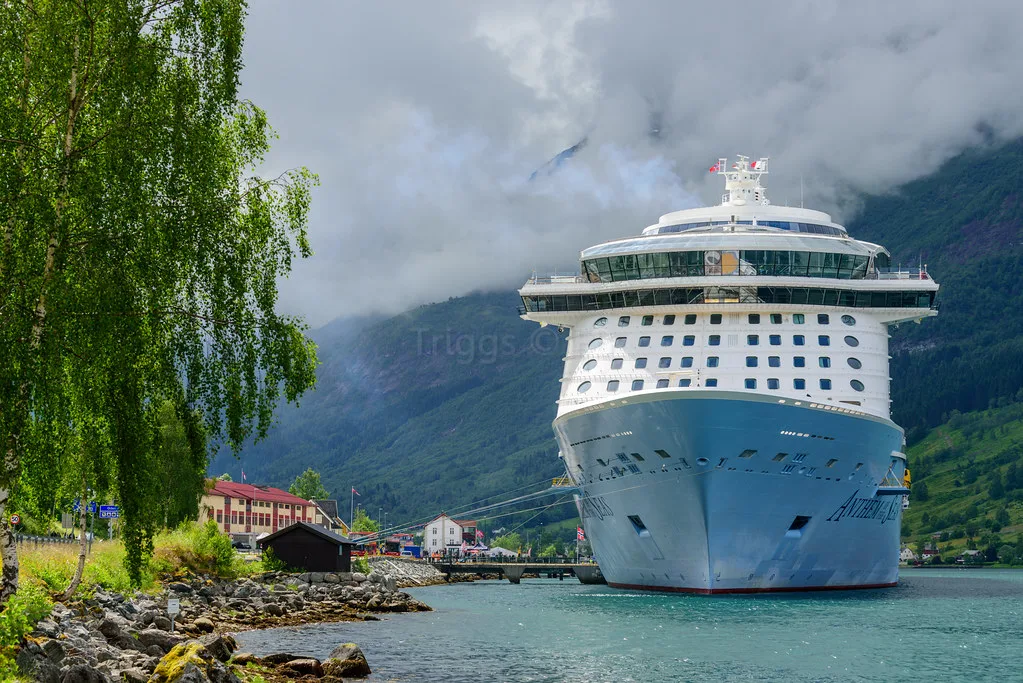
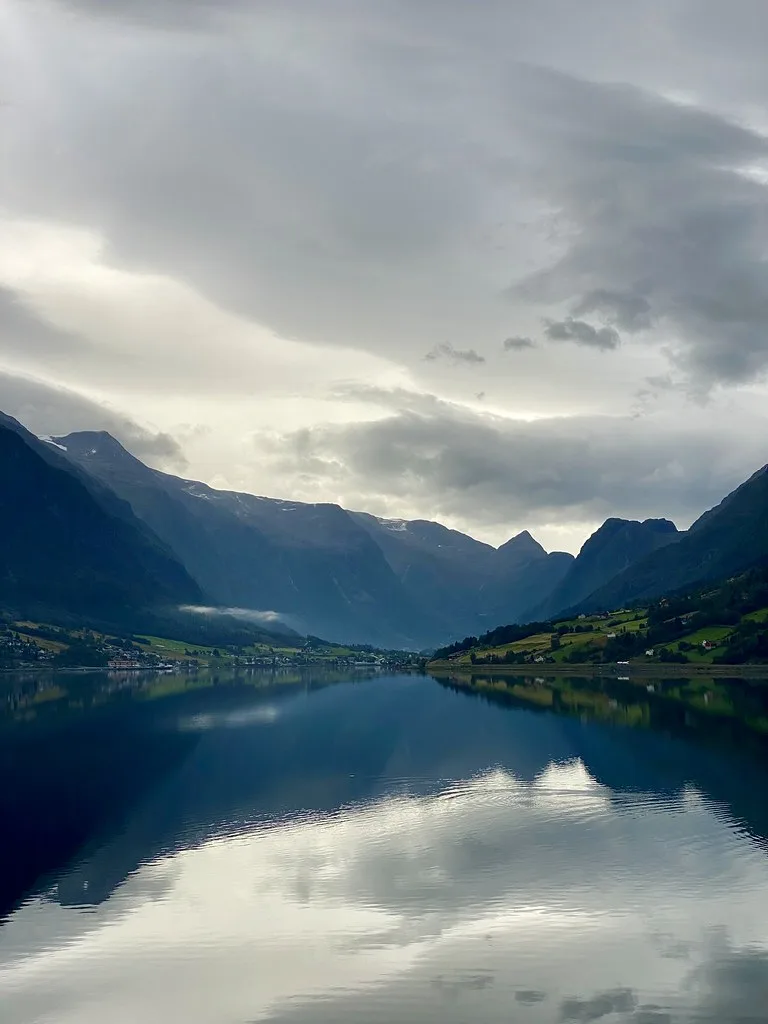
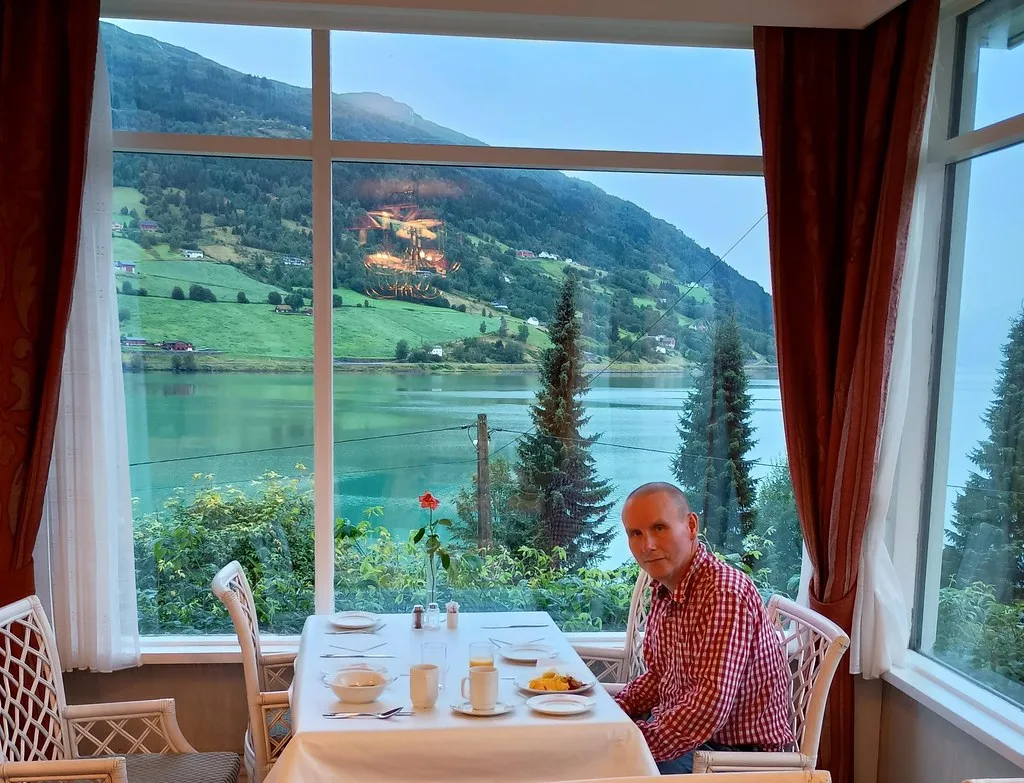
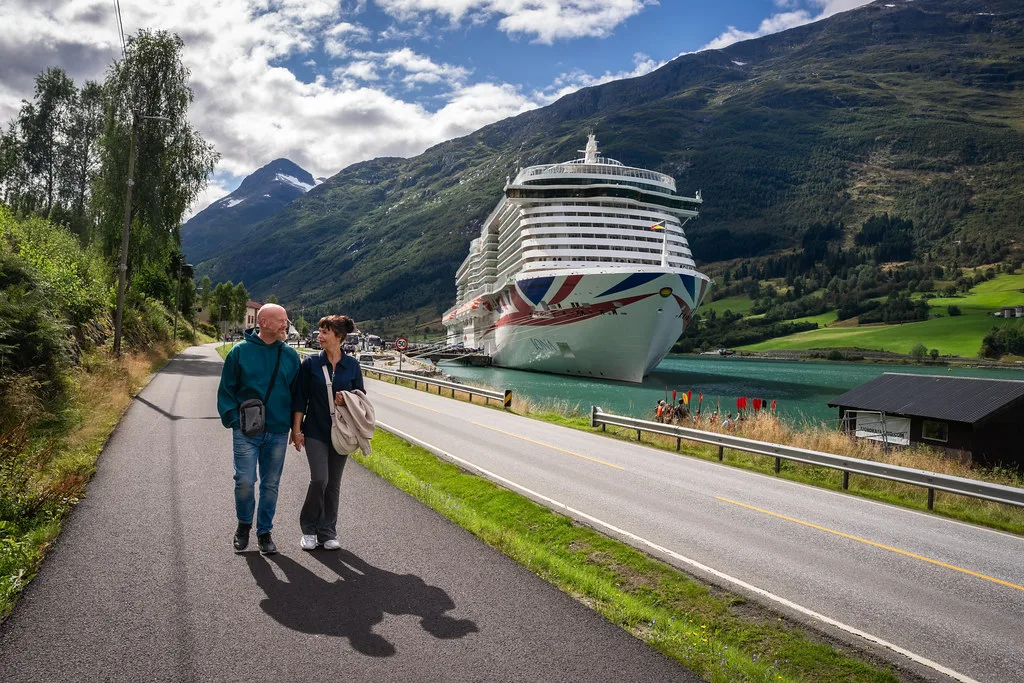
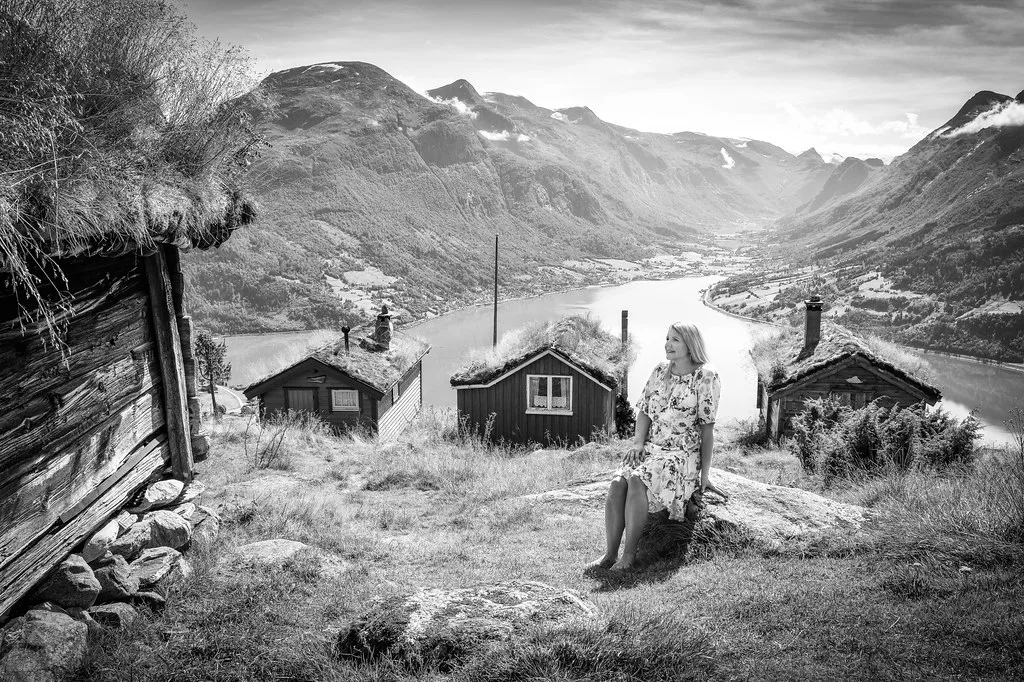
Visual impressions from Olden and the Nordfjord.
The easiest and most reliable method is booking a shore excursion through your cruise line. These include bus transport to the glacier area (30 minutes), troll car ride to the viewpoint, and coordinated timing to ensure you return before the ship departs. Independent taxis are available but significantly more expensive and require negotiation.
Yes, absolutely. Olden offers the unique experience of accessing mainland Europe's largest glacier — something neither Geiranger nor Flam provides. The village is also quieter and less developed, offering a more intimate Norwegian experience. The combination of glacier, dramatic valley, and tiny village creates a different character than other fjord ports.
Waterproof jacket, warm layers (fleece or wool), comfortable waterproof walking shoes, hat, and gloves even in summer. The temperature at the glacier can be near freezing regardless of valley weather. Sunglasses help with glacier glare. Bring water and snacks if you want to spend extended time at the viewpoint.
You can walk the village and visit Olden Church (15 minutes from pier) easily. However, Briksdal Glacier is 25 km away through a mountain valley — walking is not feasible. Transportation via excursion, taxi, or private car is necessary for glacier and skylift visits.
Yes. Briksdal Glacier has retreated significantly over the past decades. The viewpoint that once allowed close approach now overlooks the glacier from a distance. This adds urgency and poignancy to visiting — future generations may not have this opportunity. The Norwegian Glacier Museum addresses climate impacts in depth.
Typical temperature range is 22-66°F — Nordfjord gateway; rain/humidity pattern: Wet year-round; humidity Moderate to high (59-77%); wind Sheltered fjord. Peak cruise months: Jun, Jul, Aug Transitional: May, Sep Low season: Oct, Nov, Dec, Jan, Feb, Mar, Apr Months often better avoided if you can choose: Nov, Dec, Jan, Feb, Mar Align your itinerary with the activities you care about most.
Olden is not marked as a warm-water hurricane zone in our seasonal guide. Local weather concern: Cool fjord; glacier conditions change Cruise-day plans should still leave flexibility if weather shifts.
For Olden, prioritize layers for 22-66°F — Nordfjord gateway conditions and be ready for Wet year-round. Seasonal packing nudges: Waterproof jacket and pants; Warm layers; Hiking boots for glacier approach; Cash for small village cafes. Waterproof outer shell, comfortable walking shoes, sun protection, and a small dry-bag for tender reboarding are usually wise.
Brief rain is common enough around Olden that a flexible port-day plan beats canceling everything. Local gotchas: Gateway to Briksdal Glacier — popular excursion; Glacier hike requires good fitness and appropriate gear; Loen Skylift opened recently — stunning views. Have one indoor or covered option, keep electronics dry, and remember many outdoor sights stay worthwhile in a light shower.
Helpful resources for your shore day: