


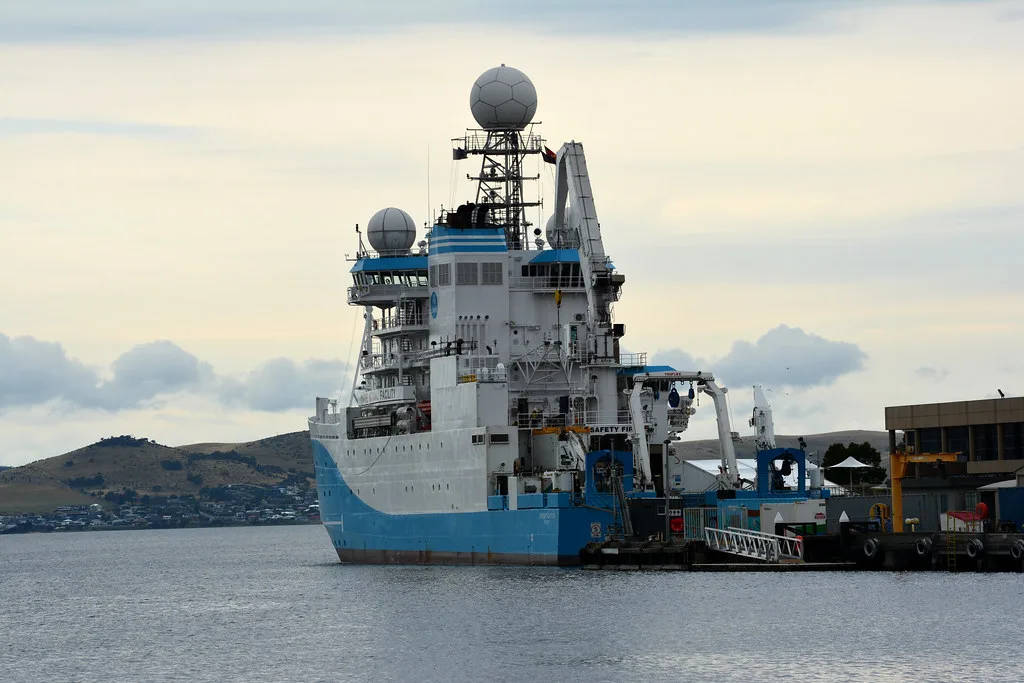
Photo: Wikimedia Commons
My Logbook: At the Edge of the Known World
I heard Hobart before I saw it — a low whistle of wind through the rigging as our ship rounded the Iron Pot lighthouse and entered the Derwent estuary. The morning air hit my face with a sharp, clean coldness I had not felt anywhere else on this voyage. It smelled of eucalyptus and rain-washed stone, carried from the forested slopes of Mount Wellington that filled the entire sky ahead. I stood at the bow rail, watching the city materialise along the waterfront — low sandstone buildings, red roofs, the green smudge of parks — and I felt something settle inside me, a quiet recognition that we had arrived somewhere different, somewhere old and honest and unapologetically itself.
The gangway deposited us directly onto Macquarie Wharf, and within five minutes I was standing among the Georgian sandstone warehouses of Salamanca Place. It was a Saturday — I had planned carefully for this — and the market was already in full cry. Over three hundred stalls stretched along the cobblestones in a gorgeous riot of colour: hand-turned Huon pine bowls that smelled of honey, wheels of Bruny Island cheese stacked on wooden boards, jars of leatherwood honey glowing amber in the morning light. A busker played "Waltzing Matilda" on a battered fiddle. An old woman wrapped in a wool scarf sold hand-knitted beanies for $15 AUD each, and when I bought one she told me she had been coming to this market since 1978. I pulled the beanie on against the cold and kept walking. The coffee from a tiny stall near the end of the row cost $5 AUD and tasted of roasted earth and something faintly floral — Tasmanian coffee beans, the stallholder said, grown in the northeast of the island where nobody expects coffee to grow.
Behind Salamanca, I climbed Kelly's Steps — convict-built in 1839, the stone worn smooth by nearly two centuries of feet — into Battery Point. The neighbourhood felt like stepping through a portal into the 1850s. Tiny weatherboard cottages with lace curtains sat shoulder to shoulder along narrow lanes. Roses climbed over fences. A cat watched me from a windowsill with the unconcerned superiority that cats specialise in. Arthur Circus, a village green ringed by perfectly preserved Georgian houses, was so quiet I could hear birds calling from three gardens over. I sat on a bench and simply looked, letting the silence work on me, aware that in a few hours I would be back in the noise and motion of the ship. But for now there was nowhere to be except here.
I took the MONA ferry from Brooke Street Pier after lunch. The catamaran itself was part of the experience — leopard-print seats, a bar serving Moorilla wine, sheep suspended from the cabin ceiling in some inexplicable art installation. The thirty-minute ride up the Derwent gave me time to watch the shoreline change from urban to suburban to bush, and then we rounded a headland and MONA appeared: a concrete and glass structure half-buried in the sandstone cliff face like a bunker for the imagination. I paid my $35 AUD entry fee and descended three stories underground into the galleries. There were no labels on the walls — only a handheld device called "The O" that offered commentary if you chose it and silence if you did not. I chose silence. I wandered past ancient Egyptian sarcophagi and a waterfall of words projected onto a wall and a room filled entirely with darkness and sound. I stood before Sidney Nolan's enormous "Snake" mural — forty-six metres of coiled serpent painted in fierce reds and blacks — and felt small in a way that was not uncomfortable but humbling. MONA does not comfort you. It confronts you, sometimes disturbs you, and occasionally makes you laugh out loud in sheer disbelief. However, it never bores you. I spent four hours there and could have stayed longer.
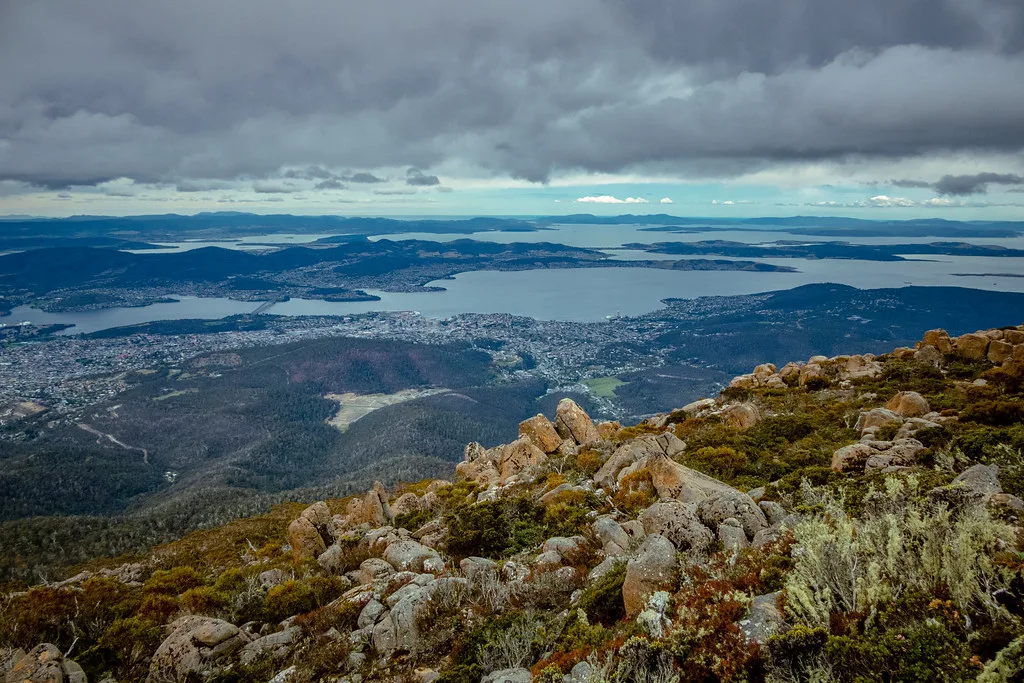
The next morning, before the ship departed, I hired a taxi to Mount Wellington. The driver — a wiry Tasmanian named Greg who spoke in clipped half-sentences — took me up the winding summit road through bands of vegetation that changed every few hundred metres: tall eucalyptus forest giving way to stunted subalpine scrub, then bare dolerite columns like broken organ pipes standing against the sky. At 1,271 metres, the temperature had dropped twelve degrees from the waterfront below. I stepped out of the car and the wind nearly knocked me sideways. Yet the view stopped me still. Hobart lay spread out beneath me like a watercolour painting, the Derwent River a wide silver ribbon winding toward the sea. I could see our ship at the wharf, tiny as a toy. To the southwest, the wilderness stretched unbroken to the horizon — ridge after ridge of forested mountains, no roads, no buildings, nothing but trees and sky. I thought of the convicts who had been sent here to the end of the earth, how this remoteness had been their punishment, and how it had become the island's greatest treasure.
Back at the waterfront, I bought a bag of freshly shucked oysters from a floating fish punt at Constitution Docks — half a dozen for $12 AUD, briny and cold and tasting of the Southern Ocean itself. I ate them standing at the railing, watching seagulls argue over scraps, and I thought about what Hobart had taught me. It had taught me that remoteness is not emptiness — that at the edge of the world you can find art that rewrites the rules, markets that smell of honey and woodsmoke, mountains that take your breath and give it back changed. Something shifted inside me during those two days in Tasmania, a recalibration of what I thought mattered. I came expecting a small colonial town at the bottom of Australia. I left carrying a lesson I did not know I needed: that the places furthest from the centre are often the places closest to the truth. I carry that with me still.
Weather & Best Time to Visit
The Cruise Port
Ships dock at Macquarie Wharf, located in the heart of downtown Hobart on Sullivan's Cove. This is one of the most convenient cruise berths in Australia — the city is literally at your feet when you step off the gangway. Salamanca Place, with its Georgian sandstone warehouses and Saturday market, is a five-minute walk south along the waterfront. Constitution Docks, home to floating fish punts and the finish line of the Sydney to Hobart Yacht Race, is adjacent to the wharf. The terminal facilities are basic — a covered area with security screening — but given that the entire city centre is within walking distance, amenities are unnecessary. Taxis queue at the wharf entrance, and Brooke Street Pier, where MONA ferries depart, is a short stroll north. The wharf area is mostly flat and wheelchair accessible, with ramps at the gangway connection points, though some of the older cobblestone areas around Salamanca require care for wheelchair users and those with limited mobility. There is no shuttle bus needed — this is a genuine walk-off port.
Getting Around
Hobart is a compact city and many of its key attractions are within walking distance of the wharf. Salamanca Place, Battery Point, Constitution Docks, and the waterfront restaurants are all reachable on foot within ten to fifteen minutes. For destinations further afield — Mount Wellington, MONA, the Cascade Brewery, and the Royal Tasmanian Botanical Gardens — you will need transport. Taxis are readily available at the wharf and throughout the city. A taxi from the wharf to the base of Mount Wellington costs approximately $25–30 AUD, and to the summit about $50–60 AUD one way. Uber and other rideshare apps operate in Hobart, though with fewer drivers than mainland Australian cities.
Metro Tasmania runs public buses throughout the city. A day pass costs about $5.20 AUD and covers unlimited travel. Buses run to the Cascade Brewery area and the Botanical Gardens, but not to the Mount Wellington summit. For those wanting flexibility, half-day hire cars are available from agencies near the waterfront for approximately $60–80 AUD. The roads are well-maintained and driving in Hobart is straightforward by Australian standards. The central city streets are mostly flat and suitable for low-energy exploration. Battery Point involves some steep hills and steps. Wheelchair users will find the waterfront promenade and Salamanca Place accessible, but Battery Point's narrow lanes and Kelly's Steps are not wheelchair-friendly. Mount Wellington's summit lookout has paved paths and accessible viewing platforms.
Port Map
Tap markers to explore Hobart's highlights
Excursions & Activities
MONA (Museum of Old and New Art)
Australia's largest private museum, opened in 2011, burrows three stories underground into sandstone cliffs on the Derwent River. The collection spans ancient Egyptian artefacts to confronting contemporary installations. Entry costs $35 AUD (free for Tasmanians). Take the ferry from Brooke Street Pier — the return ticket costs approximately $25 AUD and the quirky thirty-minute ride is part of the experience. Allow 3-4 hours minimum. This is a moderate-energy visit with extensive walking through underground galleries. A ship excursion typically costs $90–120 AUD and includes ferry and guided orientation. You can also visit independently — simply walk to Brooke Street Pier from the wharf and buy a ferry ticket. Book ahead online during peak cruise season as ferries can fill up.
Salamanca Market (Saturdays Only)
Running every Saturday from 8:30 AM to 3 PM since 1972, this market features over 300 stalls selling Tasmanian produce, artisan crafts, local cheese, leatherwood honey ($10–15 AUD per jar), and handmade goods. A five-minute walk from the wharf. Free entry, low-energy, fully accessible along the main market strip. No need to book ahead — simply walk over. If your ship arrives on a non-Saturday, the Salamanca galleries and cafes are still open in the warehouses.
Mount Wellington Summit
The 1,271-metre summit offers panoramic views over Hobart, the Derwent River, and Tasmania's wilderness interior. Half-day ship excursions cost $70–90 AUD and typically combine the summit with city highlights. Independently, a return taxi costs approximately $100–120 AUD including wait time, or you can hire a car for about $60–80 AUD for a half-day. The summit lookout has accessible viewing platforms with paved paths. Bring warm layers — temperatures at the top can be 15 degrees colder than at sea level, even in summer. High-energy if hiking; low-energy if driving to the summit carpark.
Port Arthur Historic Site
Australia's most intact convict settlement, a UNESCO World Heritage site, lies about an hour's drive southeast of Hobart. Entry costs approximately $45 AUD for adults. The ruins are haunting and historically significant — over 12,500 convicts were imprisoned here between 1833 and 1877. Budget a full half-day minimum. Ship excursions cost $120–160 AUD and guarantee your return to the vessel — booking the ship excursion is sensible here because the drive time leaves little room for error. Independently, a private driver costs approximately $200–250 AUD for a half-day round trip. The main grounds have accessible paths, though some ruins involve uneven surfaces. Moderate-energy overall.
Cascade Brewery & Botanical Gardens
Australia's oldest operating brewery (since 1824) sits at the foot of Mount Wellington, about ten minutes from the wharf by taxi ($15–20 AUD). Guided tours cost $35 AUD and include tastings. The Royal Tasmanian Botanical Gardens, founded 1818, are free to enter and offer gentle walks among heritage trees and native species. Both are low-energy, relaxed options for a shorter port day. No need to book ahead for the gardens; brewery tours can be reserved online.
Depth Soundings
Hobart uses the Australian Dollar (AUD). Credit cards and contactless payments are accepted virtually everywhere in the city — Australia is one of the most cashless societies in the world. ATMs are plentiful along the waterfront and Elizabeth Street Mall. Tipping is not expected in Australia, though rounding up a taxi fare or leaving 10% at a sit-down restaurant for good service is appreciated. Market vendors set fixed prices and haggling is not customary.
Hobart is Australia's driest capital city, receiving only about 626 mm of rain annually — less than Sydney or Melbourne. However, the weather can shift quickly. Locals say "four seasons in one day" and they are not exaggerating. A morning of sunshine can turn to rain and wind by afternoon, so carry a light jacket even on clear days. The UV index in Tasmania is among the highest in the world due to the thinning ozone layer at southern latitudes — wear SPF 50+ sunscreen even when it feels cool. English is the universal language. Tasmanians are famously friendly and happy to offer directions or recommendations. The pace of life here is slower than mainland Australian cities, and that unhurried quality is part of the charm.
Photo Gallery
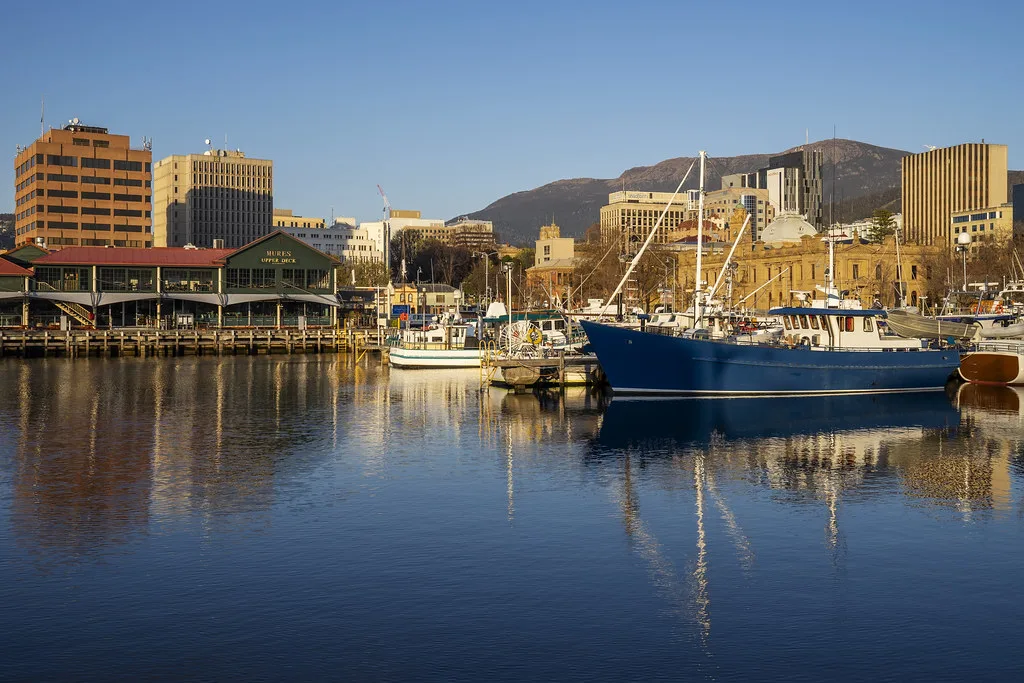
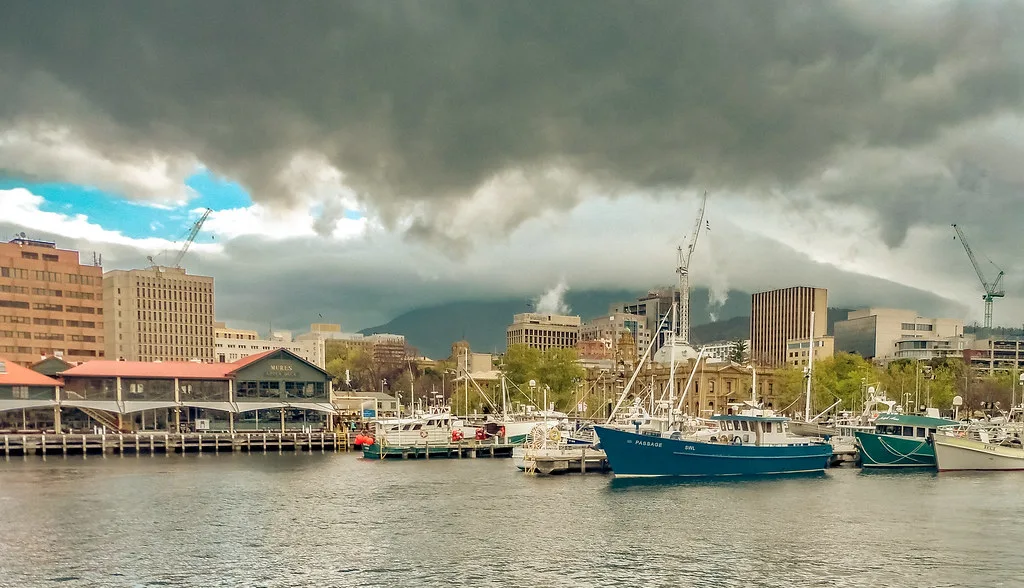
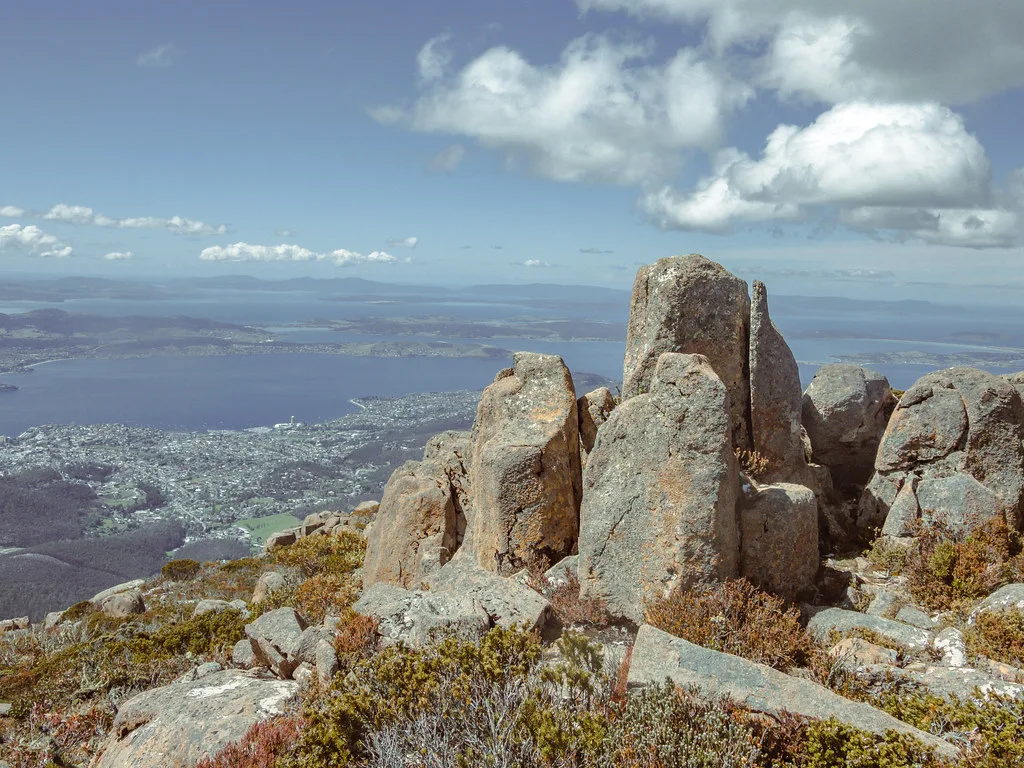
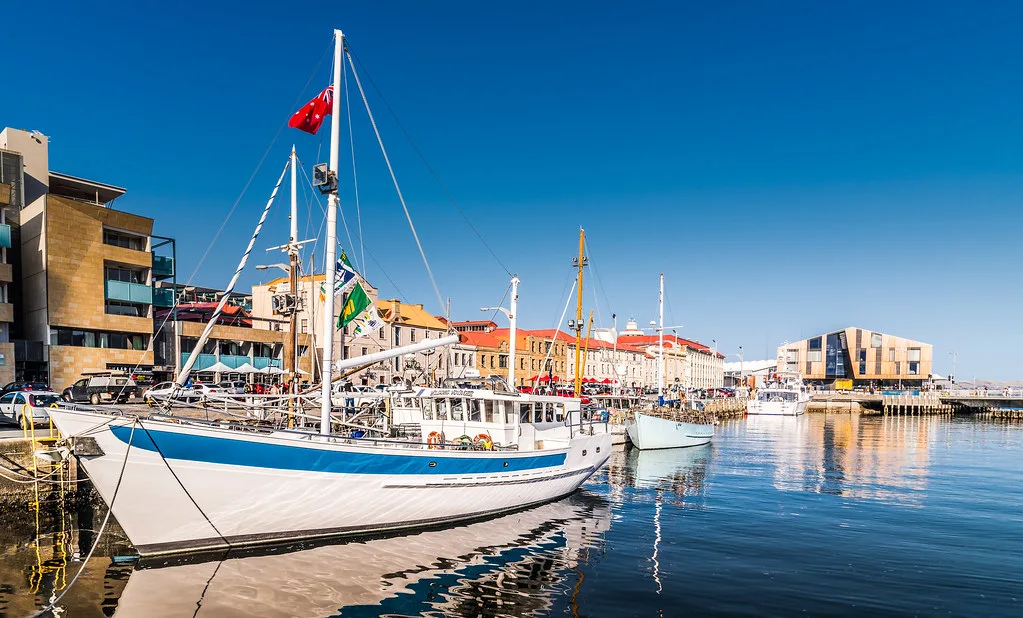
Image Credits
All photographs on this page are used under Creative Commons or free-use licenses. Images sourced from Wikimedia Commons, Unsplash, Pexels, Pixabay, and Flickr.
Frequently Asked Questions
Where do cruise ships dock in Hobart?
Ships dock at Macquarie Wharf in downtown Hobart on Sullivan's Cove. Salamanca Place is a five-minute walk south. The waterfront, restaurants, and city centre are all immediately accessible on foot — no shuttle needed.
Is Salamanca Market worth planning a Saturday port call?
Yes. The market runs every Saturday 8:30 AM to 3 PM with over 300 stalls of Tasmanian produce, crafts, and food. It has been a Hobart institution since 1972. If your ship is not in port on Saturday, the galleries and cafes in the warehouses are still open.
How do I get to MONA?
The recommended way is by ferry from Brooke Street Pier, a short walk from the wharf. The return ticket costs approximately $25 AUD and the thirty-minute ride is part of the art experience. Alternatively, it is a twenty-minute drive.
Can you drive to the top of Mount Wellington?
Yes. The summit is a thirty-minute drive from the waterfront via a sealed road. Bring warm layers as it can be 15 degrees colder at the top. A return taxi costs about $100–120 AUD with waiting time.
Is Port Arthur worth the journey from Hobart?
If you have a full half-day, absolutely. It is Australia's most significant convict heritage site and a UNESCO World Heritage location. The drive is about an hour each way. Entry costs approximately $45 AUD.
What should I eat in Hobart?
Tasmanian oysters from the waterfront fish punts at Constitution Docks are essential — about $12 AUD for half a dozen. Local cheeses, salmon, scallops, and anything with leatherwood honey are all outstanding.
When is the best time to visit Hobart?
The seasonal panel above lists Peak Season as Dec-Mar (the Tasmanian summer) when daylight runs late and the Mt Wellington walks are most accessible. May-Jul is the Low Crowds window — colder, wetter, but the museums and Salamanca Market warehouses don't mind. The Catches list warns that Hobart weather "changes rapidly — four seasons in one day is a local cliché because it is true." The live weather widget in the seasonal panel above is the primary source for short-term conditions on a specific sailing date.
When is hurricane and storm season in Hobart?
The Weather Hazards panel above labels Hobart's heavy-weather window "Rapid Weather Changes" — Tasmania at ~42°S sits south of the South Pacific cyclone basin entirely. The relevant pattern is Southern Ocean fronts and winter storms (Jun-Aug peak per the panel) that bring sudden wind and temperature drops. The Catches list emphasizes the same: "Mt Wellington summit is 10-15°C colder than the waterfront, even on warm summer days." For current conditions on a specific sailing date, the live weather widget in the seasonal panel above is the primary source.
What should I pack for a Hobart port day?
Layers, layers, layers. The page's own Catches list warns of four seasons in one day. A waterproof jacket year-round (Tasmanian rain arrives without warning). Comfortable walking shoes for the steep Salamanca-to-Battery Point lanes. Warm fleece for Mt Wellington (always 10-15°C cooler than town). Very high-SPF sunscreen — the Catches list notes "UV levels are extremely high due to the thin ozone layer over Tasmania."
Will rain ruin my Hobart port day?
Hobart's compact waterfront keeps indoor refuges close — Salamanca's warehouse galleries and cafés, the Tasmanian Museum and Art Gallery (TMAG), the Maritime Museum, MONA via ferry (the ferry has covered seating; MONA itself is fully indoor), and the Constitution Dock fish punts (most are covered). The Catches list reminds you "four seasons in one day" — most rain showers pass quickly. The exposed parts (Mt Wellington summit, Port Arthur excursion) lose appeal in heavy weather. The live weather widget in the seasonal panel above is the primary source for short-term forecasts on a specific sailing date.
Hobart — Port Guide
Last reviewed: February 2026