A German town on a cold desert coast, and a ghost town that closes before lunch
Lüderitz is sixteen thousand people wedged between the Namib and the South Atlantic, with Jugendstil villas on a rock above a bay that has no fresh water, no farmland and no reason to exist except that in 1908 a railway worker picked a diamond out of the sand ten kilometres inland. The Benguela Current runs cold up this coast, which is why a town at twenty-six degrees south has an August maximum of twenty degrees and takes about 35 millimetres of rain a year.
It is one of the easiest ports on a world cruise to arrive at and one of the easiest to get wrong. The tender lands you at the edge of a town you can walk in an hour — but the thing everyone comes for is on a fixed tour schedule that ends at eleven in the morning, and the boat to the penguins leaves at eight. Get the order right the night before and it is a fine day. Get it wrong and you look at a locked gate.
Last reviewed: 31 July 2026
Weather & Best Time to Visit
Captain's Logbook
An honest note before I begin: I have not stood on Diamond Hill. What follows is read from the record — from Namport's own berth data, from the Kolmanskop operator's 2026/27 price list, from Namibia's Ministry of Home Affairs, from Amnesty International, from Weather Spark's series. Soundings taken in another's wake. When I sail here I will come back and log what I actually found.
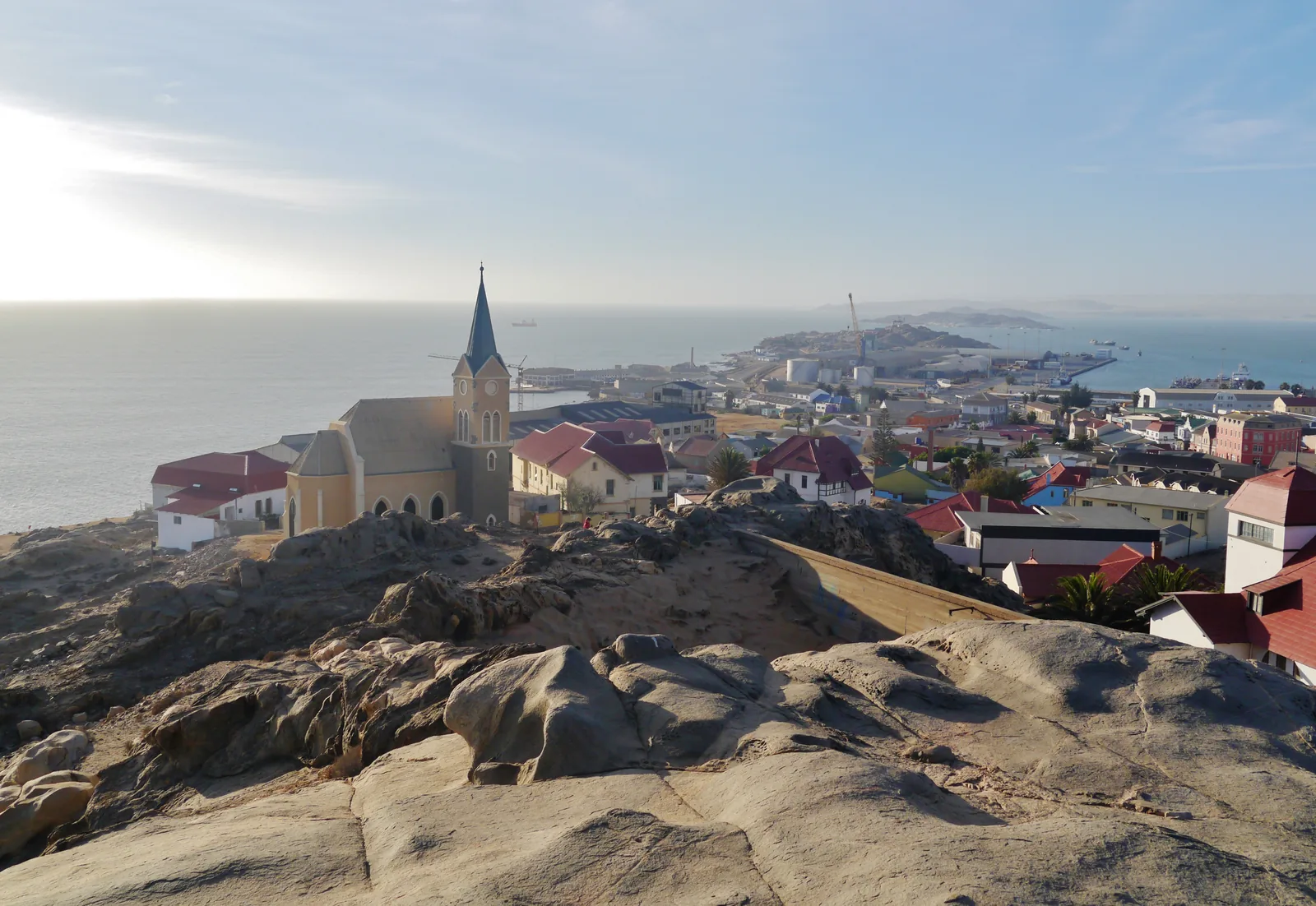
Lüderitz from the bay. Sixteen thousand people on a coast with no fresh water, built in five years of diamond money. Photo: Sonse, CC BY 2.0 via Wikimedia Commons
The first thing is a number, and it is unusually clean. The Port of Lüderitz has one berth, 500 metres long, 8.75 metres deep, and Namport's own description says the plain thing: it is considered a shallow port, and it is founded on bedrock which is not financially viable to dredge. A world-cruise ship of Volendam's class draws about 8.1 metres. That leaves sixty-five centimetres before you think about tide, swell or squat, though the usual working minimum is ten per cent of draft. So the ship anchors in Robert Harbour and you come ashore by launch.
What I found interesting is that this is not the usual story of a ship being too big. The berth is five hundred metres long — twice the ship. AIDAstella berths at Lüderitz and she is 253 metres and 71,304 tons, larger than Volendam in every dimension except the one that counts. She draws 7.3. Run down Namport's published thirteen calls for the 2026 season and not one ship draws more than that. The fleet that calls here is systematically shallower than the fleet that does not, and that is a fact about the seabed rather than about the ships.
The good news is what the tender lands you into. Sixty-five centimetres is not enough water — but unlike almost every other tender port on a world cruise, there is no transfer to lose here. The Waterfront jetty is the town. Bahnhof Street, the Felsenkirche, the harbour and Shark Island are all inside a twenty-minute walk of where you step off the boat, and Kolmanskop is ten kilometres inland — twenty minutes, with operators meeting the pier.
So the constraint is not distance. It is opening hours, and this is the part I would most want a passenger to know a day early rather than an hour late. Kolmanskop's guided tours run at 09:30 and 11:00 Monday to Saturday, and at 10:00 on Sundays and public holidays. That is the complete list. The site itself closes at 13:00 at weekends and on public holidays, 15:00 on weekdays, and only Ghost Town Tours guides may take you round. A permit is N$230 for an adult; a photography permit that gets you sunrise-to-sunset access is N$480.
Set that against the other fixed time in the day: the boat to the penguins leaves the Waterfront at 08:00 and is back about a quarter past ten. If your first tender is early, both are just about possible. If it is not, they are not, and the choice has to be made the night before because there is no version of it you can make ashore.
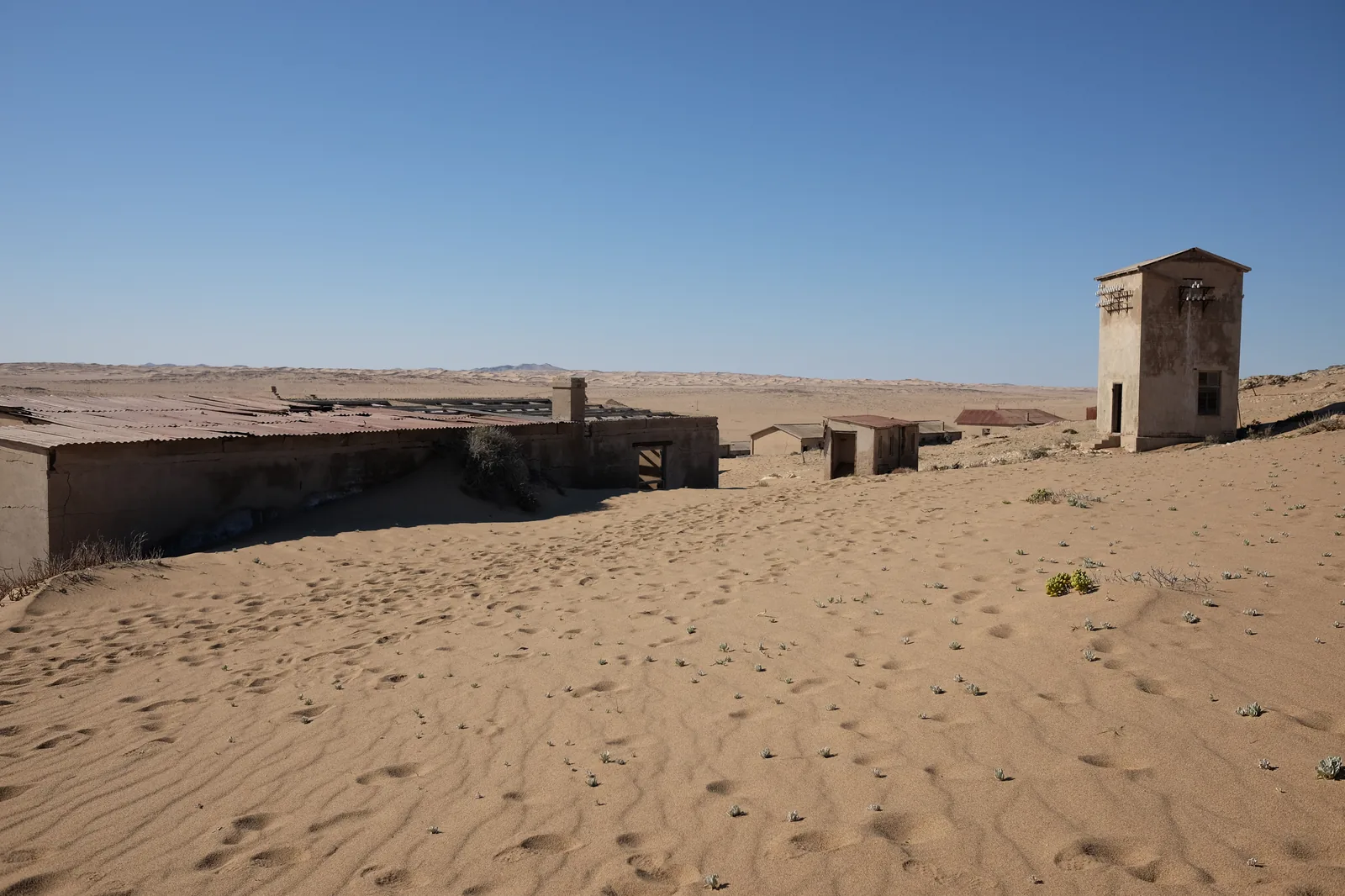
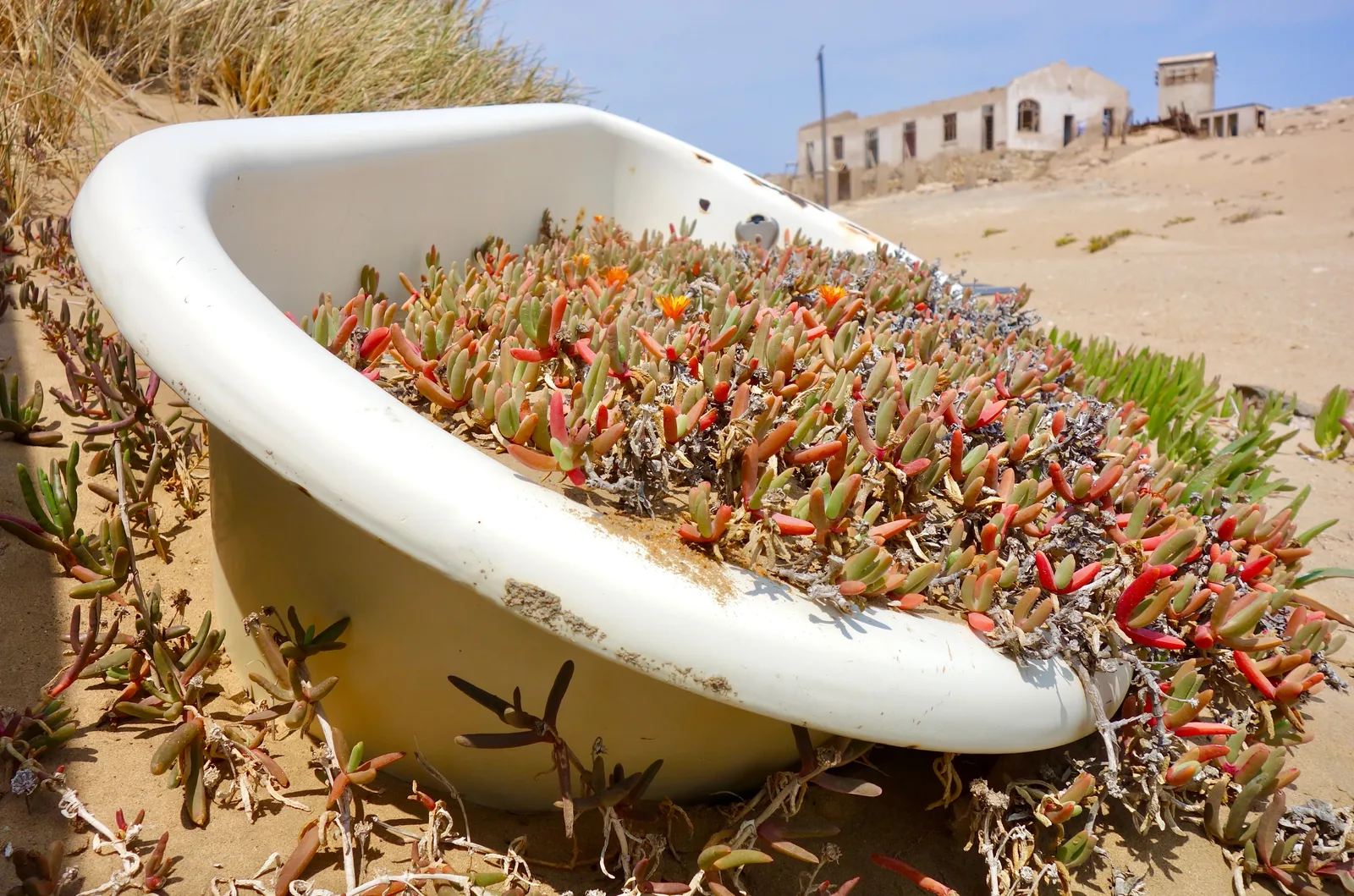
Kolmanskop deserves its reputation, but not for the reason people expect: what makes it is the sand rather than the ruins. The town was built for about three hundred German families with a ballroom, a skittle alley, an ice factory, a hospital with the first X-ray machine in the southern hemisphere, and a tram — and when the field played out the desert simply resumed. What you walk through now is rooms half-full of dune, doorways drifted shut, a bath standing in sand with succulents growing out of it. It photographs so well that the site sells a permit specifically for photographers.
Kolmanskop. The desert simply resumed when the field played out — and the site sells a photography permit precisely because of what that looks like. Photo: Johan Jönsson, CC BY-SA 4.0 via Wikimedia Commons
The founding fact is worth telling properly, because the usual version leaves out the man. On 14 April 1908, at Grasplatz on the Aus–Lüderitz railway line, a worker named Zacharias Lewala picked up several stones he suspected were diamonds. He knew what he was looking at — he had worked the diamond fields at Kimberley and could recognise rough. He handed one to his German supervisor, August Stauch, who sent it to Swakopmund to be tested and applied for the prospecting licence. The rush followed. Stauch became rich. Lewala's name survives in the record and very little else does.
Which brings me to the hardest thing on this page, and I am not going to soften it. Shark Island, the peninsula you can walk to over a causeway in ten minutes, was a German concentration camp from March 1905 to April 1907, during the Herero and Nama genocide of 1904 to 1908. Estimates of the dead there run from 1,032 to 3,000 Herero and Nama men, women and children. It is one of the places where the twentieth century learned how to do this.
Shark Island. A German concentration camp from March 1905 to April 1907, in which between 1,032 and 3,000 Herero and Nama people died. It is a ten-minute walk from the tender jetty. Photo: Zairon, CC BY-SA 4.0 via Wikimedia Commons
Two things about the site as it stands today are difficult, and both are simply true. It is a campsite — Namibia Wildlife Resorts runs it with pitches and ablutions and published rates, and people camp on it. And the cluster of memorials behind the gate is centred on a semicircular wall carrying white plaques that name members of the German Schutztruppe who died here. I read that description twice, because I assumed I had misread it. I had not. The monument standing on the site of the camp commemorates the garrison, and the one to three thousand Herero and Nama dead have no equivalent stone. That is the moment of silence this port asks for, and there is nothing at the gate that will tell you to observe it.
Nor is any of this settled. Germany formally recognised the killings as genocide on 28 May 2021 and offered €1.1 billion in development aid while expressly rejecting legal responsibility. The declaration was negotiated between two governments; Ovaherero and Nama representatives were not party to it, and their traditional authorities went to Namibia's High Court in 2023 to have it declared unlawful. As of October 2025 Amnesty International's position is that Germany has failed to engage in meaningful consultations with these communities or provide reparations. Since 2025 Namibia has marked 28 May as Genocide Remembrance Day — the date the camps were closed in 1907, after international criticism.
I do not think a passenger should skip Shark Island and I do not think anyone should arrive at it unbriefed. It is a ten-minute walk from a tender jetty, it has a view, and there is nothing at the gate that will tell you what you are standing on.
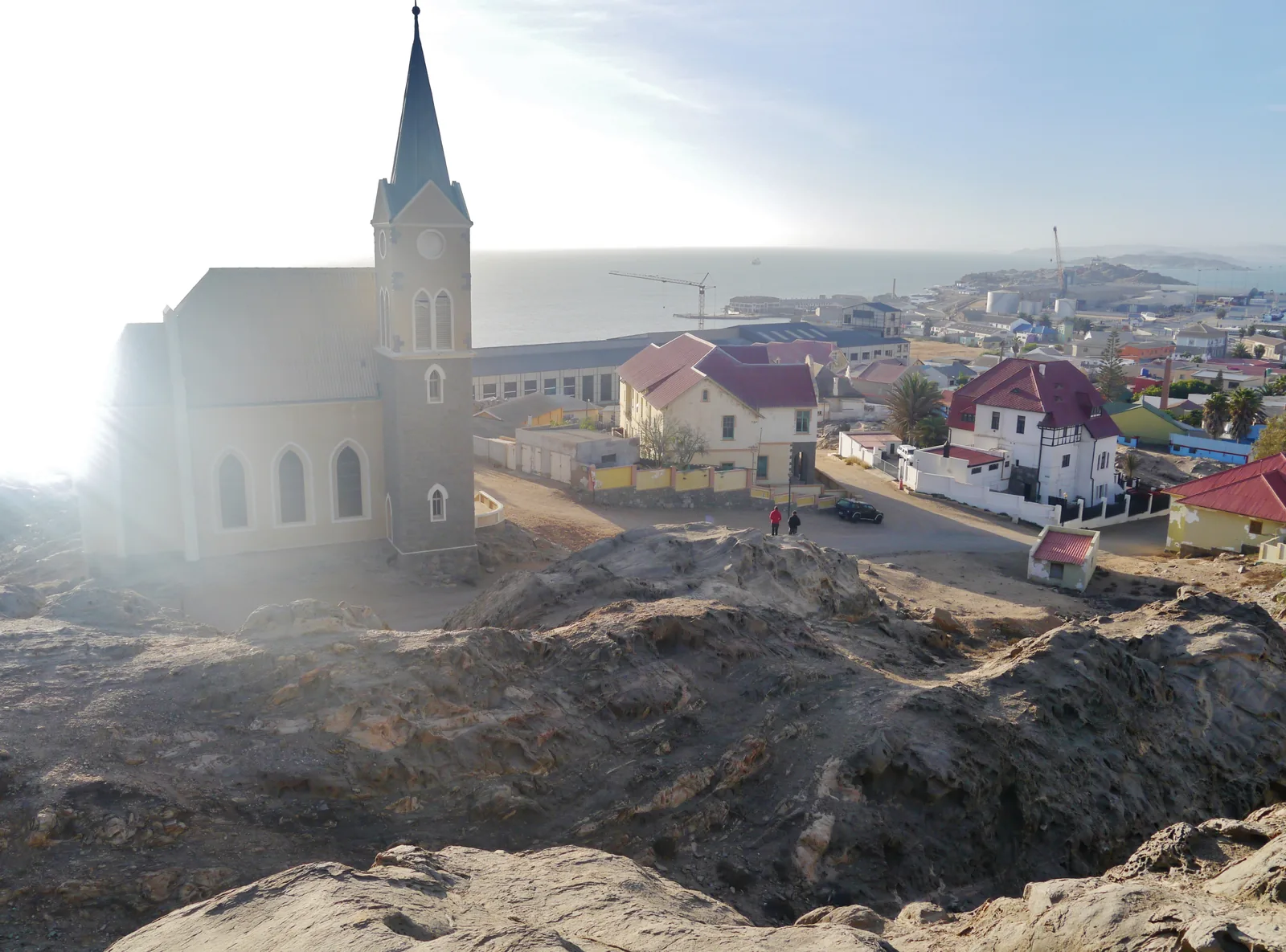
The town itself is a genuine oddity: German Jugendstil and Art Nouveau villas, a Lutheran church of 1911 to 1912 on a bare rock, a railway station, all built in five years of diamond money on a coast with no water. The Felsenkirche takes no entrance fee and asks for a donation. Goerke Haus — Lieutenant Hans Goerke's 1910 villa, later the magistrate's residence, now a national monument — publishes hours of 14:00 to 16:00 on weekdays, which places it at the opposite end of the day from Kolmanskop and makes the two fit together rather than compete.
The Felsenkirche, 1911–12, from Diamond Hill. No entrance fee; a donation box for the upkeep. Photo: Zairon, CC BY-SA 4.0 via Wikimedia Commons
One thing about the name, since the page has to use it. The town is still officially Lüderitz. The constituency was renamed ǃNamiǂNûs in August 2013 — President Pohamba described it as the original name of the area — and the debate about the town itself has not resolved. Adolf Lüderitz was the Bremen merchant who bought this bay in 1883 in the transaction that started German South West Africa. Given everything above, the name is not a neutral piece of trivia, and the honest thing is to say what it is rather than to use it without comment.
The weather will surprise anyone who has packed for Africa. Lüderitz is cold desert under Köppen — at twenty-six degrees south — because the Benguela Current runs cold up this coast: maxima of 20 to 24 °C in every month of the year, a sea of 13 to 17, and about 35 millimetres of rain a year. And then the wind, which is what this place is actually famous for among people who care about wind. Means run 16 to 24 km/h and summer afternoons average over 40. A few kilometres from town there is a purpose-cut canal, ten metres wide and eight hundred long, where the offshore wind is funnelled between slopes and accelerated across a plain to the sea; Antoine Albeau's windsurfing world record of 53.49 knots was set in it. You will not be sailing it. You will feel why it exists.
One practicality to settle a long way out, and it is genuinely unresolved rather than merely awkward. Namibia ended visa-free entry for a long list of previously exempt nationalities on 1 April 2025 — and the published list of ports offering a visa on arrival is airports and land borders only. No seaport appears on it. I could not establish from any official source how a cruise passenger arriving by tender is handled, which is exactly the sort of gap you want answered in writing by your line rather than discovered at a gangway. The detail is under Know Before You Go.
A bath at Kolmanskop, filled with sand and succulents. Diamond money bought porcelain and an ice factory on a coast with no water; the dunes took both. Photo: Sonse, CC BY 2.0 via Wikimedia Commons
What I learned putting this together is that Lüderitz refuses to arrange itself. Sixteen thousand people on a bay with no fresh water; a ghost town ten kilometres east that shuts before lunch; the fastest sailing water on earth in a ditch to the south; a man who recognised a diamond and a supervisor who filed the claim; and, ten minutes' walk from the jetty, a peninsula where between one and three thousand people were worked and starved to death, which is now a campsite with a monument to the guards. Every guide I read wanted it to be one thing — quaint German colonial charm, or a photographer's ghost town, or a dark-tourism stop. It is all of them at once and it does not reconcile. The honest thing is to write it down as it is rather than to tidy it, and to give a passenger enough that they are not ambushed by the parts nobody put on a sign.
Cruise Port Guide
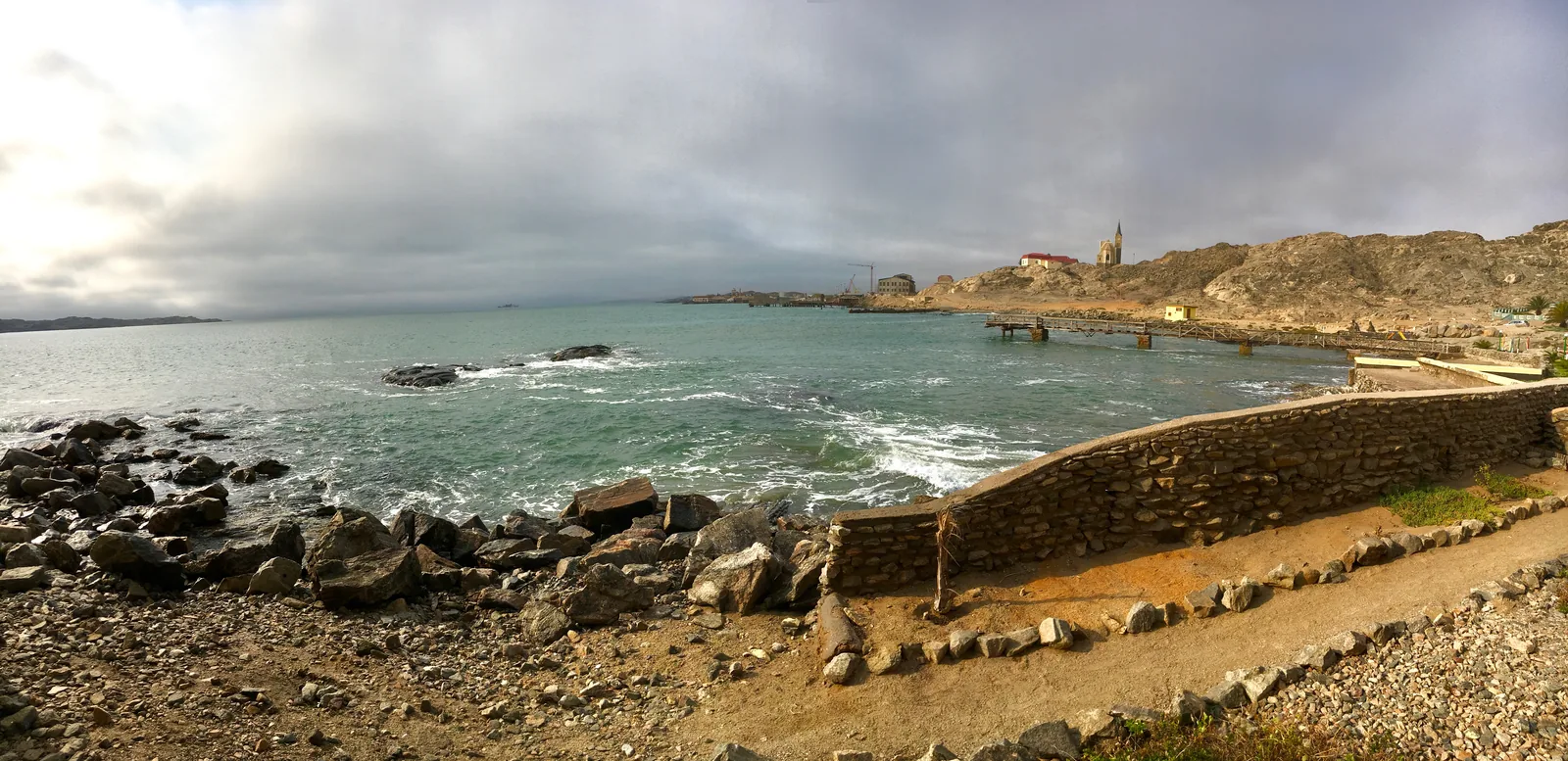
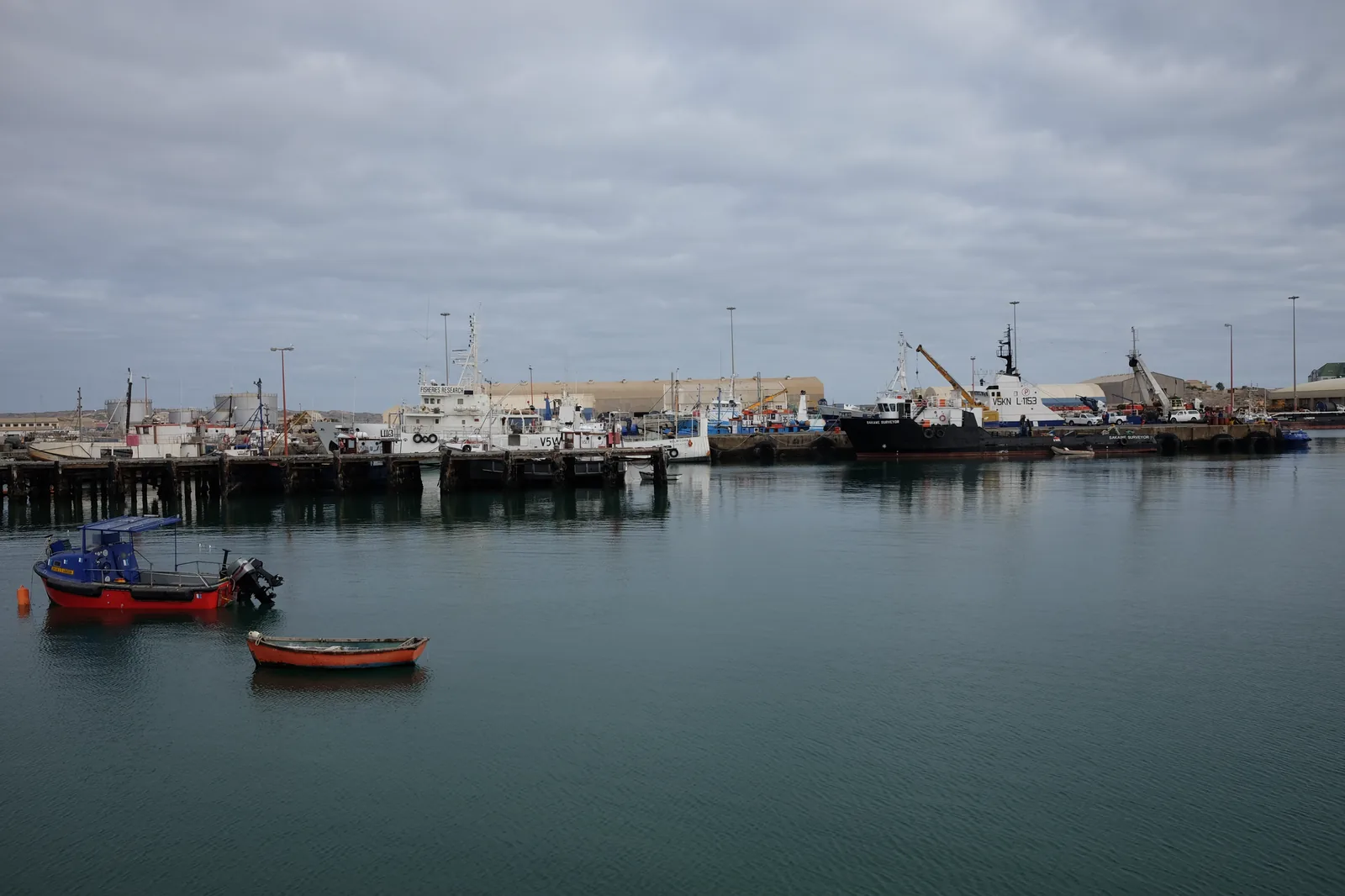
Lüderitz harbour. One berth, 500 metres long and 8.75 metres deep on bedrock Namport says is not worth cutting — which is why you arrive by tender. Photo: Johan Jönsson, CC BY-SA 4.0 via Wikimedia Commons
This is a tender call, and the reason is depth rather than length. The Port of Lüderitz has a single 500-metre berth at Robert Harbour with 8.75 metres alongside, on bedrock that Namport states is not financially viable to dredge. A world-cruise ship drawing about 8.1 m has no workable margin, so the ship anchors and tenders to the Lüderitz Waterfront jetty.
Bigger ships berth here; deeper ones do not. AIDAstella — 253 m and 71,304 GT — is on Namport's published 2026 Lüderitz list, and she draws 7.3 m. Across thirteen scheduled calls in that season, no ship draws more than 7.3. Length has never been the constraint at Lüderitz.
What might change, and what will not. Namport has a N$4-billion Lüderitz expansion aimed at an oil-and-gas supply base for the Orange Basin, with a Phase 3 adding 370 m of berth — but at quay-wall depths of 6 and 7 m, which is shallower. Only the separate Angra Point proposal, at 14–16 m, would change the cruise picture, and it has no date. Namport has since paused southern-harbour upgrades to clarify scope. Plan on tendering in 2028.
Getting Around Lüderitz
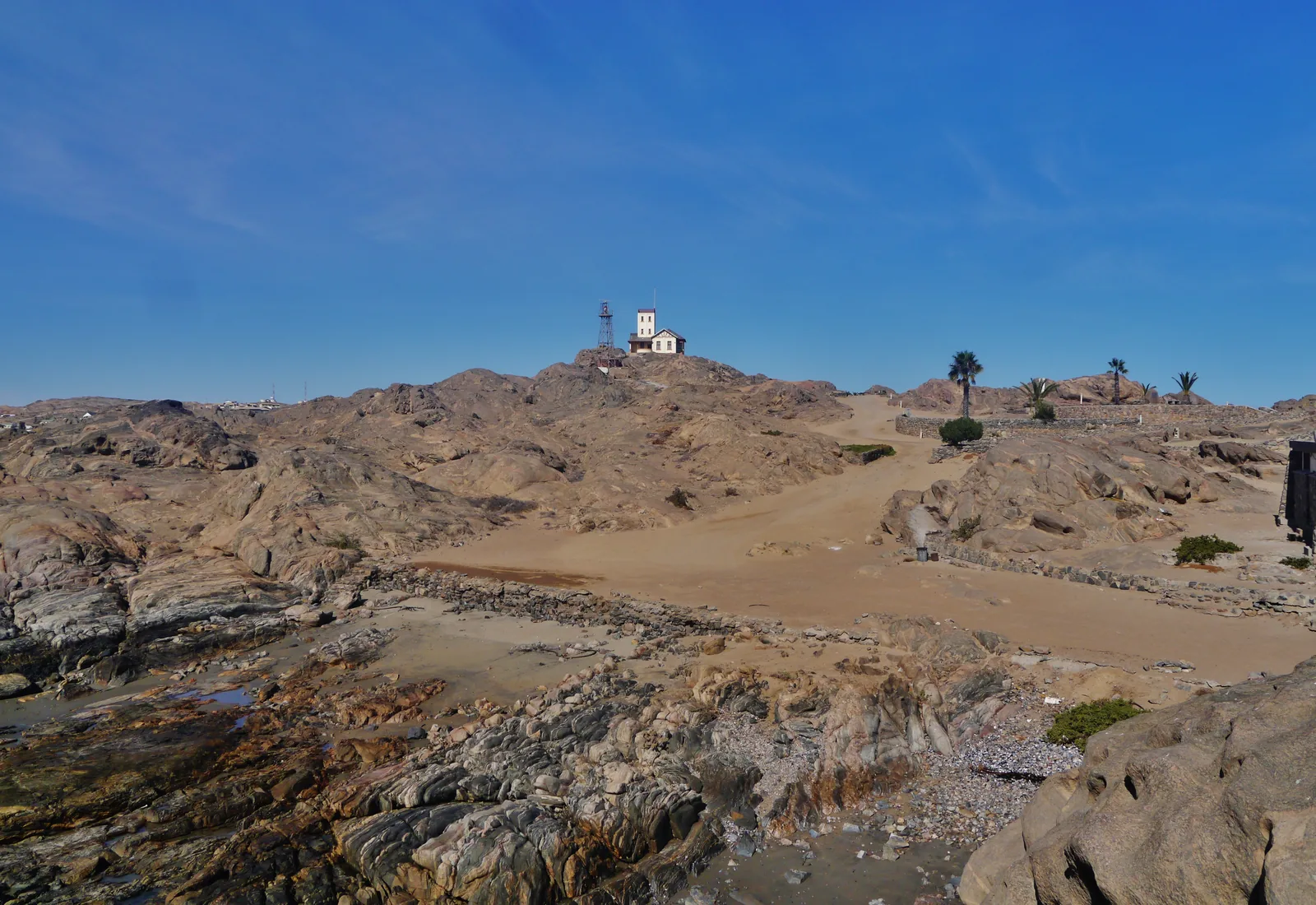
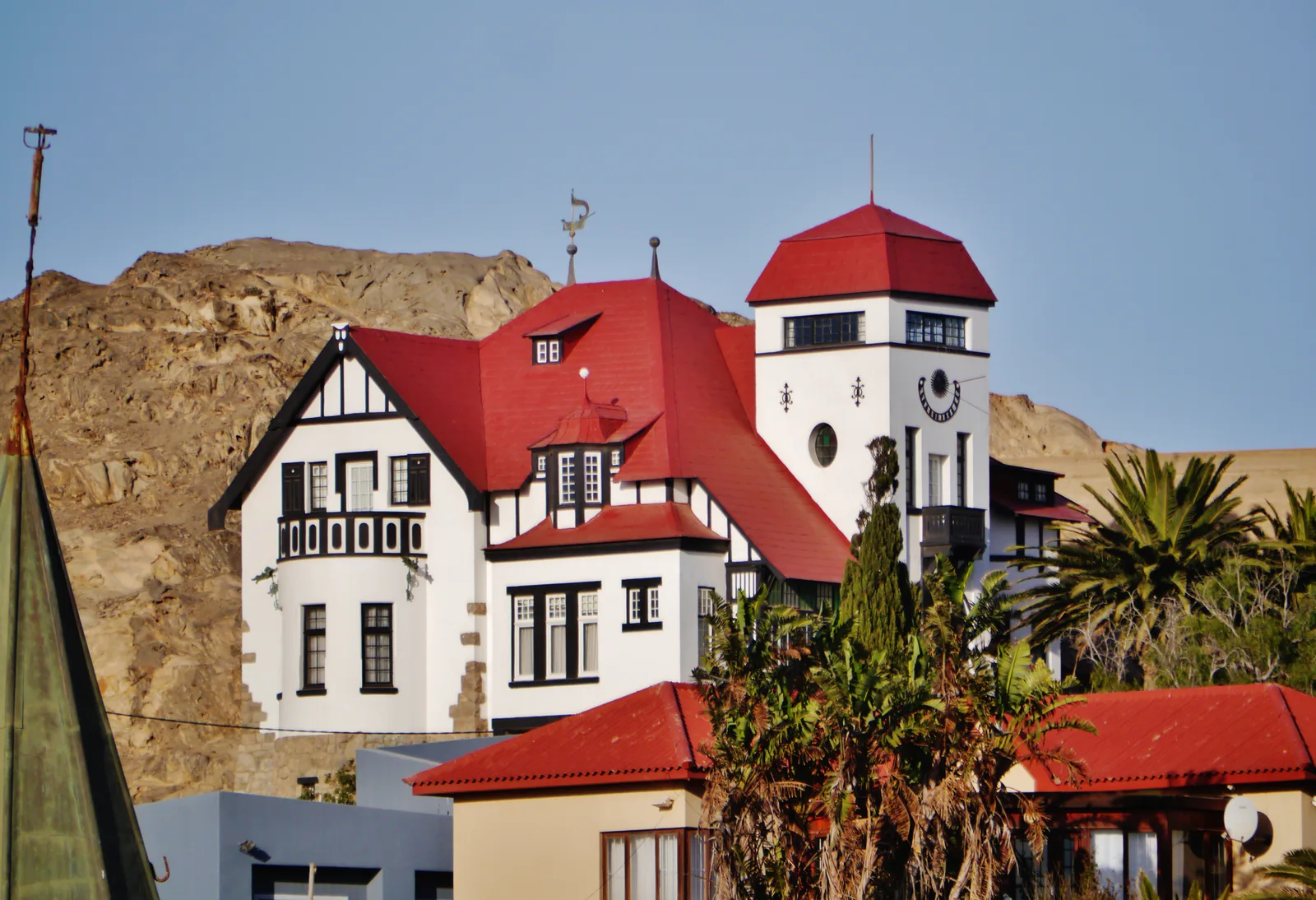
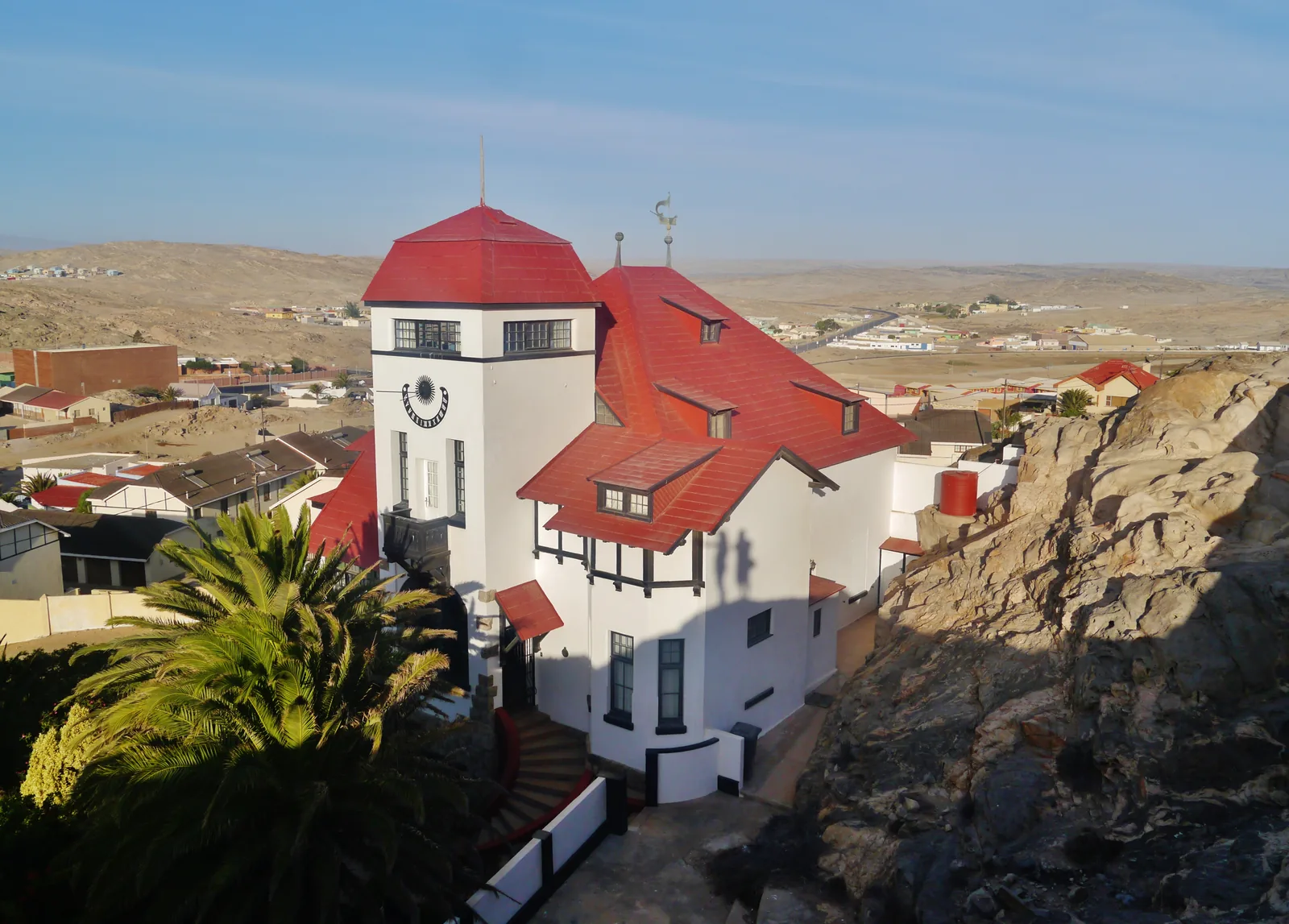
Goerke Haus on Diamond Hill. Published hours are 14:00–16:00 on weekdays — the opposite end of the day from Kolmanskop, which for once helps. Photo: Zairon, CC BY-SA 4.0 via Wikimedia Commons
On foot, mostly, and that is the luxury of this port. The tender lands at the Waterfront, and the Waterfront is the town. Bahnhof Street and its Jugendstil houses, the railway station, the harbour, the Felsenkirche and Goerke Haus on Diamond Hill, and Shark Island over the causeway are all within about twenty minutes' walk. Diamond Hill is a genuine climb — short, but steep enough to notice.
Kolmanskop needs wheels and a booking. It is 10 km inland on the B4, roughly twenty minutes, and operators meet the pier. Only Ghost Town Tours guides may conduct the tours, which run at 09:30 and 11:00 Monday to Saturday and 10:00 on Sundays and public holidays. Book through the ship or arrange it at the Waterfront the moment you land.
The peninsula loop is a drive. Diaz Point, Guano Bay, Sturmvogelbucht, Knochenbucht and Grosse Bucht run west and south from town on gravel; the Kleiner Bogenfels arch is at the far end. A half-day with a local operator, and worth it for the seals and the coast if the ghost town is not your reason for coming.
Language and money. English is Namibia's official language, and German and Afrikaans are widely spoken here in particular — Kolmanskop's tours are offered in English and German. The currency is the Namibian dollar, pegged one-for-one to the South African rand, and the rand is legal tender here. The reverse does not hold: Namibian dollars are not accepted in South Africa, so spend or change them before you sail.
Lüderitz Port Map
Excursions & Experiences
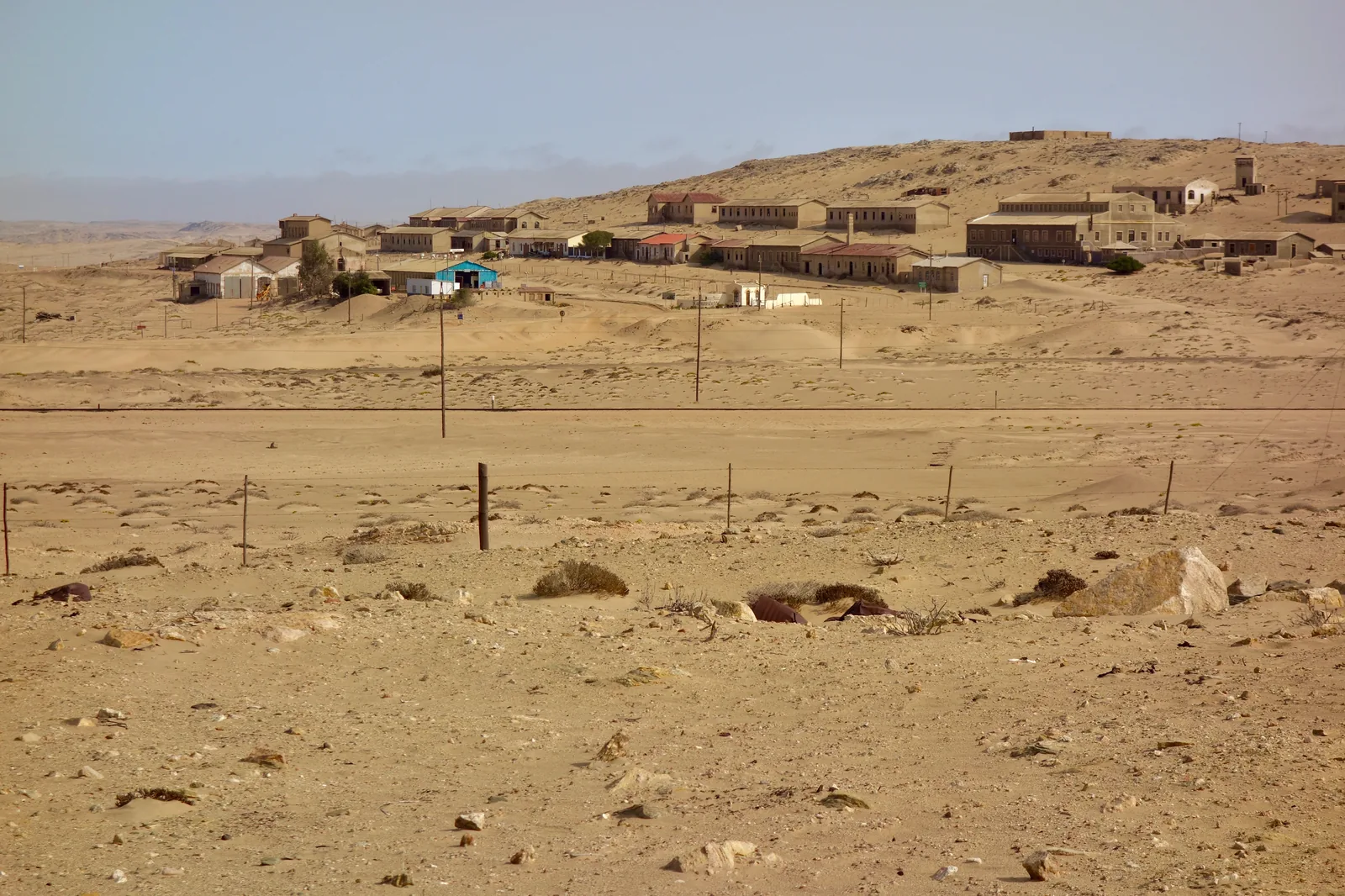
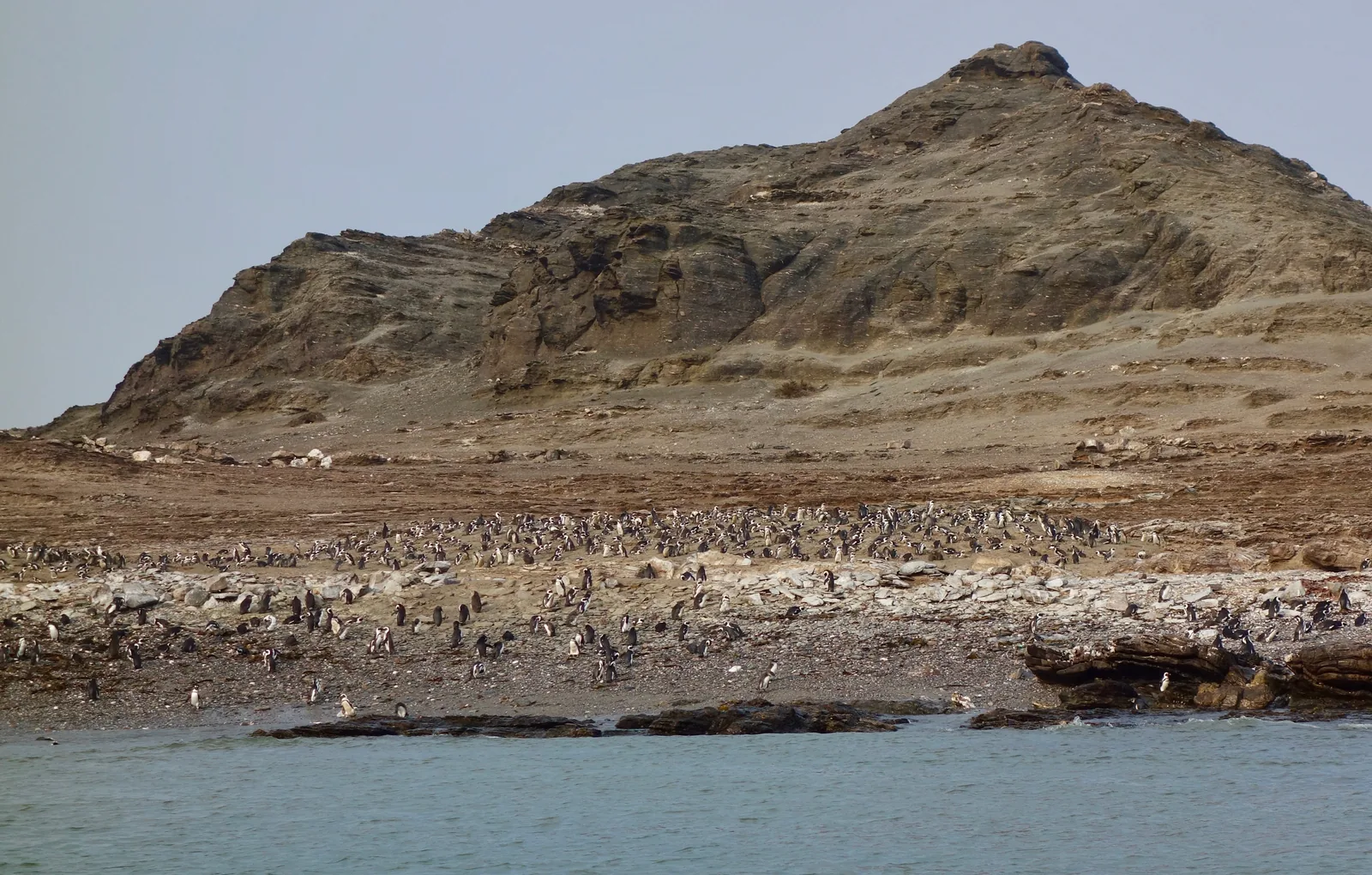
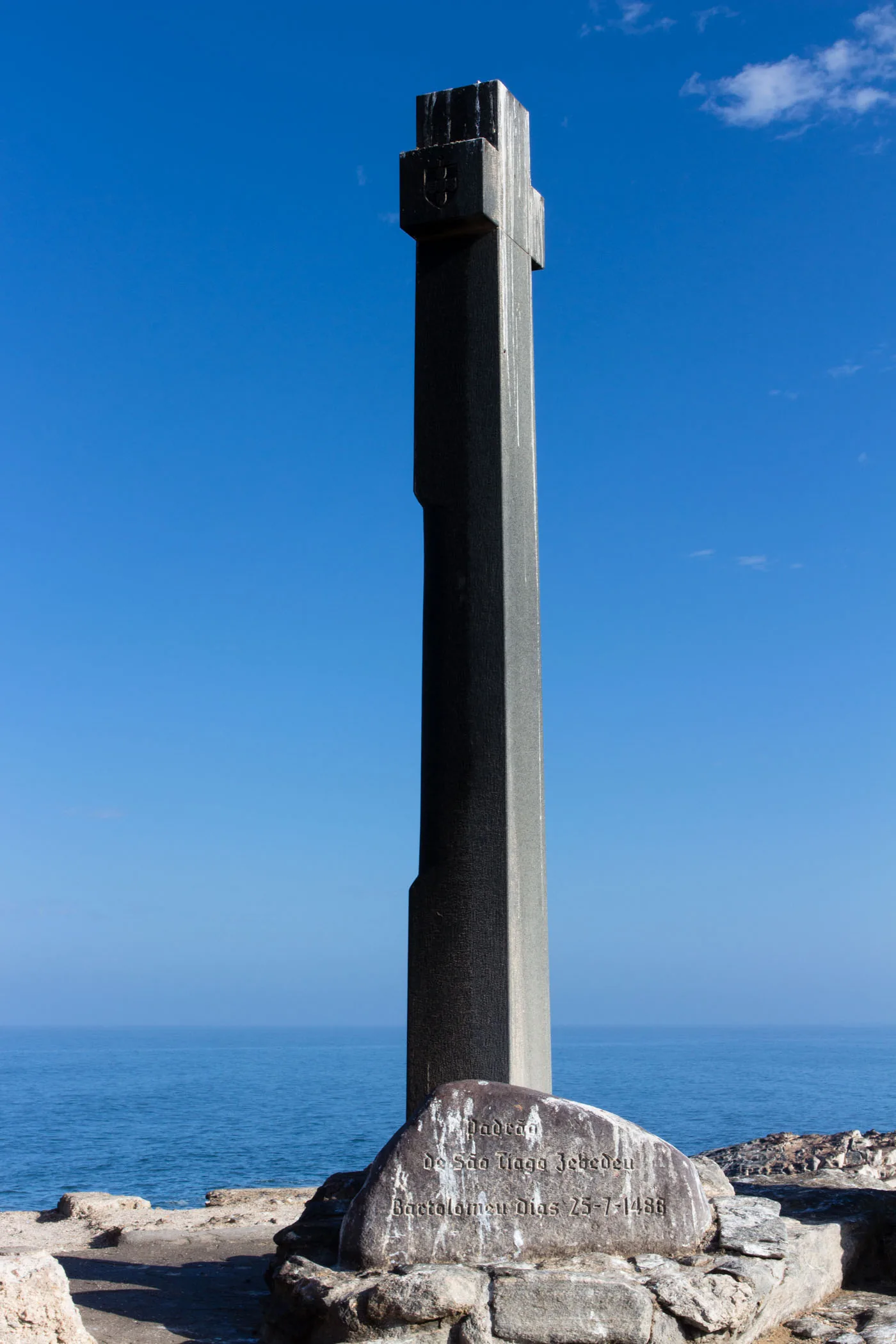
Kolmanskop from the plain. Built for about three hundred German families, with a ballroom, a skittle alley and the first X-ray machine in the southern hemisphere. Photo: Sonse, CC BY 2.0 via Wikimedia CommonsAfrican penguins on Halifax Island — the third most important breeding site for the species in Namibia. The boat leaves the Waterfront at 08:00. Photo: Sonse, CC BY 2.0 via Wikimedia CommonsThe replica padrão at Diaz Point. Bartolomeu Dias reached this bay in 1487 and raised the original on his way home in July 1488. Photo: Ragnhild & Neil Crawford, CC BY-SA 2.0 via Wikimedia Commons
There are three things worth doing here and two of them are on fixed clocks that do not overlap kindly. Read the times before you read the descriptions.
Kolmanskop — the reason most people come
The ghost town, 10 km inland. A diamond-boom settlement built for about three hundred German families with a ballroom, a skittle alley, an ice factory and a hospital, abandoned as the field played out and now being taken back by the dune field. Rooms half-full of sand, doorways drifted shut, a bath standing in dune with succulents in it.
The times are the whole planning problem. Guided tours run at 09:30 and 11:00 Monday to Saturday, 10:00 Sundays and public holidays — 45 to 60 minutes, in English and German, and only Ghost Town Tours guides may conduct them. The site closes 13:00 at weekends and on public holidays, 15:00 on weekdays.
Permits. N$230 adult, N$90 child 6–14. A photography permit at N$480 buys sunrise-to-sunset access, which is what the people whose pictures you have seen were holding. Kolmanskop sits inside the Tsau ǁKhaeb (Sperrgebiet) National Park and the restricted diamond area; the permit is not a formality.
Book it through the ship or the moment you land. With two tour departures a day and a shipful of people wanting the same thing, this is the one excursion here where going independent can genuinely fail.
The penguin boat — if your tender is early enough
Halifax Island holds the third most important African penguin breeding colony in Namibia. Boats leave the Lüderitz Waterfront at 08:00 and are back about 10:15, running out past Shark Island and Diaz Point. Cape fur seals, dolphins and seabirds are usual; whales occasional. Two operators work it — Zeepaard Boat Tours and Penguin Catamaran Tours.
This is the decision of the day. An 08:00 departure and an 11:00 last Kolmanskop tour are compatible only if the ship's first tender is early. If it is not, pick one. The penguins are the rarer sight; the ghost town is the one people regret missing.
The town, on foot — and Shark Island
The Felsenkirche, 1911–12, on its bare rock above the town. No entrance fee; a donation is requested for upkeep. The climb up Diamond Hill is short and steep and the view over the bay is the one on the postcards.
Goerke Haus, the 1910 villa of Lieutenant Hans Goerke, later the magistrate's residence, now a national monument — published hours 14:00–16:00 Monday to Friday, 16:00–17:00 at weekends. That is the opposite end of the day from Kolmanskop, which for once makes two attractions fit together instead of competing.
Bahnhof Street and the railway station, and the Jugendstil and Art Nouveau houses along it — five years of diamond money spent on a coast with no fresh water.
Shark Island, ten minutes over the causeway. Read the history section before you go. It was a German concentration camp from March 1905 to April 1907 in which between 1,032 and 3,000 Herero and Nama people died; it is now a Namibia Wildlife Resorts campsite; and the principal memorial on it names the German Schutztruppe dead. There is nothing at the gate that will tell you any of that.
Not feasible on a port day
Bogenfels — the 55-metre sea arch down the coast inside the Sperrgebiet. Licensed operator and permit only, and a full day from town.
The Fish River Canyon, Sossusvlei, or anything that implies Namibia's interior. Hundreds of kilometres. Lüderitz is a town-and-ghost-town day and it is a good one; it is not a gateway to the country.
On booking. A ship excursion to Kolmanskop is worth more here than it looks on the price list, and not for access — the permit is N$230. It is the two tour departures. With a shipful of passengers and 09:30 and 11:00 the only options, a ship excursion buys you a place and a guaranteed return to the tender. Going independent in the town itself is completely straightforward and needs nothing arranged, but if the ghost town is your reason for coming, book ahead rather than turning up.
On cost. Very little of this day is expensive. Kolmanskop is N$230, the Felsenkirche is free, the town is a walk. The penguin boat and any peninsula drive are the real outlays, and both are modest. As at the Îles du Salut, what a ship excursion sells here is timing and a guaranteed return rather than admission.
History & Heritage
Lieutenant Hans Goerke's 1910 villa, later the magistrate's residence and now a national monument — one of the few buildings the diamond rush left standing in the town itself. Photo: Zairon, CC BY-SA 4.0 via Wikimedia Commons
The bay was Angra Pequena to the Portuguese. Bartolomeu Dias reached it in 1487 on the outbound voyage that would round the Cape, and on the return leg in July 1488 he raised a padrão — the padrão de São Tiago — on the headland now called Diaz Point. Sources give the day as either 24 or 25 July, the latter argued from St James's Day; what stands there now is a replica.
Nothing much happened for the next four centuries, because the bay has no fresh water. Then in 1883 the Bremen merchant Adolf Lüderitz bought it, and the German Empire declared a protectorate over the coast — the transaction that began German South West Africa and gave the town its name.
Between 1904 and 1908 the German colonial authorities carried out the Herero and Nama genocide, and Shark Island, on the edge of this town, was one of its concentration camps — open from March 1905 to April 1907, with a death toll estimated between 1,032 and 3,000. Germany recognised the killings as genocide on 28 May 2021, offering €1.1 billion in development aid while rejecting legal responsibility; Ovaherero and Nama representatives were not party to that agreement and have challenged it in Namibia's High Court. Since 2025, 28 May is Namibia's Genocide Remembrance Day.
The diamonds came a year after the camp closed. On 14 April 1908, at Grasplatz on the Aus–Lüderitz railway, a worker named Zacharias Lewala — who had worked the Kimberley fields and knew rough diamonds by sight — picked up several stones and handed one to his supervisor August Stauch. Stauch had it tested at Swakopmund and filed the prospecting claim. The rush that followed built Kolmanskop and the Jugendstil town you walk through, and it was over within about forty years: the richer fields lay south toward Oranjemund, the town emptied, and by the 1950s the desert had it back.
Food & Drink Ashore
Lüderitz is a cold-water fishing town and that is what to eat. The Benguela upwelling is among the richest fishing grounds on the African coast, which is the same fact that keeps the town at 22 °C and the sea at 14. Rock lobster, kingklip, hake and oysters are the local catch; the Waterfront restaurants beside the tender jetty are where they land.
Practically, on a ship day, the Waterfront is the answer. It is a few metres from where you step ashore, it takes cards, and it is the natural place to be at the end of the day when the ghost town has closed and Goerke Haus has not yet opened.
Money. Namibian dollar, pegged one-for-one to the rand, and rand is legal tender. Namibia is a straightforward card economy in town. Change or spend Namibian dollars before you sail — they are not accepted in South Africa.
Know Before You Go
Namibia ended visa-free entry for many nationalities on 1 April 2025. A visa is now required — N$1,600 on arrival, or an eVisa in advance at roughly US$70–95. But no seaport appears on the published visa-on-arrival list, which is airports and land border posts only. How a cruise passenger arriving by tender is handled is not documented in any official source we could reach. Ask your line, in writing, and check eservices.mhaiss.gov.na before sailing.
Kolmanskop's last guided tour is at 11:00. Tours run 09:30 and 11:00 Monday–Saturday and 10:00 Sundays and public holidays; the site closes 13:00 at weekends and public holidays, 15:00 on weekdays. This is the single most important scheduling fact of the day.
Shark Island was a concentration camp. Between 1,032 and 3,000 Herero and Nama people died there between March 1905 and April 1907. It is now a campsite, and the principal memorial on the site names German Schutztruppe dead rather than the victims. Nothing at the gate will tell you this.
Dress for cold and wind, not for Africa. Maxima are 20–24 °C every month of the year, the sea is 13–17 °C, and mean wind runs 16–24 km/h with summer afternoons averaging over 40. A windproof layer matters more here than anything else in the bag.
Kolmanskop is inside a restricted diamond area. It lies within the Tsau ǁKhaeb (Sperrgebiet) National Park and entry requires a valid permit; only Ghost Town Tours guides may conduct tours. Kolmanskop and Agate Beach are the only parts of the park reachable without a tour operator and a special permit.
This is a tender call and it can be weather-affected. Robert Harbour is sheltered by comparison with an open roadstead, but this is a famously windy coast and the tender operation is at the master's discretion.
Depth Soundings Ashore
Kolmanskop is inside the Tsau ǁKhaeb (Sperrgebiet) National Park and the restricted diamond area. The permit is not a formality. Photo: Johan Jönsson, CC BY-SA 4.0 via Wikimedia Commons
Things about this call that only make sense once someone says them:
It is draft, not size, that keeps you off the quay. The berth is 500 m long — twice the ship. AIDAstella at 253 m and 71,304 GT berths here and draws 7.3 m; a world-cruise ship drawing 8.1 m does not fit under 8.75 m of water on undredgeable bedrock.
The ghost town shuts before lunch. Last guided tour 11:00, site closed 13:00 at weekends and on public holidays. Almost nothing written about Lüderitz mentions this, and it decides the day.
Shark Island's memorial commemorates the garrison. The semicircular wall behind the gate carries plaques naming German Schutztruppe dead. The camp's own dead — between one and three thousand Herero and Nama people — have no equivalent monument on the site, which is now a campsite.
The man who found the first diamond was Zacharias Lewala, a railway worker who had learned to recognise rough at Kimberley. He handed it to his supervisor August Stauch, who filed the claim and became rich. The date was 14 April 1908, at Grasplatz.
The town has not been renamed. The constituency became ǃNamiǂNûs in August 2013; Lüderitz itself is still officially Lüderitz, and the debate has not resolved.
Namibia's coast is cold desert. Twenty-six degrees south, and maxima never exceed 24 °C in any month. The Benguela Current does it, and it is also why there are penguins here.
Practical Information
Currency: Namibian dollar (NAD), pegged 1:1 to the South African rand, and rand is legal tender in Namibia. Cards are widely accepted in town. Namibian dollars are not accepted in South Africa, so spend or change them before you sail.
Language: English is the sole official language, and German and Afrikaans are both widely spoken in Lüderitz specifically. Kolmanskop's guided tours run in English and German.
Cold, wind and sun together. A windproof outer layer, something warm under it, and high-factor sunscreen — the sun at 26° S over a 14 °C sea burns without ever feeling hot. Morning fog off the Benguela is normal and usually clears by mid-morning.
Accessibility. The tender is the first hurdle and rules the port out for many wheelchair users. Ashore, the Waterfront and the harbour front are level and close, which makes this an unusually manageable town for a short walk. Minimal: the Waterfront itself, a few metres from the jetty. Moderate: Bahnhof Street and the station, on the flat; Shark Island over the causeway. High energy: Diamond Hill for the Felsenkirche and Goerke Haus, which is short but genuinely steep. Kolmanskop is loose sand throughout — that is the entire point of the place — and is not manageable on wheels or with an unsteady gait.
What it costs: among the cheapest calls on the voyage. Kolmanskop N$230 for an adult permit, N$480 if you want the photographer's sunrise-to-sunset access; the Felsenkirche free with a donation box; the town free. The money goes on the boat trip and the transfer, and what a ship excursion buys is a place on a tour and a guaranteed return rather than admission.
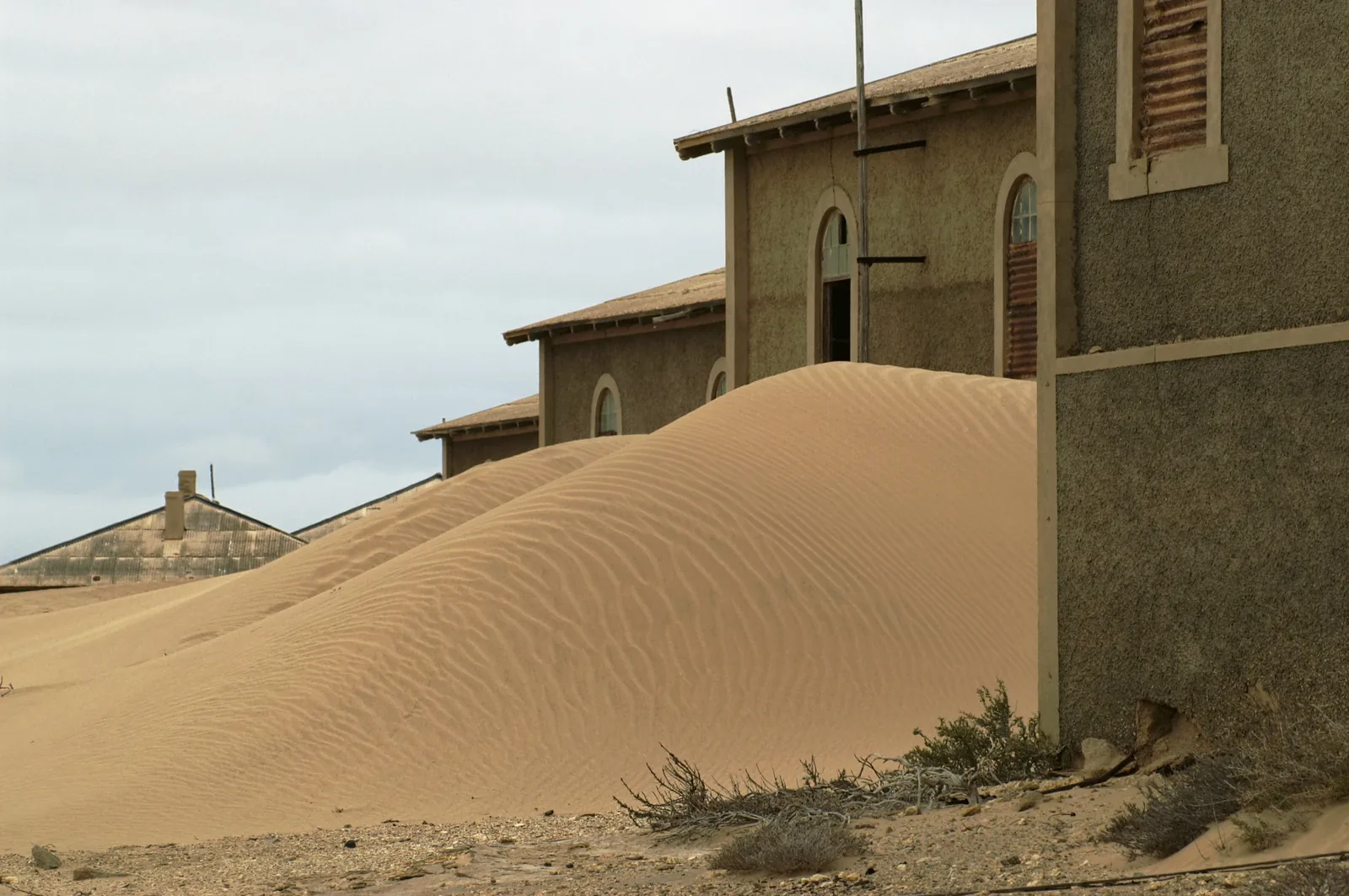
A doorway drifted shut. Loose dune throughout — which is the attraction, and the reason this is not a wheelchair site. Photo: Henning Sidow, CC BY-SA 4.0 via Wikimedia Commons
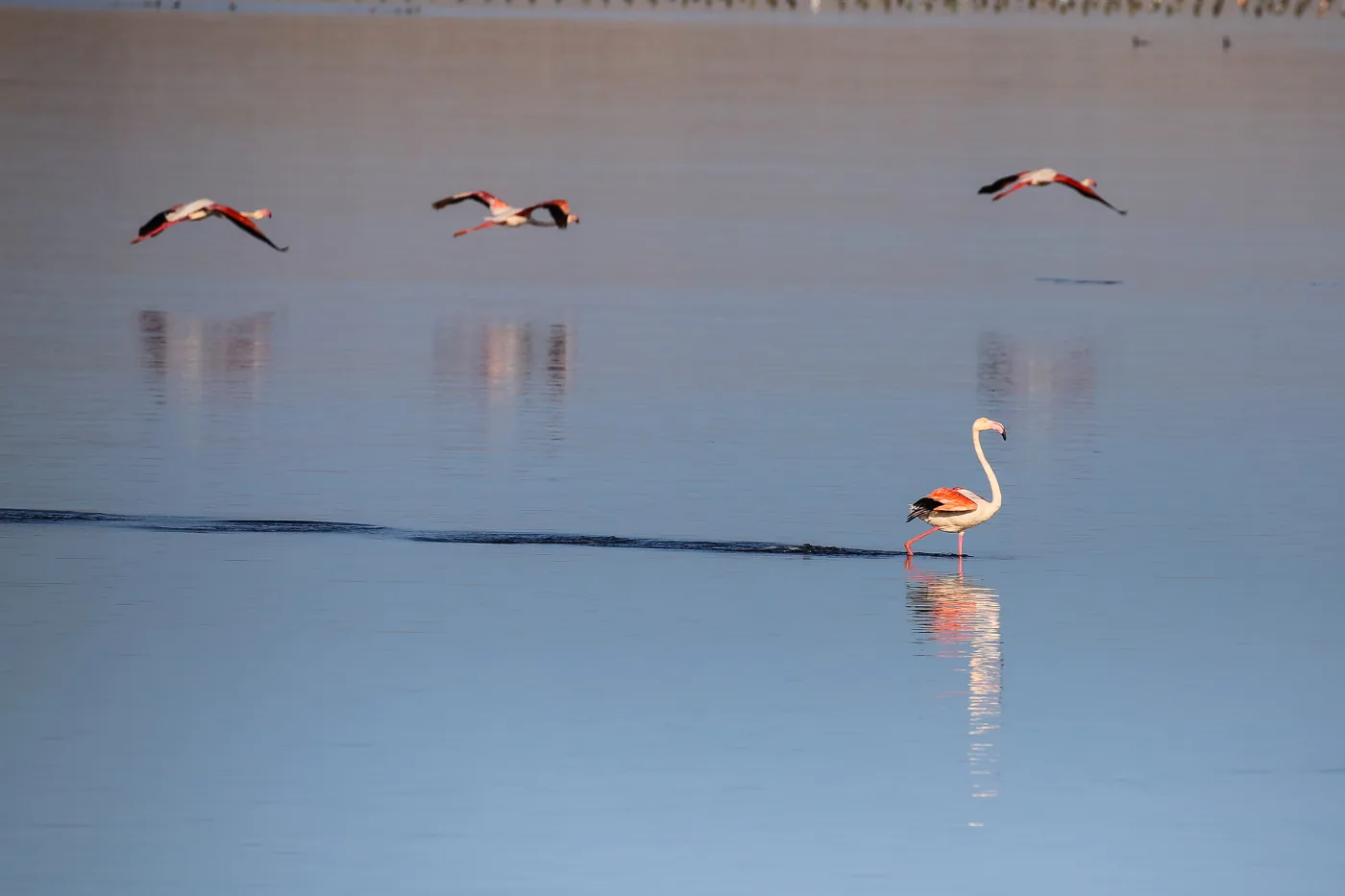
A greater flamingo in Radford Bay, on the edge of town. The Benguela upwelling that keeps Lüderitz cool is also what feeds all this. Photo: Ragnhild & Neil Crawford, CC BY-SA 2.0 via Wikimedia Commons
Credits
Every image on this page comes from Wikimedia Commons under the license noted and is credited to its creator below. In the Wake does not claim authorship of these images; when we can add our own photographs from a future visit, we will.
The Felsenkirche on its rock outcrop (page header image) — Zairon, CC BY-SA 4.0
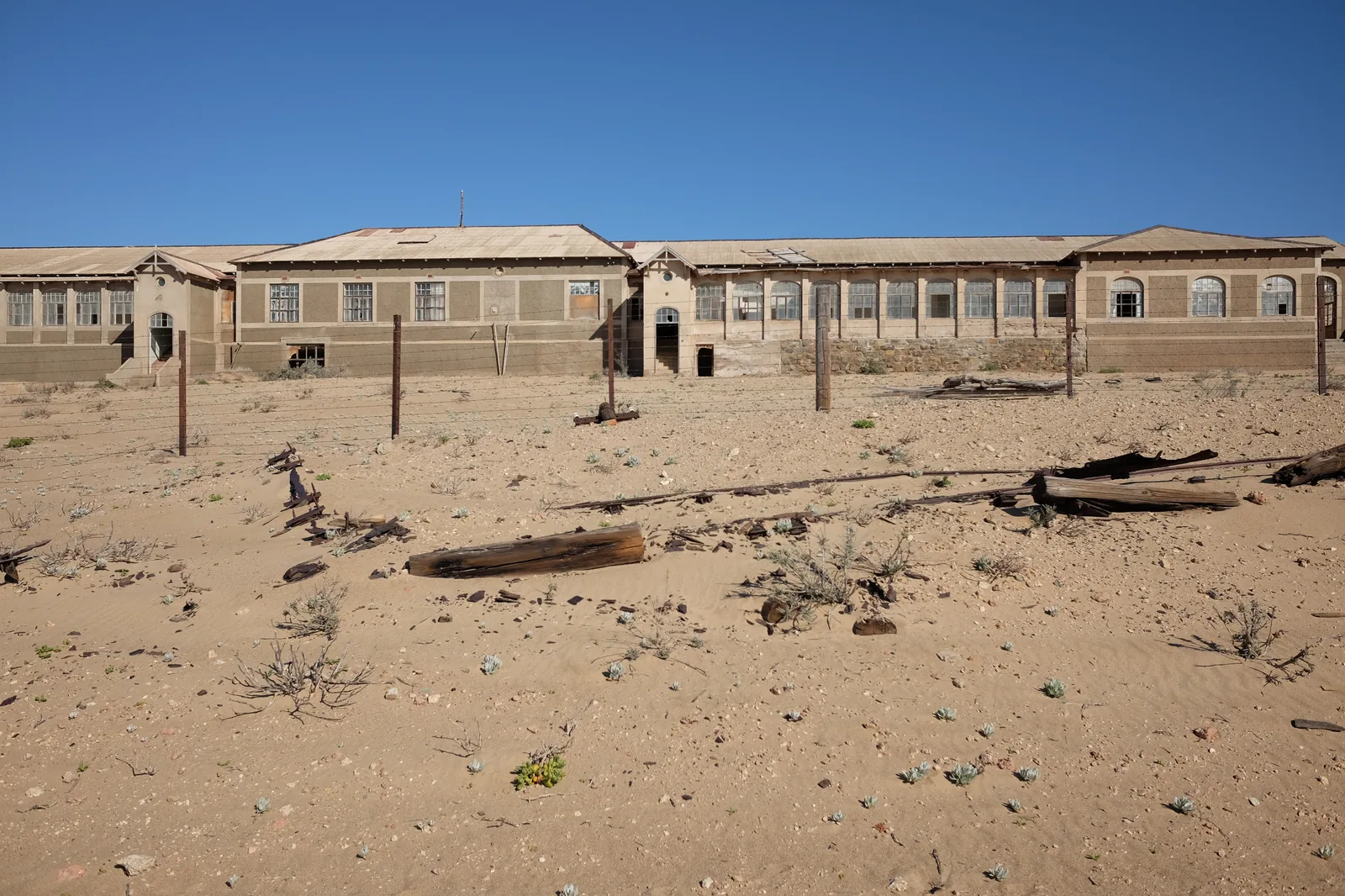
A long communal building at Kolmanskop — Johan Jönsson, CC BY-SA 4.0
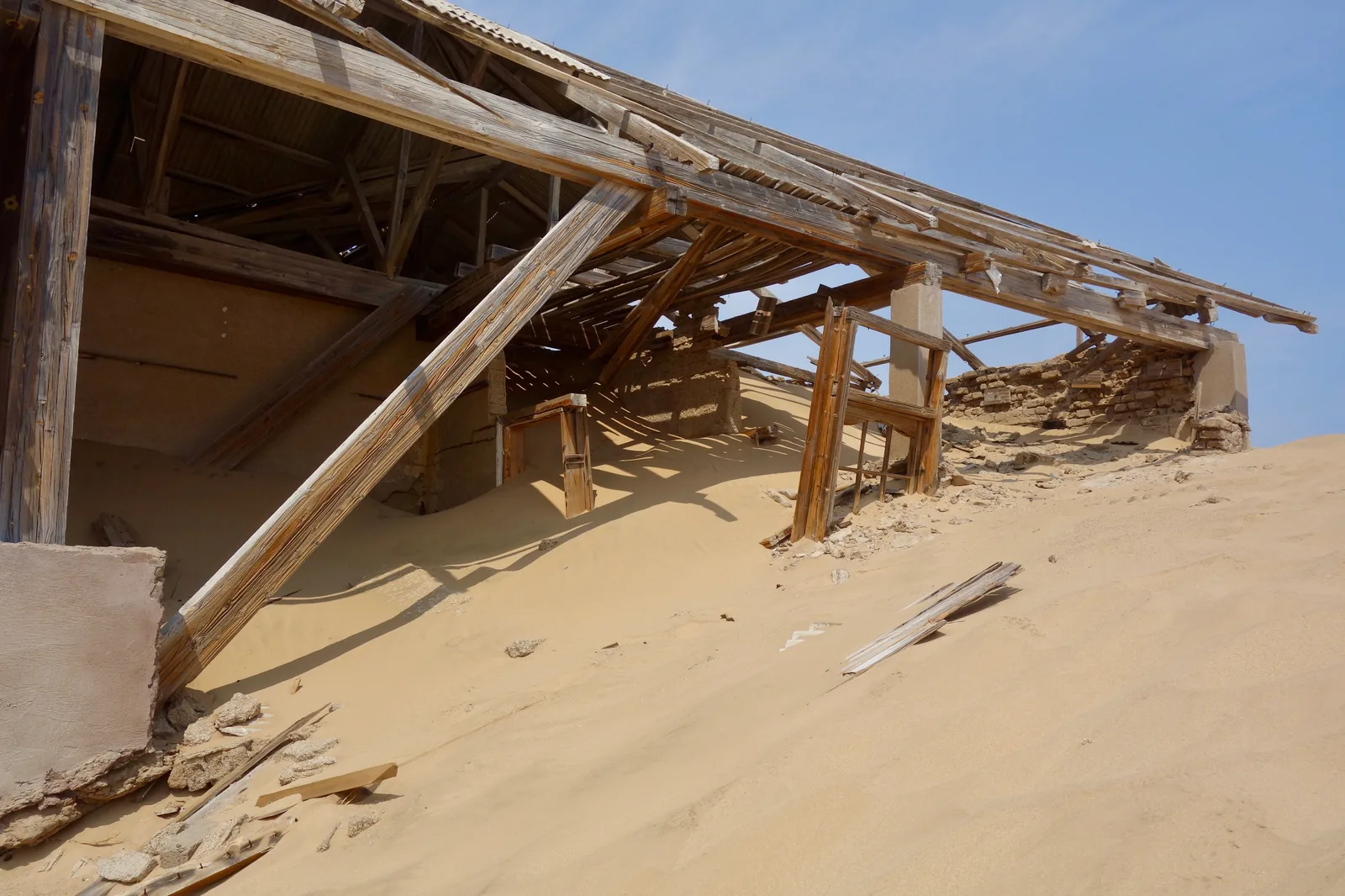
A collapsing building at Kolmanskop — Sonse, CC BY 2.0
A doorway drifted shut at Kolmanskop — Henning Sidow, CC BY-SA 4.0
A greater flamingo in Radford Bay — Ragnhild & Neil Crawford, CC BY-SA 2.0
Frequently Asked Questions
What is the best time of year to visit Lüderitz?
April to August, and the reason is wind rather than heat or rain. Mean wind speed drops to its annual minimum of 16–17 km/h in May and June, against 24 km/h in December and January when afternoon averages exceed 40 km/h. Temperature barely helps you choose: maxima sit between 20 and 24 °C in <em>every</em> month of the year, and annual rainfall is about 35 mm. A world-cruise call in late April or May lands in the calmest part of the Lüderitz year, which is genuinely fortunate.
What should I pack for the weather here?
A proper windproof outer layer, and something warm under it. This is cold desert at 26° south — the Benguela Current keeps maxima at 20–24 °C year-round and the sea at 13–17 °C, and packing for Africa is the standard mistake. Add high-factor sunscreen and sunglasses, because the sun burns without ever feeling hot here, and shoes you do not mind filling with sand: Kolmanskop is loose dune throughout. A dust cover for the camera, for the same reason.
Will rain concerns affect my day in Lüderitz?
Almost certainly not. Lüderitz takes about <strong>35 mm of rain in an entire year</strong> — several months record none at all — and cloud cover runs 8–9% in midsummer. What you should plan around instead is <strong>wind and morning fog</strong>: fog off the cold Benguela water is routine on this coast and usually burns off by mid-morning, and the wind is a daily constant rather than a seasonal event.
Does Lüderitz have a storm season, and can this call be cancelled?
There is no cyclone season and effectively no rainy season, so the usual weather risks do not apply. The variable here is <strong>wind</strong>, which blows year-round and hardest in December and January, and the fact that this is a <strong>tender call</strong>. Robert Harbour is sheltered compared with an open roadstead, but a tender transfer in a strong blow is at the master's discretion, and it is honest to treat any tender port as conditions-dependent. Lüderitz is a good deal less cancellable than somewhere like the Îles du Salut, but it is not a berth.
Do cruise ships dock at Lüderitz, or is this a tender port?
For a world-cruise ship, <strong>tender</strong>. The port has one berth, 500 m long and <strong>8.75 m deep</strong>, on bedrock Namport states is not financially viable to dredge. A ship drawing about 8.1 m has no workable under-keel margin, so she anchors in Robert Harbour and tenders to the Waterfront jetty. Note that this is about draft, not size: AIDAstella is 253 m and 71,304 GT — larger than Volendam — and she berths here, because she draws 7.3 m. Across Namport's thirteen scheduled Lüderitz calls in 2026, no ship draws more than 7.3.
What is the one thing that will spoil my day here?
Arriving at Kolmanskop after 11:00. <strong>Guided tours run at 09:30 and 11:00 Monday to Saturday and 10:00 on Sundays and public holidays — that is the whole list</strong> — and the site closes at 13:00 at weekends and on public holidays, 15:00 on weekdays. Only Ghost Town Tours guides may conduct tours. The ghost town is 10 km inland and twenty minutes away, so distance is not the problem; the fixed schedule is. Book through the ship or arrange it the moment you land, and take the earliest tender you can.
Can I do Kolmanskop and the penguin boat in one day?
Only if the ship's first tender is early. The Halifax Island boat leaves the Waterfront at <strong>08:00</strong> and is back about 10:15; the last Kolmanskop tour is at <strong>11:00</strong>. On paper that works with about forty-five minutes to spare — in practice it depends entirely on when the ship starts running tenders, which you will not know until the night before. If you have to choose: the penguins are the rarer sight, and the ghost town is the one people regret missing.
Do I need a visa for Namibia?
Quite possibly, and this is the item to settle in writing rather than assume. <strong>Namibia ended visa-free entry for a long list of previously exempt nationalities on 1 April 2025.</strong> The visa costs N$1,600 on arrival, or roughly US$70–95 as an eVisa applied for in advance, which the Ministry of Home Affairs has made the default route. The complication is that <strong>the published list of ports offering visa on arrival is airports and land borders only — no seaport appears on it</strong>. How a cruise passenger arriving by tender is handled is not documented in any official source we could reach. Ask your line's documentation desk explicitly, by name, and check eservices.mhaiss.gov.na before sailing.
What is Shark Island, and should I go?
It is a peninsula at the edge of the town, joined by a causeway, and from <strong>March 1905 to April 1907 it was a German concentration camp</strong> during the Herero and Nama genocide. Estimates of the dead there run from <strong>1,032 to 3,000</strong>. Two things about it now are difficult and both are simply true: it is operated as a Namibia Wildlife Resorts <strong>campsite</strong>, and the principal memorial on the site is a semicircular wall carrying plaques that name German <em>Schutztruppe</em> dead. Go, and go knowing what you are standing on — there is nothing at the gate that will tell you.
Has Germany paid reparations for the genocide?
No. Germany formally recognised the killings as genocide on 28 May 2021 and offered <strong>€1.1 billion in ex gratia development aid while expressly rejecting legal responsibility</strong>. The Joint Declaration was negotiated between the two governments; Ovaherero and Nama representatives were not party to it, and their traditional authorities applied to Namibia's High Court in 2023 to have it declared unlawful. As of October 2025 Amnesty International states that Germany has failed to engage in meaningful consultations with those communities or provide reparations. Namibia has marked <strong>28 May as Genocide Remembrance Day</strong> since 2025.
Who actually found the first diamond?
<strong>Zacharias Lewala</strong>, a worker on the Aus–Lüderitz railway, at Grasplatz on <strong>14 April 1908</strong>. He had worked the diamond fields at Kimberley and could recognise rough by sight, which is precisely why he picked the stones up. He handed one to his German supervisor <strong>August Stauch</strong>, who had it tested at Swakopmund and applied for the prospecting licence. Stauch became rich on the rush that followed and built Kolmanskop. Lewala's name is in the record; almost nothing else about him is.
Is the town called Lüderitz or ǃNamiǂNûs?
Officially, still Lüderitz. In August 2013 the <strong>constituency</strong> was renamed ǃNamiǂNûs, with President Hifikepunye Pohamba describing it as the original name of the area, and debate followed about whether the town was covered. The settled reading is that the constituency was renamed and the town was not. Adolf Lüderitz was the Bremen merchant who bought this bay in 1883 in the transaction that began German South West Africa — which, given what happened here twenty years later, is not a neutral piece of trivia.
Is this call suitable if I have limited mobility?
Partly, and unusually the town is the easy part. It is a <strong>tender</strong> port, which is the first hurdle. But once ashore the Waterfront and harbour front are level and immediately at the jetty, which makes Lüderitz one of the more manageable short walks on the voyage. Bahnhof Street and the causeway to Shark Island are flat. <strong>Diamond Hill, for the Felsenkirche and Goerke Haus, is short but genuinely steep.</strong> And <strong>Kolmanskop is loose sand throughout</strong> — that is the whole point of the site — so it is not manageable on wheels or with an unsteady gait, and no operator can change that.



.jpg)


.jpg)


.jpg)
.jpg)


.jpg)

