


Photo: Wikimedia Commons (CC BY-SA)
Captain's Logbook
Phuket
I watched Thailand's largest island emerge from the Andaman's morning haze – verdant hills cascading toward waters that shift from jade to sapphire as the light changes, weathered long-tail boats rocking gently in hidden coves, and high on Nakkerd Hill, the white marble Big Buddha gleaming like a beacon across eight miles of sea. Phuket wears its contradictions with the ease of an island that has seen centuries of travelers: saffron-robed monks collecting alms on streets where the night before, music pulsed until dawn; century-old Sino-Portuguese mansions painted in pastels beside modern glass towers; fishing nets drying in the sun while parasails arc overhead. You can find whatever version of Thailand you seek here, though the best discoveries often come when you stop seeking and simply wander.
On our way into Old Town that first morning, we stopped at a street stall where a woman was grilling satay over charcoal, the smoke carrying that unmistakable sweetness of peanut sauce caramelizing in the heat. I bought four skewers and ate them standing on the pavement while a monsoon rain swept in from nowhere, warm and vertical, turning the gutters into rivers within seconds. A tuk-tuk driver honked and waved us under his awning. Temple bells rang somewhere behind the shophouses, mixing with the rain's percussion on the tin roofs. A vendor nearby was stringing jasmine garlands, the fragrance cutting through the charcoal smoke like a whispered prayer. I stood there dripping and grinning, holding my satay above the downpour, thinking this is the Thailand that no brochure captures.
The island's history runs deeper and stranger than its beach resort reputation suggests. Thailand alone in Southeast Asia was never colonized – no foreign flag ever claimed these shores – yet in the 17th century, tin deposits in Phuket's hills drew prospectors from half the world: Dutch merchants with their ledgers, French traders with their wines, English mining engineers with their surveying tools, Portuguese sailors with their navigational charts. They came for metal and left their architectural fingerprints. Chinese laborers arrived by the thousands to work the mines, married local Thai and Malay women, and created something entirely new – the Baba or Peranakan culture, a fusion that lives on in Old Town's shophouses, in temple ceremonies that blend Buddhist and Taoist traditions, in cuisine that tastes of Fujian province and the Andaman Sea simultaneously.
We walked through Old Town that afternoon, past shophouses whose facades told their own stories in faded pastel plaster and carved wooden shutters. I pressed my hand against a doorframe on Thalang Road and felt the roughness of wood that had absorbed a hundred and fifty monsoon seasons. Inside a small Chinese shrine tucked between two shophouses, a woman was lighting incense and murmuring something I could not understand. She saw me watching and smiled — not a tourist-industry smile but the kind you give a stranger who has wandered close to something private. I bowed slightly and backed away, carrying the scent of sandalwood and smoke on my clothes for the rest of the day.
Looking back, I think Phuket teaches a different lesson than the one printed on the postcard. The postcard promises paradise — turquoise water, white sand, cocktails at sunset. What Phuket actually gave me was subtler and harder to frame: the scent of jasmine in the rain, a woman's smile at the door of a shrine, and a forty-five-metre Buddha that does not need you to be impressed. It simply sits there, looking south, patient as stone. I learned that the places which change you most deeply are not always the ones shouting for your attention. Sometimes they are the ones that say nothing at all and let the silence do the work.
Weather & Best Time to Visit
The Cruise Port
Cruise ships calling at Phuket use one of two arrangements depending on size. Smaller and mid-size ships may dock at Phuket Deep Sea Port on the southeastern coast near Ao Makham, a basic facility about 5 km from Phuket Town and 30+ km from the west-coast beaches. Larger ships sometimes anchor offshore near Patong and tender passengers ashore — check your ship's port information the night before to know which method your vessel will use. The deep sea port has a small terminal building with restrooms and a taxi queue, but limited facilities otherwise. Tour operators and taxi drivers set up outside the port gates.
Phuket appears on Asia and repositioning itineraries for lines including Royal Caribbean, Celebrity, Holland America, Princess, Oceania, Seabourn, and Silversea. The peak cruise season runs November through March, coinciding with the dry season. Tenders can be slow when multiple ships are at anchor, so plan your shore time accordingly.
Quick Facts
Getting Around
Phuket is a large island — about 50 km north to south — and attractions are spread across its length. Unlike compact European ports, walking is not a practical way to see Phuket. You will need transport of some kind to reach the beaches, temples, and viewpoints that make the island worth visiting.
Taxis and private drivers: Metered taxis exist but can be hard to find at the cruise port. Negotiate a price before getting in any vehicle. From the Deep Sea Port, expect to pay roughly 500-800 THB ($15-23) for Phuket Town, 800-1,200 THB ($23-35) for Patong Beach, and 1,200-1,500 THB ($35-43) for the Big Buddha or Kata Beach. Hiring a private driver for a full day (6-8 hours) costs approximately 2,000-3,500 THB ($57-100) and is often the smartest option for cruise passengers who want to see multiple sites.
Tuk-tuks: The open-sided red vehicles are a Phuket institution. Prices are not metered — always agree on a fare before climbing in. Tuk-tuks are fine for short hops between nearby attractions but expensive relative to the distance. Typical fare: 200-400 THB ($6-11) for a short ride within a single area.
Grab (ride-hailing app): Grab works throughout Phuket and is generally cheaper than negotiating with taxi or tuk-tuk drivers. Download the app and set up payment before your trip. Fares are transparent and quoted upfront. A Grab car from the port to Patong typically costs 400-600 THB ($11-17).
Songthaew (local bus): Blue songthaews (converted pickup trucks with bench seats) run between Phuket Town and some beaches for 30-50 THB ($1-1.50). Schedules are loose and routes can be confusing for visitors. Not practical from the cruise port, but useful if you make it to Phuket Town first.
Mobility considerations: Phuket's tourist infrastructure is uneven. Beach access often involves steps or sand. Temple visits require climbing. The Big Buddha hilltop has a steep access road. Patong's main streets are flat but crowded and chaotic. Wheelchair users should pre-book accessible transport through their ship's shore excursion desk for the best experience.
Excursions
Phuket offers both natural beauty and cultural depth, though the island's size means you will need to choose priorities rather than trying to see everything in one port day. Ship excursions handle logistics and guarantee return times — particularly valuable here where distances are long and traffic unpredictable. Independent visitors with a hired driver can customize their route and often see more. Book ship excursions early if Phang Nga Bay or elephant sanctuaries are priorities — these sell out quickly on port days with multiple ships.
Big Buddha
The 45-meter white Burmese marble Buddha atop Nakkerd Hill is Phuket's most iconic landmark, visible from much of the island. The hilltop offers 360-degree views of the Andaman Sea. Ship excursions including Big Buddha and other stops run $60-90 per person. Independent visitors can take a taxi or Grab (~800 THB / $23 one way). No admission fee, but donations appreciated. Dress respectfully — shoulders and knees covered. The access road is steep and winding. Allow 45-60 minutes on site. Morning visits are cooler and less crowded.
Phang Nga Bay and James Bond Island
The limestone karsts rising from emerald water are among Southeast Asia's most photographed landscapes. The famous needle rock from "The Man with the Golden Gun" draws crowds, but the surrounding bay with its sea caves and floating villages is the real spectacle. Ship excursions run $80-120 per person (full day, by longtail or speedboat). Independent boat tours from Phuket start around 1,500-2,500 THB ($43-71). This is a full half-day commitment — only attempt if your ship has a long port call (8+ hours). Book in advance through operators like John Gray's Sea Canoe for higher-quality experiences.
Old Phuket Town
The Sino-Portuguese shophouses along Thalang Road, Dibuk Road, and Soi Romanee are painted in pastels and photographed obsessively. Chinese shrines sit beside Thai Buddhist temples. Street art adorns alley walls. The Sunday Walking Street Market (4-10 pm) fills Thalang Road with food stalls and local crafts. From the Deep Sea Port, Phuket Town is about 15 minutes by taxi (~500 THB / $15). No booking needed. Budget 2-3 hours for wandering. Lunch at a local curry shop costs 60-150 THB ($2-4) per dish.
Wat Chalong
Phuket's most important Buddhist temple, known for its ornate Grand Pagoda housing a relic of the Buddha. Free admission. Located about 8 km from Phuket Town. Often combined with Big Buddha in a half-day tour. Dress modestly — sarongs available to borrow at the entrance. The temple grounds are peaceful and photogenic, with less tourist pressure than the Big Buddha. A good complement to the beach-resort Phuket most visitors expect.
Elephant Sanctuaries
Ethical elephant encounters are available at sanctuaries like Phuket Elephant Sanctuary and Elephant Jungle Sanctuary. These rescue-and-rehabilitation operations allow feeding and bathing elephants without riding. Prices range from 2,500-4,000 THB ($71-114) per person including transport. Book well in advance — popular with cruise passengers and small-group limits apply. Ship excursions to sanctuaries run $100-140. Choose facilities accredited by reputable animal welfare organizations. Book ahead — these fill up fast.
Beach Time
Patong is the busiest beach with restaurants, shops, and water sports. Kata and Karon are quieter alternatives. From the cruise port, any west-coast beach is 30-50 minutes by car depending on traffic. A beach chair and umbrella rents for about 200 THB ($6) per day. For a more serene beach day, book a longtail boat from Patong to Freedom Beach (~300 THB / $9, 10 minutes) — cleaner sand and calmer water than the main strip. Beach chair and umbrella rental at Freedom Beach costs about 200 THB ($6).
Depth Soundings
Money: Thai Baht is the local currency. ATMs with international network logos are common in Phuket Town and beach areas but charge 220 THB ($6) per foreign withdrawal — withdraw larger amounts to reduce fees. Credit cards work at hotels, larger restaurants, and tour operators, but carry cash for markets, tuk-tuks, and street food. Your ship's exchange rate is poor — use a bank ATM ashore.
Timing: Start early if your ship arrives at dawn — tropical heat builds quickly after 10 a.m. Allow extra buffer time for the return trip; Phuket's traffic, especially around Patong, can be gridlocked in the late afternoon. Set a phone alarm for 90 minutes before all-aboard and confirm your driver knows the ship's departure time.
Safety: Phuket is generally safe for tourists. Use common sense with belongings in crowded areas. Motorbike rental is popular with locals but risky for visitors unfamiliar with the roads — traffic drives on the left, roads are hilly and winding, and accidents are common. Stick to cars, Grab, or organized tours.
Communication: Tourist SIM cards with data are available at convenience stores for about 300 THB ($9). Free Wi-Fi is available at most cafés, shopping centers, and beach clubs. Download offline maps before disembarking. Google Maps works well for navigation in Phuket.
Food & Water: Do not drink tap water in Thailand — buy bottled water (10-20 THB from any convenience store). Street food is generally safe if you choose busy stalls with high turnover. A plate of pad thai from a street vendor costs 60-80 THB ($2). Sit-down restaurant meals in tourist areas run 150-400 THB ($4-11). The satay skewers from charcoal grills near Old Town are worth seeking out.
Photo Gallery
Frequently Asked Questions
Q: What's the best time of year to visit Phuket?
A: Cruise season runs November through April — the dry season with year-round tropical temperatures (75-91°F). September and October are the months to avoid (peak monsoon). Dry season brings crystal-clear water and calm seas.
Q: Does Phuket have a hurricane or storm season?
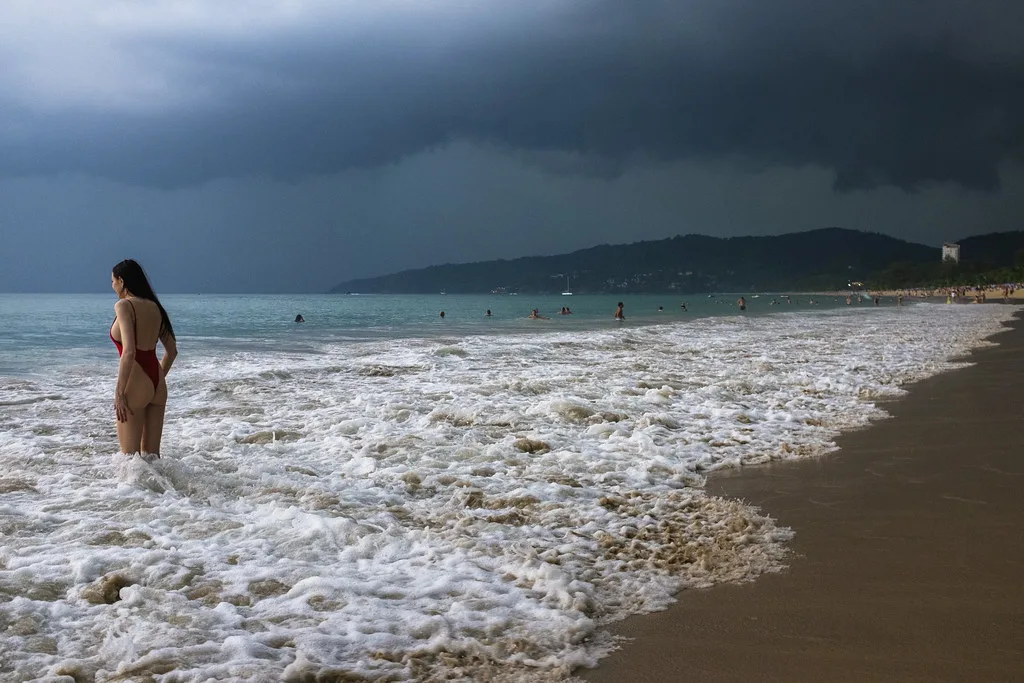
A: Phuket is not in a hurricane zone, but the southwest monsoon May through October brings rough seas. Monsoon winds create rough seas May–October; some islands close entirely during monsoon season. September and October are the months to avoid.
Q: What should I pack for Phuket's weather?
A: Reef-safe sunscreen. Light breathable clothing. Rain jacket for monsoon season. Water shoes for rocky beaches. Insect repellent for jungle excursions.
Q: Will rain ruin my port day in Phuket?
A: Southwest monsoon May through October; dry season November through April. Cruise season concentrates in the dry November–April window.
Q: Is Phuket suitable for passengers with mobility challenges?
A: Accessibility varies by area. The port vicinity and main commercial streets are generally manageable, but older historic districts may feature cobblestones, stairs, and uneven surfaces. Consider booking an accessible ship excursion if you have concerns. The ship's shore excursion desk can advise on specific accessibility options for this port.
Q: Do I need to exchange currency before arriving?
A: The local currency is Thai Baht (cards widely accepted). Most tourist-facing businesses accept major credit cards. ATMs near the port offer competitive exchange rates. Carry some local cash for small purchases, markets, and tips. Avoid exchanging money on the ship — the rates are typically unfavorable compared to local bank ATMs.
Q: Can I explore independently or should I book a ship excursion?
A: Both options work well. Ship excursions guarantee return to the vessel and handle logistics, making them ideal for first-time visitors. Independent exploration costs less and allows more flexibility — just keep track of time and allow a 30-minute buffer before all-aboard. Many passengers combine approaches: an organized morning tour followed by free afternoon exploration.
Last reviewed: February 2026
Phuket: Thailand's Andaman Pearl
Big Buddha (Phra Phutthamingmongkol Akenakkiri)
The forty-five-meter seated Buddha dominates every sight line on Phuket – from Nakkerd Hill, the white Burmese marble figure watches over the island with the patience of stone and the presence of something alive. I arrived in mid-afternoon when the marble tiles caught the sun and seemed to glow from within. Construction began in 2004 and continues still, funded entirely by donations; this remains an active temple where monks chant evening prayers, where local families bring offerings of lotus flowers and incense, where the sacred and the touristic coexist with surprising grace.
The three-hundred-sixty-degree views from the summit justify the winding climb alone. On clear days I could trace the entire southern coast – Patong's crescent beach to the west, Chalong Bay's protected waters to the south, Kata and Karon beaches stretching like golden ribbons, the offshore islands floating in haze. The breeze at this elevation carries the scent of frangipani from the temple grounds rather than the sea salt from below. Morning visits are wisest – the heat builds quickly, and tour buses arrive by ten. The road itself winds through rubber plantations and past viewpoints that beg you to stop.
Respect requires modest dress: shoulders and knees must be covered. Temple volunteers offer free sarongs if you arrive in beach attire, though accepting their fabric feels less dignified than planning ahead. A small market at the base sells cold coconuts, fresh fruit, and souvenirs ranging from tasteful to tacky. Donation boxes throughout the complex support the ongoing construction – if the serenity moves you, as it moved me, contributing feels less like obligation than privilege.
Phuket Old Town
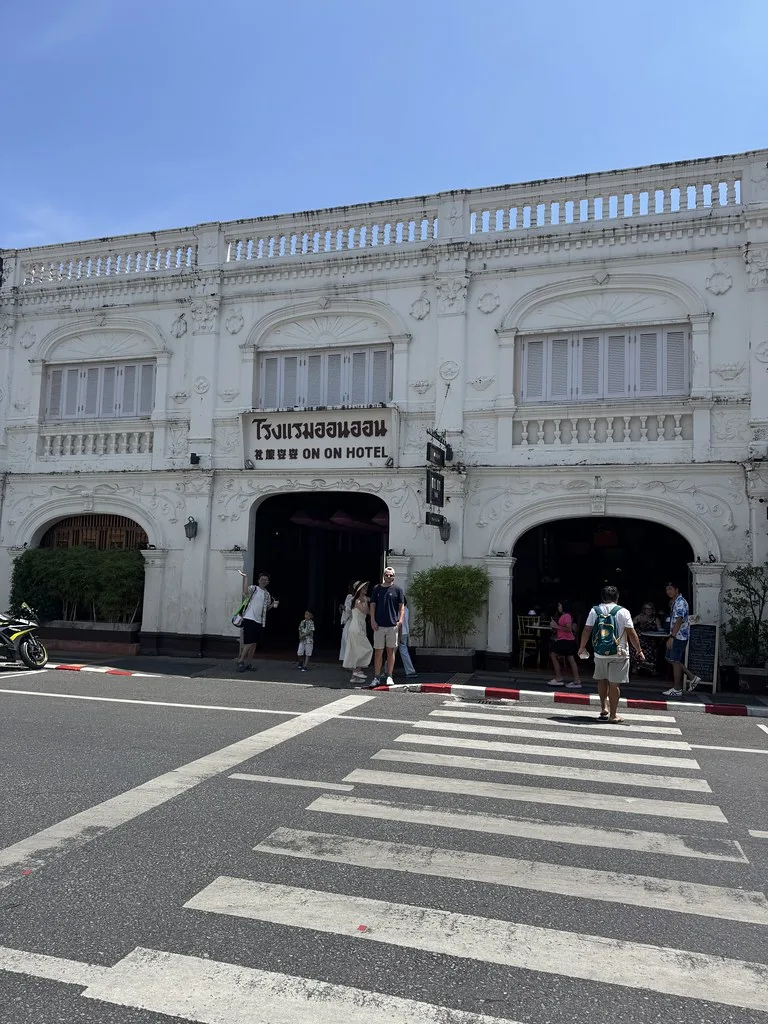
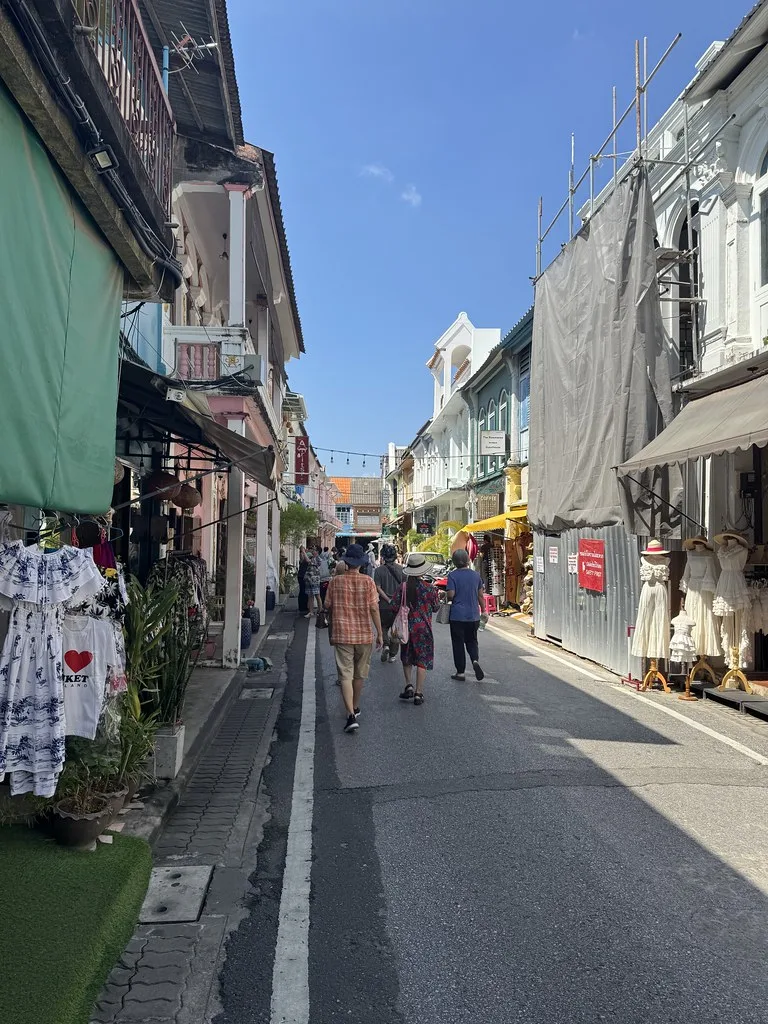
I abandoned the beach for an afternoon and found Phuket's true soul in streets where history hasn't been sanitized for tourists. Old Town's Sino-Portuguese shophouses line narrow lanes in shades that belong on an artist's palette – mint green beside ochre yellow, coral pink beside powder blue, each facade a testament to the Chinese merchants and tin barons who built them more than a century ago. The architecture itself tells the story: Chinese motifs carved into Portuguese-style doorways, Thai spirit houses mounted beside European balconies, the Baba culture made visible in stucco and tile.
Thalang Road, Soi Rommanee, and Dibuk Road form the photogenic heart of Old Town, their shophouses restored to Victorian-era splendor with wrought-iron balconies, wooden shutters that still creak open each morning, and that particular geometry that makes every corner frame-worthy. I lost an hour wandering Soi Rommanee – barely wide enough for two people to pass – where laundry still hangs from upper windows and cats sleep in doorways between art galleries and noodle shops. Chinese shrines send incense smoke curling into the afternoon heat; Thai spirit houses receive daily offerings of flowers and fruit; Portuguese-influenced Catholic churches ring bells on the hour.
The Baba or Peranakan culture – born when Chinese tin miners married local Thai and Malay women – created something neither fully Chinese nor Thai but uniquely Phuket. The Thai Hua Museum explains this hybrid world: language that mixed Hokkien and Thai, clothing that combined Chinese silks with Malay patterns, cuisine where Chinese cooking techniques met Thai ingredients. Walk these streets in early morning when shopkeepers sweep their stoops and the coffee shops fill with locals, and you'll taste it in the kopi thickened with condensed milk, smell it in curry that speaks with a Chinese accent, hear it in conversations that switch between languages mid-sentence.
Local cafes serve Thai coffee strong enough to restart your heart; restaurants offer southern Thai cuisine spicier and more complex than anything modified for tourist palates – the real stuff, with enough chilies to make you weep gratefully. If your ship is in port on Sunday, the Walking Street Market transforms Thalang Road into a food and handicraft fair where I ate things I couldn't name and regretted nothing.
The Cruise Port
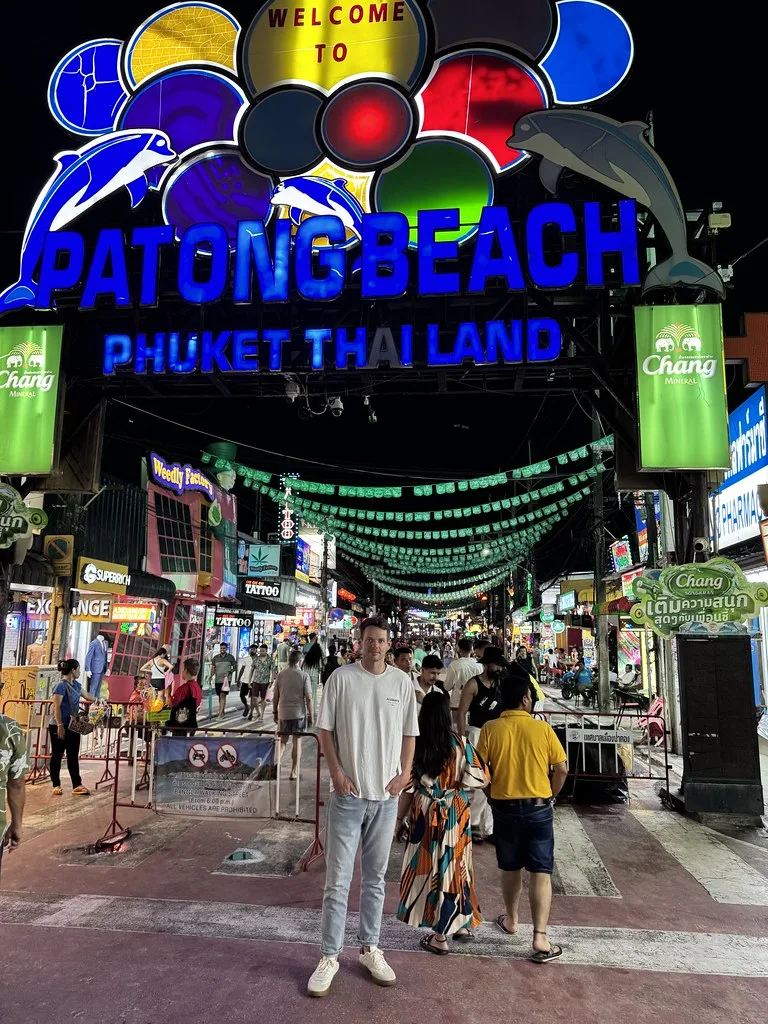
Phuket's cruise arrangements depend entirely on the season and your ship's size. During high season (November through April), when the Andaman Sea lies calm under clear skies, many ships anchor offshore in Patong Bay and tender passengers directly to Patong Beach. The tender ride takes roughly 15 minutes and deposits you at the jetty opposite The Bliss South Beach Patong Hotel — effectively placing you on the island's main tourist beach the moment you step ashore. You are within a 5-minute walk of Bangla Road and the beach, and within 1.5 km of the Jungceylon shopping center. During high-traffic days, tender queues can form; priority boarding is typically given to passengers with pre-booked ship excursions. An alternative tender location at Kalim Beach, on Patong's northern end, is occasionally used depending on sea conditions.
During monsoon season (May through October), ships dock at Phuket Deep Sea Port at Ao Makham, on the island's southeastern coast. The 26-hectare facility has two berths and handles both cargo and cruise operations. A new cruise terminal upgrade was completed in mid-2025, with deep-water berths dredged to 10.5 metres at lowest tide and improved passenger-processing facilities including air-conditioned waiting areas. Despite the improvements, the location is industrial — nothing is within walking distance. From Ao Makham, Old Town Phuket is approximately 10 km away (15–20 minutes by road), and Patong Beach is roughly 22 km away (30–45 minutes depending on traffic). Approved taxi fares from the port are approximately 400 THB to Old Town and 600 THB to Patong Beach, though drivers near cruise ships may ask more.
Major cruise lines calling at Phuket include Royal Caribbean, Celebrity Cruises, Norwegian Cruise Line, Princess Cruises, Holland America Line, MSC Cruises, Costa Cruises, Viking Ocean Cruises, Seabourn, Silversea, Oceania Cruises, and Regent Seven Seas. The port sees substantial traffic from November through April, with ships on Southeast Asian, Indian Ocean, and Australia-region itineraries. A longer-term development program — budgeted at 7.4 billion baht, with a projected opening in 2031 — would significantly expand the terminal's capacity and amenities.
Getting Around
Phuket has no passenger rail system, and the island's spread-out geography means virtually every destination requires motorized transport. Options are plentiful; the complication is that pricing in tourist areas is largely unregulated, and the gap between what you pay and what locals pay can be significant.
Taxis
Metered taxis in Phuket start at approximately 50 THB for the first 2 km, adding roughly 8 THB per additional km. In practice, metered taxis are difficult to find outside airports and designated stands. From the Deep Sea Port (Ao Makham), expect to pay approximately 400–600 THB to Old Town, and 600–800 THB to Patong Beach. If tendering to Patong, short rides within the beach area run 200–400 THB. Always agree on a fare before entering any vehicle that is not running a meter. Taxis in Phuket do not accept credit cards — carry Thai Baht in cash.
Tuk-Tuks
Phuket's tuk-tuks are a festive but expensive option. A ride of even 500 meters can cost 200–300 THB in tourist zones, making them no cheaper than taxis and occasionally more expensive. A longer ride from central Patong to Old Town runs approximately 400–500 THB. Tuk-tuks are best suited to short hops within a single neighborhood. Negotiate firmly and agree on the price before you board. Think of them as an atmospheric novelty rather than a budget transport option.
Grab (Ride-Share App)
Grab is the dominant ride-hailing app in Thailand and the most transparent pricing tool available. Download it before you leave the ship. One important note: Grab drivers are often reluctant or unable to collect passengers directly from port gates or tender jetties, where informal taxi operators maintain an effective monopoly. The workaround is to walk two to three minutes to a nearby hotel driveway or side street and request pickup from there. Grab rides typically cost 20–30% less than negotiated street fares for the same journey and provide a fixed price before you confirm. The Bolt app is a similar alternative also operating in Phuket.
Songthaews (Blue Local Buses)
Songthaews — converted pickup trucks with covered bench seating — run fixed routes between Phuket Town's Ranong Road bus terminal and the main west-coast beaches: Patong, Karon, Kata, and Kamala. Fares are 30–50 THB per person one way. Service runs daily from approximately 6:30 AM to 6:30 PM. They are slow, unair-conditioned, and do not connect beaches directly to each other — to transfer, you must return to Phuket Town first. For cruise passengers arriving at the Deep Sea Port, songthaews are not a practical direct connection, but if you make your way to Phuket Town by taxi (400 THB), they provide inexpensive onward rides to the beaches. Separate pink songthaews serve routes within Old Town for 15 THB and connect to Rassada Pier for island ferries. A free Phuket Dragon Line EV bus launched in 2024 and circles Old Town daily from 10 AM to 10 PM.
Phuket Smart Bus
An air-conditioned Phuket Smart Bus runs along the west coast connecting the airport south through Patong, Karon, Kata, and Rawai. Fares range from 50–170 THB depending on distance. It is more comfortable than a songthaew but does not serve the Deep Sea Port directly and operates on infrequent schedules.
Walking
Walking is viable only within compact areas. Old Town's historic core covers roughly 1 km end-to-end and is entirely walkable once you arrive by taxi. If tendering to Patong, the beach and most Patong facilities are walkable from the jetty. Between neighborhoods, or from the Deep Sea Port to anything, walking is not a realistic option given distances and the absence of pavements on most roads.
Currency and Cash Tips
The currency is the Thai Baht (THB). Approximately 35–36 THB equals 1 USD. ATMs are widely available in Patong and Old Town but charge foreign card fees of 200–220 THB per withdrawal. Bank ATMs offer better exchange rates than currency kiosks in tourist areas; your ship's exchange desk offers the least favorable rate. Carry enough baht for transport, entry fees, and market purchases before heading out. Most formal shops and larger restaurants accept Visa and Mastercard; street food vendors, tuk-tuks, market stalls, and songthaews are cash only. US dollars are not widely accepted as direct payment.
Port Map
Tap markers to explore Phuket's highlights
Top Excursions & Attractions
Phuket rewards both independent explorers and passengers who prefer the security of a ship excursion. Given the island's size and traffic, time management is the most critical variable: a day that tries to do everything will accomplish nothing satisfactorily. Choose one or two priorities, plan your transport in advance, and build a 90-minute buffer before all-aboard. Below are the top experiences for a single port day.
Phang Nga Bay and James Bond Island (Khao Phing Kan)
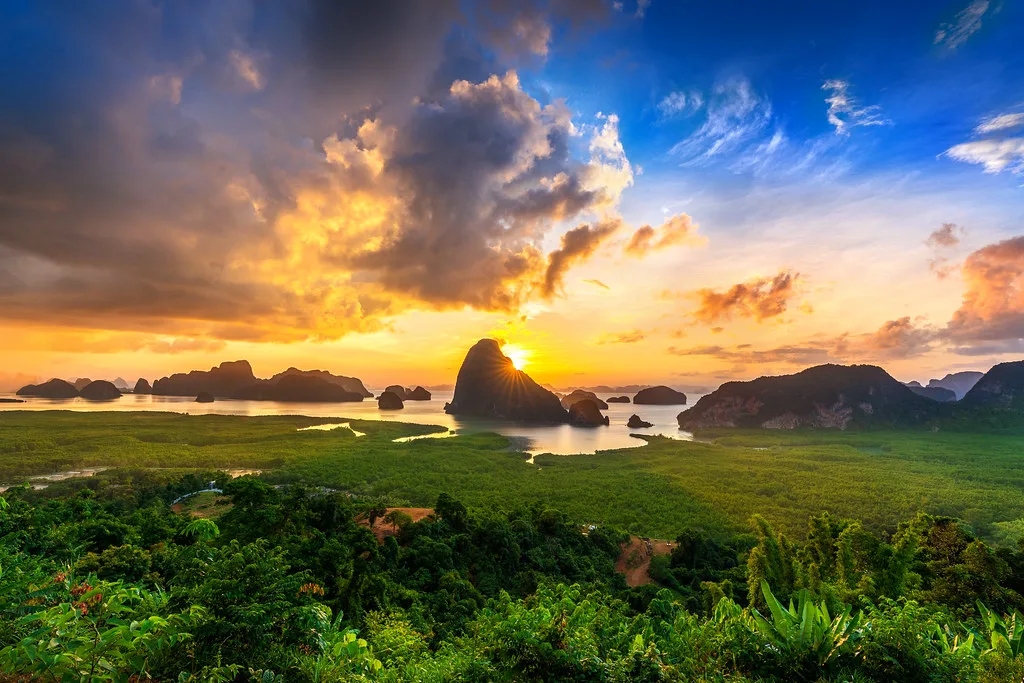
This is the single most spectacular excursion available from Phuket. Phang Nga Bay, approximately 25 km northeast of the island, is a protected marine park where hundreds of limestone karst formations rise vertically from calm green water. Khao Phing Kan — universally known as James Bond Island after its appearance in The Man with the Golden Gun (1974) — features the iconic needle-shaped Ko Tapu rock rising 20 metres from the sea. Most tours combine the bay with sea kayaking through mangrove caves and flooded chambers inaccessible to larger boats.
Group speedboat tours start at approximately 1,500–1,900 THB per person (~$42–53 USD), with premium half-day tours including sea canoeing running 2,200–2,500 THB. Big-boat (large cruise vessel) group tours cost around 1,200–1,400 THB. Private longtail boat charters run 8,000–10,000 THB for a small group. The national park entry fee is 300 THB per adult (~$8.50) — confirm whether this is included before booking. Full-day tours depart by 8 AM and return around 4–5 PM. Several operators offer cruise-passenger-specific versions with Ao Makham port pickup included, making this a strong candidate for a ship excursion if your port time is limited.
Phi Phi Islands (Ko Phi Phi)
The Phi Phi archipelago lies approximately 45 km southeast of Phuket and offers exceptional snorkeling, towering limestone cliffs, and water that photographs as impossibly blue. Maya Bay on Ko Phi Phi Leh, filmed as the location in The Beach (2000), reopened after ecological rehabilitation in 2022 and now operates with strict daily visitor limits. A standard group speedboat day trip costs 1,500–2,200 THB per adult (~$42–62 USD) and typically includes hotel transfer, buffet lunch, snorkeling equipment, and the national park entry fee (400 THB per adult, 200 THB per child — confirm whether included). Early-morning departures at 6:00–7:00 AM avoid peak crowds and cost approximately 2,200 THB. The speedboat journey takes 45–60 minutes each way; full-day tours run approximately 10–12 hours. Independent travel via Rassada Pier in Phuket Town is possible (scheduled speedboats at 850–950 THB one way), but the combined logistics make this tight for a cruise port day. Book only operators who explicitly offer cruise-specific return guarantees.
Big Buddha (Phra Phutthamingmongkol Akenakkiri)
The 45-metre Burmese marble Buddha on Nakkerd Hill is Phuket's most visible landmark. Entry is free; modest dress (covered shoulders and knees) is required — sarongs are provided at the gate. A taxi from the Deep Sea Port takes approximately 30 minutes and costs around 400–500 THB. Half-day city tour packages combining the Big Buddha, Wat Chalong, and Old Town are available from approximately 1,500–2,690 THB per person (~$42–75 USD) and last 5–6 hours. Note: as of late 2024, a partial closure related to a landslide affected access — verify current status with your operator before booking. On clear days the summit offers 360-degree views across the southern coast.
Wat Chalong
Phuket's largest Buddhist temple complex sits in the Chalong district, roughly 8 km south of Old Town. The temple honors two 19th-century abbots revered for leading local resistance during the Angsee Rebellion. Entry is free. The gilded main chedi is said to house a fragment of the Buddha's bone. Modest dress is required. Wat Chalong is typically combined with the Big Buddha in half-day city tours — the two sites are approximately 6 km apart. A taxi from Ao Makham runs approximately 400–500 THB and takes 20 minutes. The main paved paths are accessible to visitors with walking difficulties.
Old Phuket Town
Phuket's historic center offers the most culturally rich and independently manageable experience on the island for a cruise day. The Sino-Portuguese shophouses of Thalang Road, Dibuk Road, and Soi Rommanee date to the 19th-century tin-mining era and are well-preserved. The area is compact — approximately 1 km of main streets covers the key architecture, Chinese shrines, the Thai Hua Museum (admission around 200 THB), and independent cafes and food stalls. A taxi from Ao Makham takes 15–20 minutes and costs approximately 400 THB. From a Patong tender landing, a Grab ride to Old Town costs around 400–500 THB and takes 20–30 minutes. Street food from busy local stalls runs 60–120 THB per dish. On Sundays, the Walking Street Market on Thalang Road draws locals and visitors alike. Old Town is an excellent candidate for a well-organized DIY half-day.
Ethical Elephant Sanctuaries
Several ethical elephant sanctuaries operate on Phuket, offering observation and limited-interaction experiences with rescued former working elephants — no riding, no performing, no chains. The Phuket Elephant Sanctuary (the island's first ethical sanctuary) offers a 3.5-hour morning program on 30 acres of jungle bordering Khao Prae Teao National Park. The Green Elephant Sanctuary Park lists half-day programs from approximately 2,400 THB per person (~$67 USD), including transport from Phuket hotels. The Elephant Jungle Sanctuary lists programs from around 1,500–2,000 THB with hotel transport included. Cruise port transport supplements typically run 500–800 THB per group. Book at least 12 hours in advance — programs fill quickly. Confirm that your chosen sanctuary has a clear no-riding policy and transparent rescue program before committing.
Beaches: Patong, Kata, and Karon
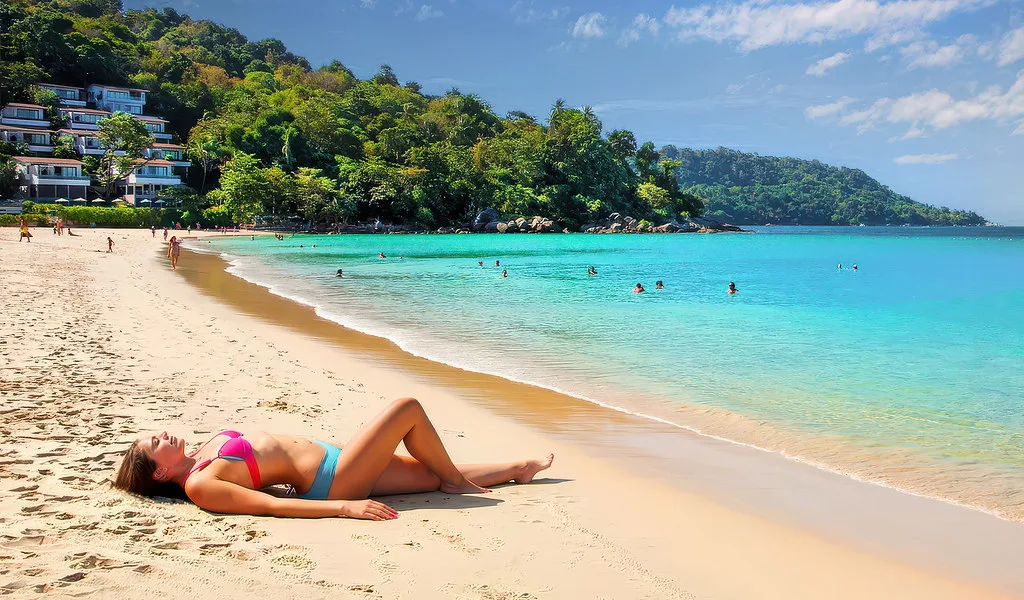
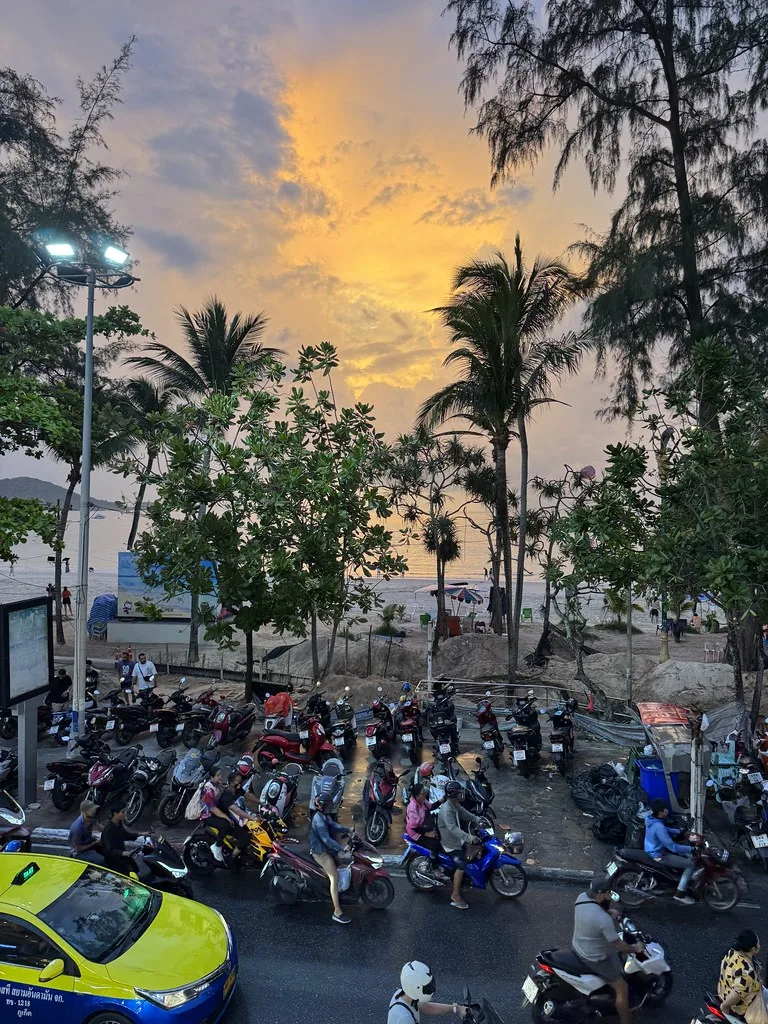
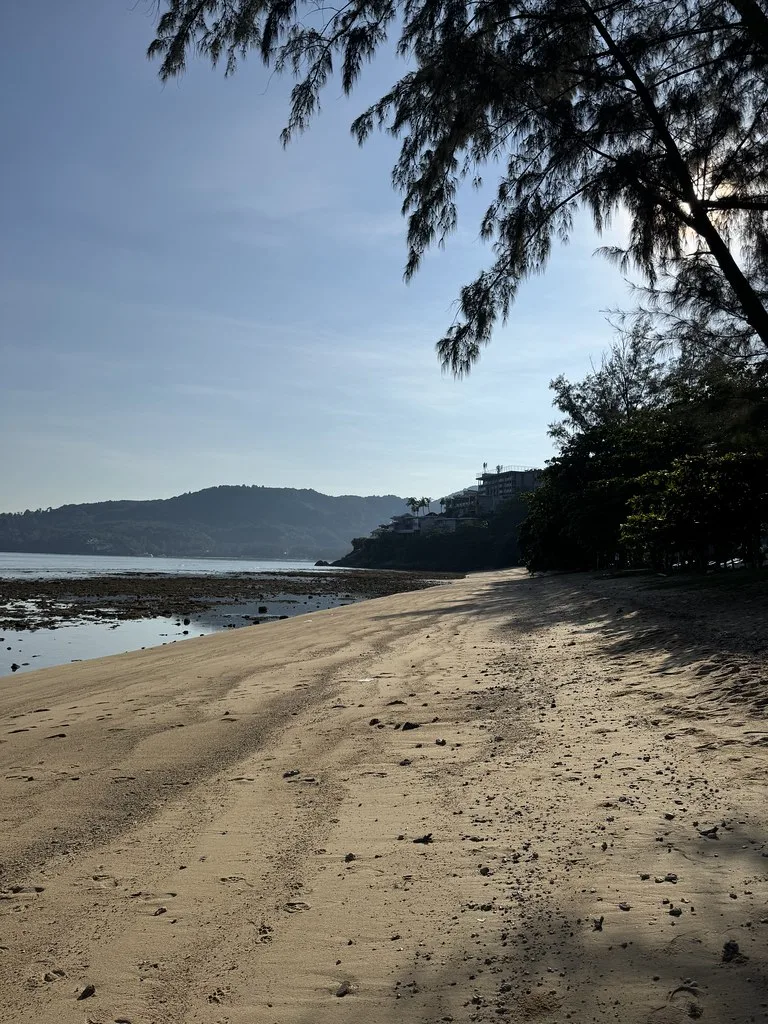
If your ship tenders to Patong Bay during high season, the beach is immediately accessible from the jetty. Patong Beach is Phuket's most developed and energetic stretch: water sports rentals, beachside restaurants, and a lively atmosphere. For calmer alternatives, Kata Beach (approximately 17 km south of Patong) and Karon Beach (12 km south of Patong) offer longer, less-crowded sand with excellent swimming from November through April. A taxi between Patong and Kata or Karon costs approximately 400 THB. From the Deep Sea Port, reaching any west-coast beach takes 30–45 minutes and costs 600–800 THB by taxi.
Ship Excursion vs. Independent Booking
For Phang Nga Bay and Phi Phi Islands, booking through your cruise line provides the most valuable benefit Phuket can offer: a guaranteed return to the ship. Phuket traffic is genuinely unpredictable, tender queues at Patong can extend significantly in peak season, and the multi-step logistics of island excursions combined with port transit make a missed ship a real possibility for overconfident independent planners. Ship excursion pricing typically runs 30–50% higher than comparable independent operators, so the premium buys certainty rather than quality.
For Old Town, Big Buddha with Wat Chalong, or beach days, independent travel is practical and cost-effective. Use Grab for transparent pricing, negotiate all non-metered fares before departure, and build a genuine 90-minute buffer before your all-aboard time. For island day trips, well-reviewed third-party operators (GetYourGuide, Klook, Viator, or direct local bookings) typically save 1,000–2,000 THB per person compared to ship pricing — but verify that the operator offers an explicit guarantee to return you to your specific port before departure, and book well ahead during November–April peak season when top tours sell out days before the ship arrives.
Frequently Asked Questions
Where do cruise ships dock in Phuket?
It depends on season. During high season (November-April), many ships anchor and tender passengers directly to Patong Beach. During monsoon season (May-October), ships dock at Phuket Deep Sea Port at Ao Makham – about 45 minutes to an hour from Patong, 20-30 minutes to Old Town. Taxis and shuttle buses available at the port.
Is Phuket safe for tourists?
Generally yes – tourist areas are well-policed. Use common sense: don't accept drinks from strangers, use metered taxis or the Grab app, and be extremely cautious with motorbike rentals as accidents are distressingly common even on short rides.
What's the best way to get around?
From the Deep Sea Port, taxis (negotiate fare first or use Grab app), organized tours, or rental cars with driver work best. Tuk-tuks are fine for short distances in town. Public transport is limited. Motorbike rental is popular but risky for inexperienced riders – tropical roads and unfamiliar traffic patterns produce unfortunate statistics.
Can I do Phang Nga Bay in a port day?
Challenging but possible if your ship is in port ten-plus hours and docks early. Full-day tours depart by 8 AM and return around 5 PM. Factor in transport time from Deep Sea Port. Check timing carefully – missing your ship because you underestimated logistics would be a very expensive error with memorable consequences.
What is the dress code for the Big Buddha?
Modest dress required – shoulders and knees must be covered. Temple volunteers offer free sarongs if needed, but bringing appropriate clothing avoids the borrowing ritual. It's an active temple, not just a tourist site; dress respectfully.