Takoradi is a working cargo port in Ghana's Western Region, and the good news comes first: you tie up alongside. The General Multipurpose Berths carry eight to eleven and a half metres, and Holland America's 285-metre Zuiderdam berthed here in March 2023 with 2,272 passengers aboard. After Belém and Lüderitz, arriving by gangway rather than by launch is a genuine gift.
The difficulty is everything after that. The reason this port is on a world cruise is 81 kilometres east, and reaching it costs two and a half hours of driving before you have stood anywhere. What is at the end of the road is Cape Coast Castle and Elmina Castle — the dungeons, the condemned cell, the Door of No Return — and they do not belong in a morning between other things. This is the one call on the voyage where the right plan may be to spend five hours in a vehicle for reasons that have nothing to do with enjoyment.
Last reviewed: 31 July 2026
Weather & Best Time to Visit
Captain's Logbook
An honest note before I begin: I have not stood in the male dungeon at Cape Coast. What follows is read from the record — from UNESCO's inscription file, from the Ghana Museums and Monuments Board's own fee schedule, from the Ghana Ports and Harbours Authority, from Weather Spark. Soundings taken in another's wake. This is a port where that distance matters more than usual, and I would rather say so at the top than write my way round it.
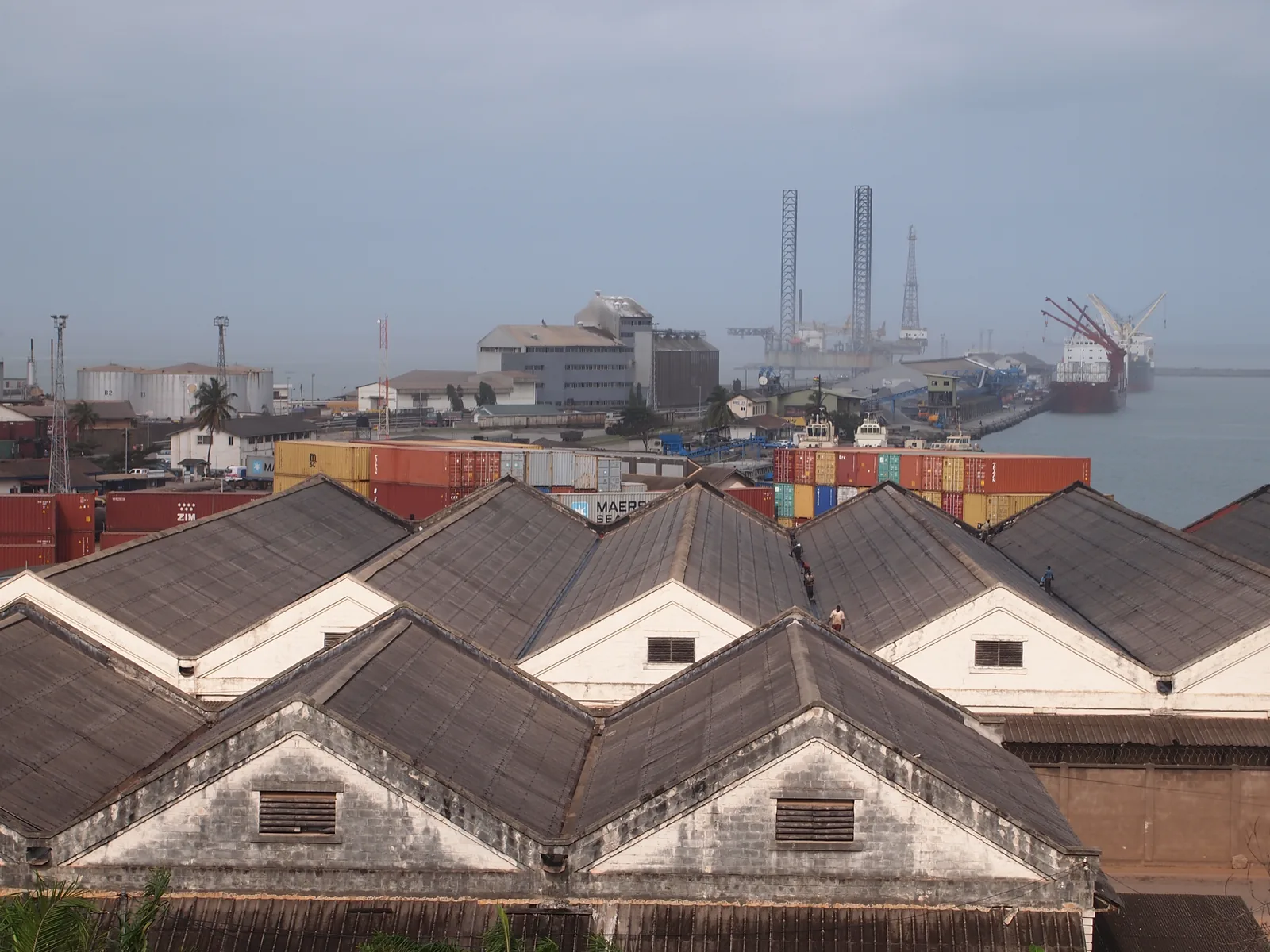
The berth first, because it is the one easy thing. Takoradi is a docked call. Cruise ships use the General Multipurpose Berths inside the commercial harbour, which carry eight to eleven and a half metres, and the precedent is direct: on 25 March 2023 the 285-metre Zuiderdam berthed here with 2,272 passengers aboard, one of three cruise ships totalling 3,790 passengers in a single month. A 237-metre ship drawing 8.1 has no problem at all.
Takoradi Harbour. A working cargo port with 8 to 11.5 metres alongside and no passenger terminal — you berth, and then the day is a decision about one road. Photo: Banku, CC BY-SA 3.0 via Wikimedia Commons
What Takoradi does not have is a passenger terminal. You berth at a general-purpose quay alongside cargo working, in a harbour operated since April 2023 by a Turkish-Ghanaian joint venture. And here is the thing I could not settle, which I want to flag rather than paper over: whether a passenger may simply walk out of the gate. No source I could reach addresses it. That would be a pedantic question anywhere else — but Abidjan, a few days later on this same leg, berths you inside a closed customs enclosure where port regulation requires a pass from the Port Commander for any person or vehicle, and nobody walks out. Ask the line in writing. It costs nothing a year ahead.
Now the reason the port is on the itinerary at all, which is 81 kilometres east. Cape Coast Castle and Elmina Castle. The road takes about an hour and a quarter each way in free-flowing traffic, Elmina is a further fifteen minutes from Cape Coast, and the two together are a full day. Two and a half hours of driving before you have stood anywhere at all.
Before anything else about them, a correction that changes how the whole coast reads. These are not two World Heritage Sites. They are two components of one. The 1979 inscription is called Forts and Castles, Volta, Greater Accra, Central and Western Regions, it was listed under criterion (vi), and it covers three castles and fifteen forts — the remains of fortified trading posts built between 1482 and 1786 along roughly five hundred kilometres of coast between Keta and Beyin. The property is the chain. That is the point of it.
And that correction has a practical edge I did not expect to find. If the inscription is the chain rather than the pair, then there is a component of the same World Heritage property twenty kilometres from where the ship ties up: Fort San Sebastian at Shama, Portuguese, from the 1520s — sources give 1523 and 1526 — and one of the oldest European forts in sub-Saharan Africa. There is another at Sekondi next door, Fort Orange, Dutch from 1642. There is a third at Dixcove out past Busua. Every mainstream description of this port treats the 81-kilometre run as the only option, and it is not.
Fort San Sebastian at Shama, 20 km from the berth — Portuguese, from the 1520s, and a component of the same 1979 World Heritage inscription as Cape Coast and Elmina. Photo: Esthee2010, CC BY-SA 4.0 via Wikimedia Commons
Elmina is the older and the more astonishing of the two famous ones. Founded by the Portuguese in 1482 as São Jorge da Mina — the first European trading post on the Gulf of Guinea and the oldest European building still standing anywhere south of the Sahara. The Dutch took it in 1637 and rebuilt it between 1770 and 1775. Cape Coast is younger: built by the Swedes in 1653 as Carolusburg, changing hands repeatedly before the British held it from 1664.
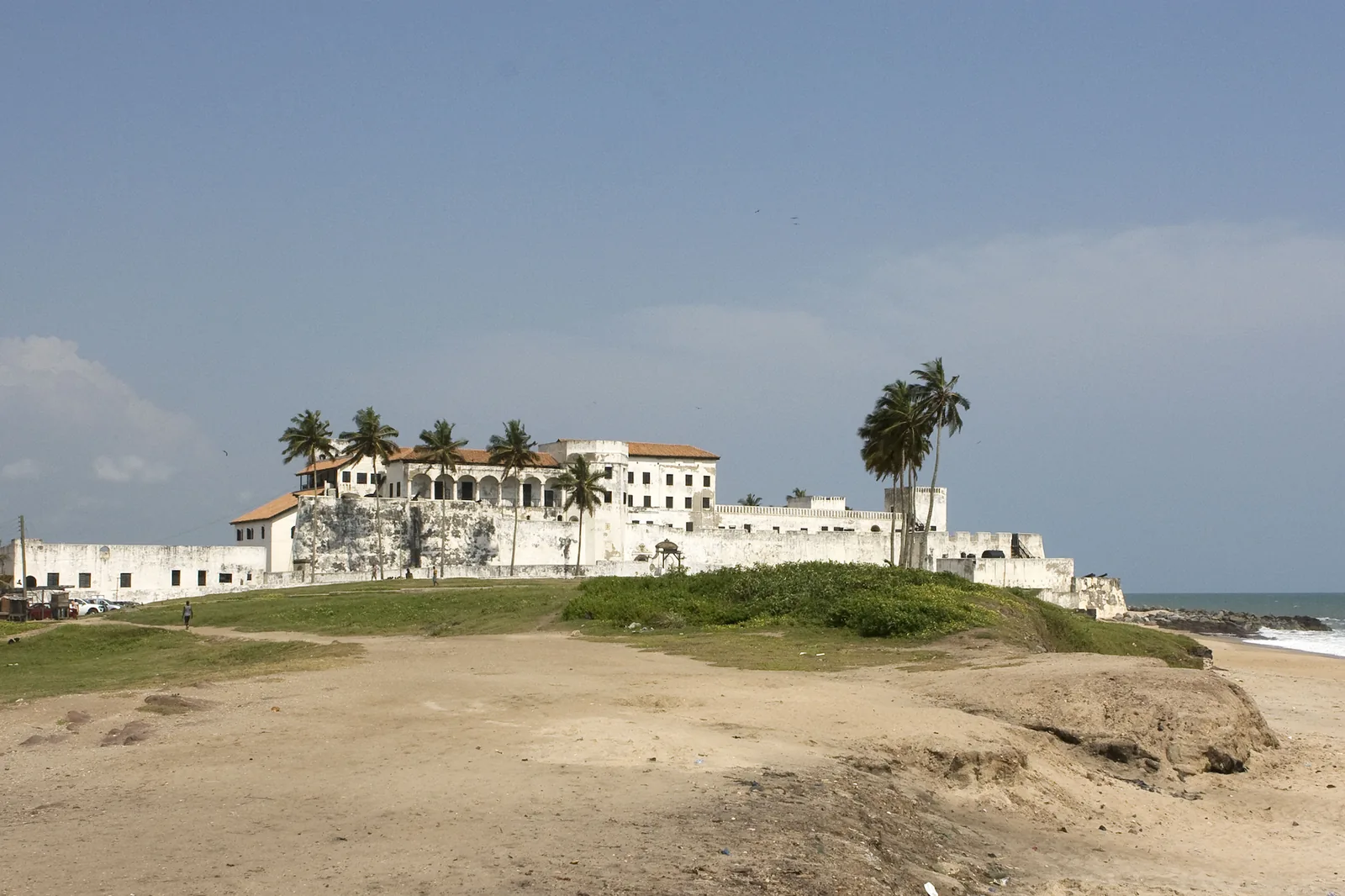
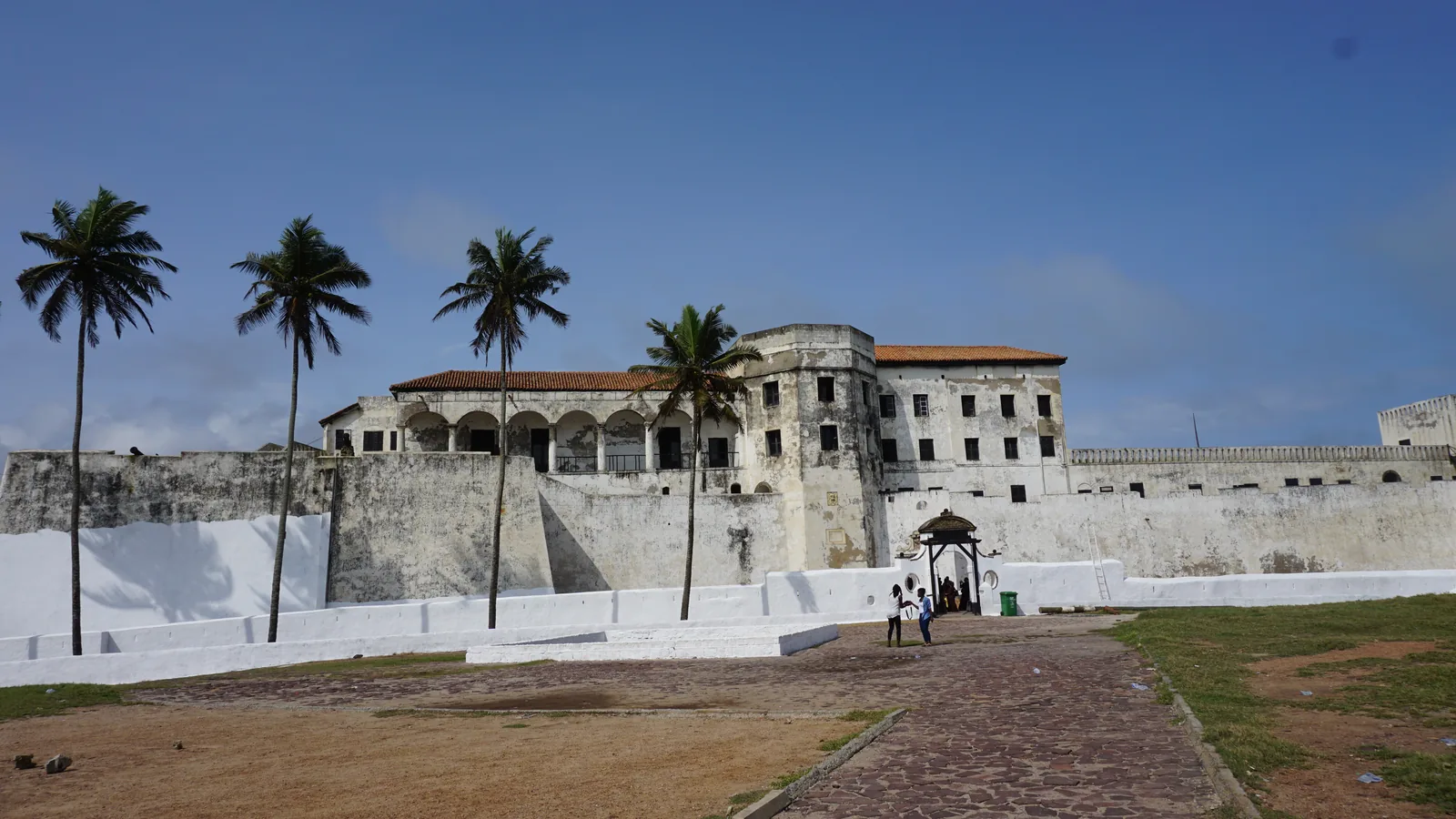
Elmina — São Jorge da Mina, founded by the Portuguese in 1482. The oldest European building still standing anywhere south of the Sahara. Photo: Damien Halleux Radermecker, CC BY-SA 2.0 via Wikimedia Commons
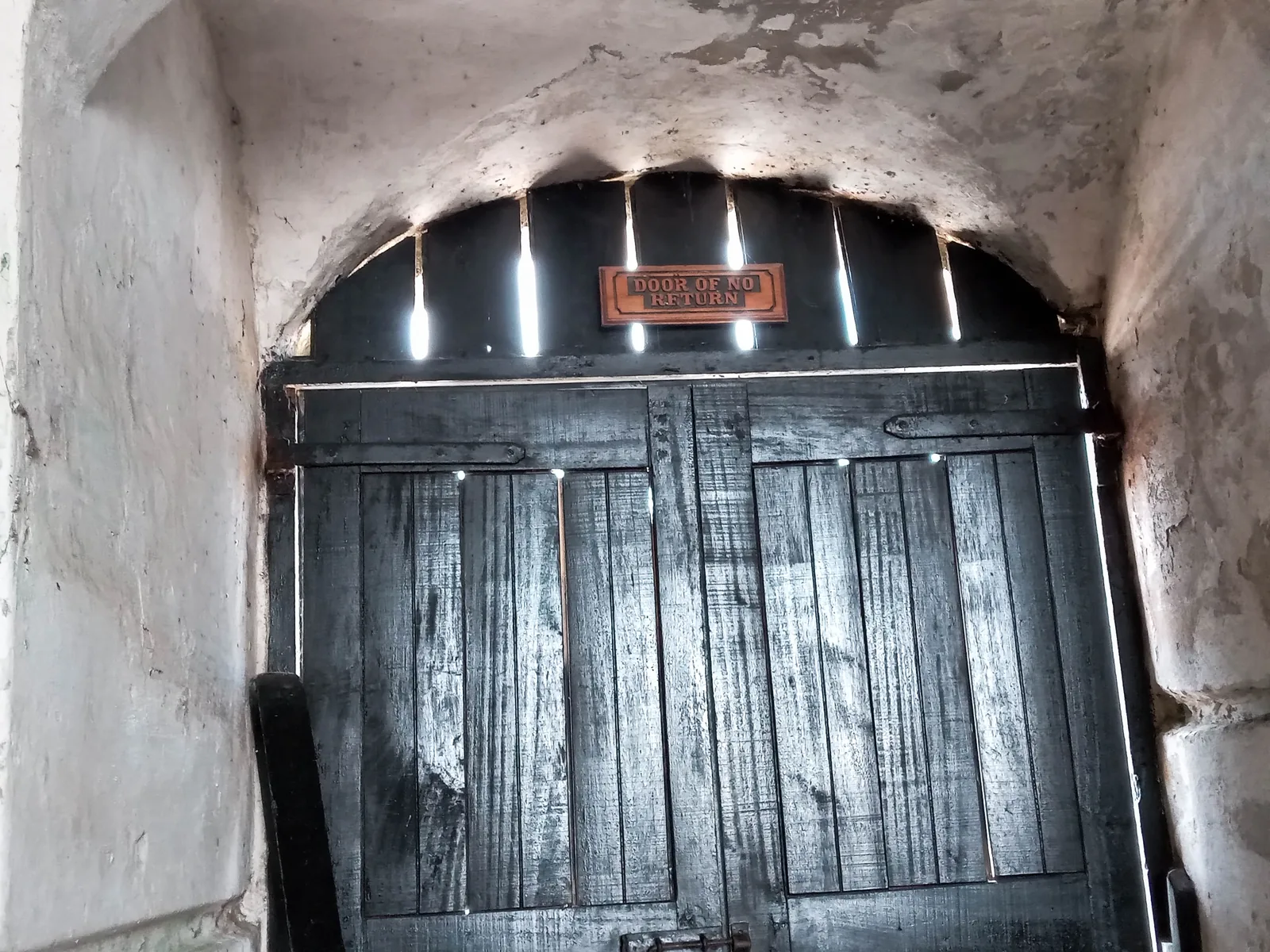
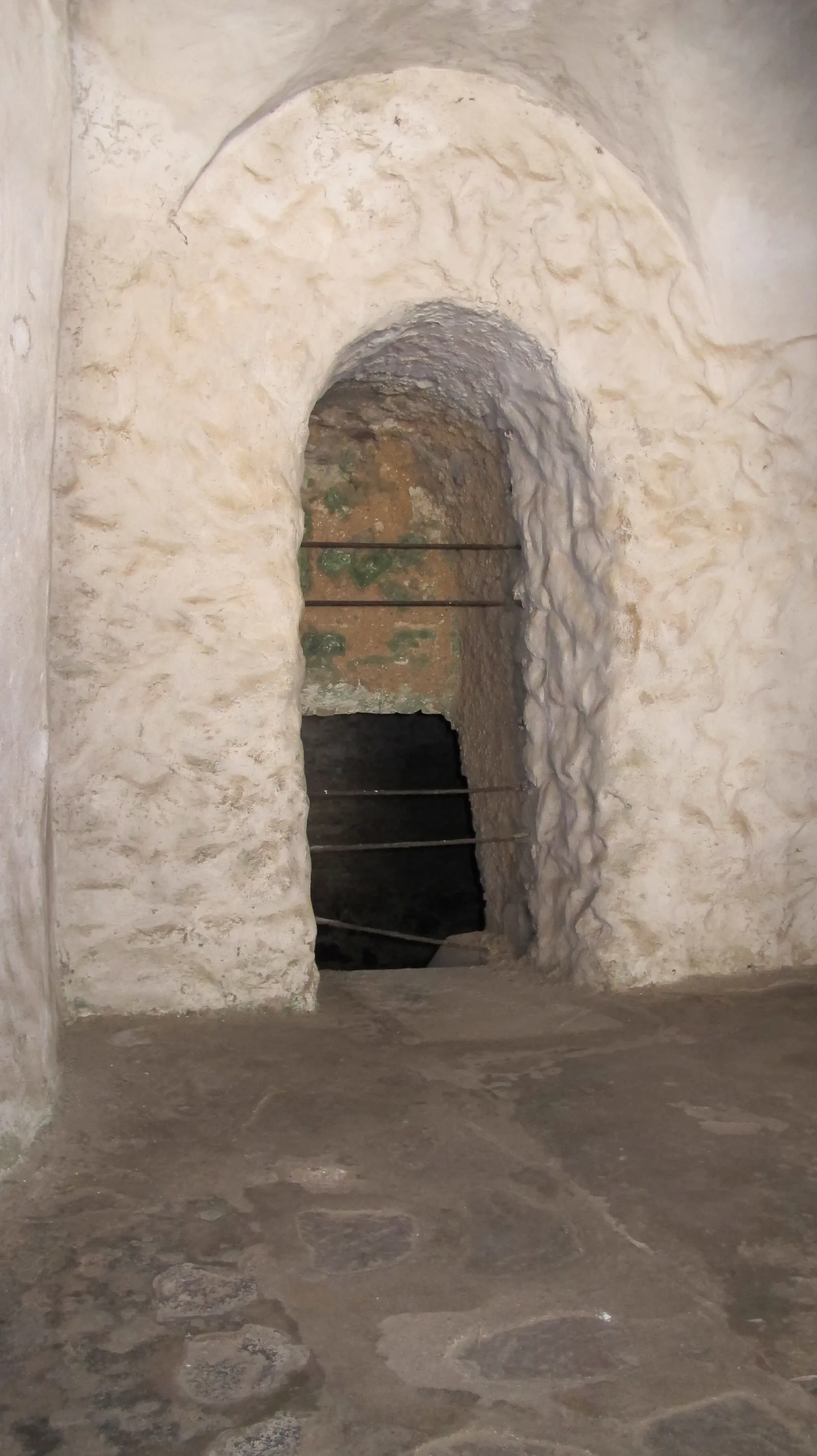
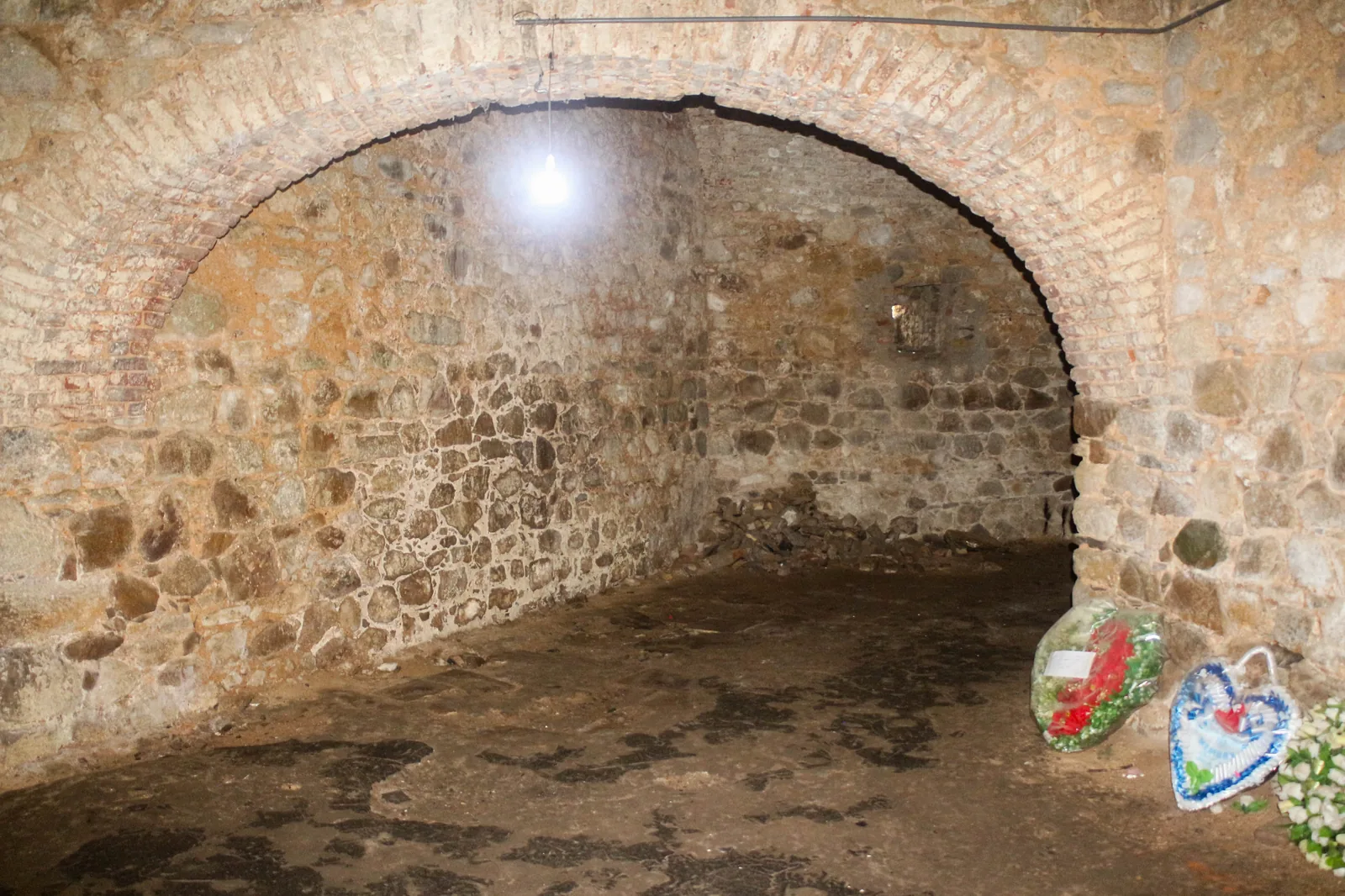
Those dates are the ordinary kind of fact and they are not what the buildings are. What they are is the dungeons — the male dungeon and the female dungeon, the condemned cell at Elmina where captives who resisted were left to die, and the low doorway at the end of the passage that both sites call the Door of No Return. Millions of people went out through those gates onto the water this ship is floating on. I stopped writing for a while at the condemned cell: it is not a punishment block or a prison, it is a small room built for the specific purpose of a door not being opened again, and it is still standing. The page wanted a moment of silence there and so, it turned out, did I. What I am not going to do is describe standing in it, because I have not, and this is the last place on earth to borrow someone else's experience and pass it off as mine.
The Door of No Return at Cape Coast Castle. I have not stood here, and this is the last place on earth to borrow someone else's account of it. Photo: Antorsu10, CC BY-SA 4.0 via Wikimedia Commons
What I can say from the record is the shape of the visit. Entry for a non-Ghanaian adult is GH₵80 under the Ghana Museums and Monuments Board's own published schedule; hours are widely given as 09:00 to 17:00, though the board publishes fees without publishing hours. Both castles are guided. And the pack this page belongs to already says the right thing about how to do it: budget the whole day and go quiet rather than pairing them with anything else. I would not improve on that.
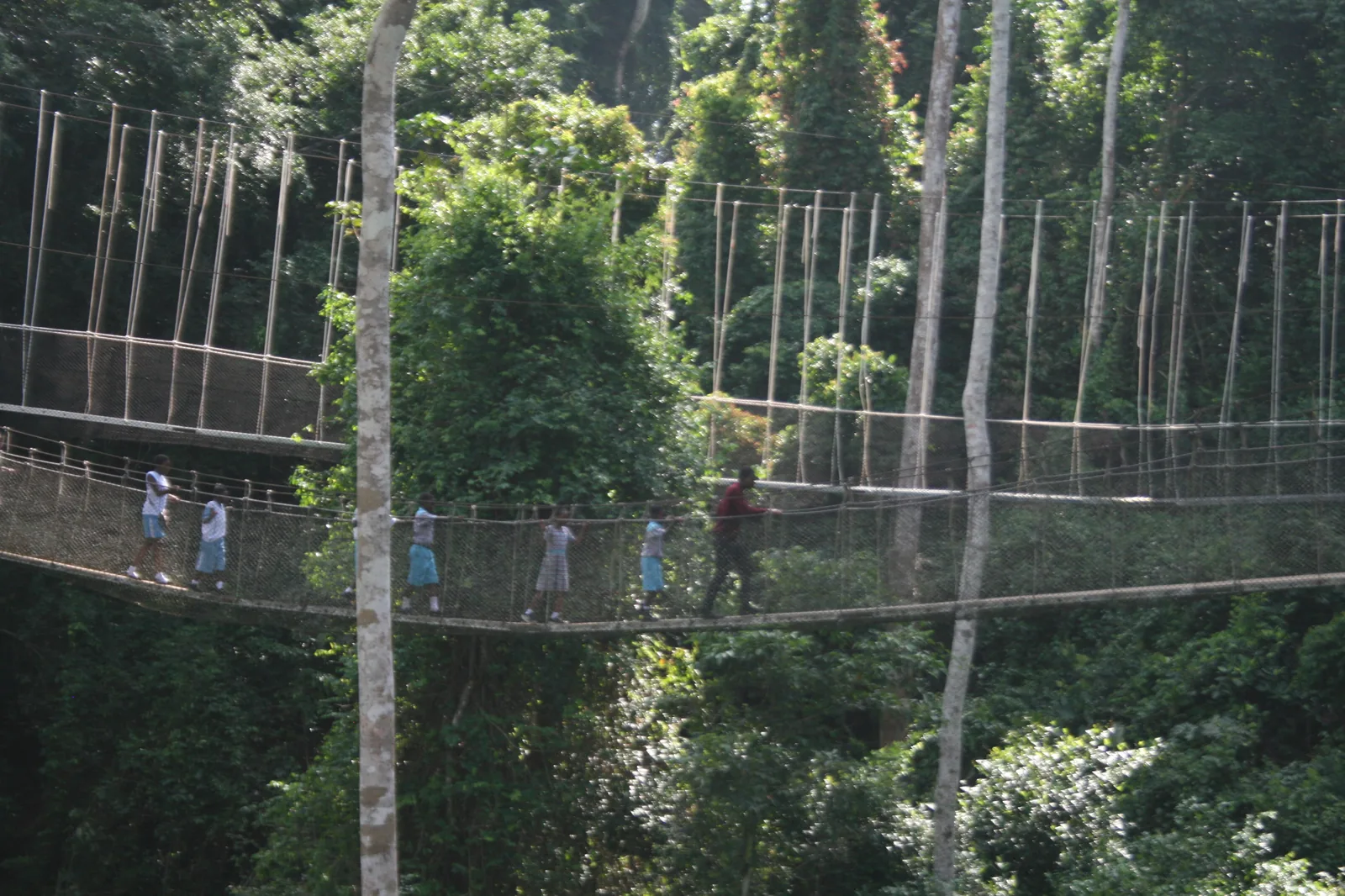
Which means saying plainly what does not fit. Kakum National Park is thirty kilometres beyond Cape Coast — its canopy walkway is seven suspension bridges across 350 metres, reached by a twenty-minute uphill walk, GH₵130 for a foreign visitor, open daily from six. It is a fine thing. Adding it to the castles makes about two hundred and twenty kilometres of driving in a day. Excursions selling both exist; ask hard about the timing before you buy one.
One health item, and it is a documentation trap rather than a medical one. Ghana requires yellow fever vaccination of everyone aged nine months and over — you are carrying that certificate anyway for Abidjan. But Ghana's own consular documentation still defines a valid certificate as one where vaccination is "not more than ten years" old, language written before the 2016 amendment to the International Health Regulations made every ICVP certificate valid for the life of the holder. Carry the card. Do not buy a booster you do not need because a form has not been updated.
The weather is the same story as Abidjan and worth setting expectations plainly. Takoradi is tropical monsoon: highs of 27 to 31 °C every month, lows of 23 to 26, and humidity that Weather Spark records as 100 per cent "muggy" days in every month except January. A world-cruise call falls in late April or early May, on the ramp into a wet season that peaks in June — April averages 117 mm across 17.5 wet days, May 211 mm across 23. But it is the heat rather than the rain that will shape the day, exactly as at Abidjan, and this time with five hours in a vehicle folded into it. Take more water than seems reasonable, and treat the air-conditioning in the coach as part of the plan rather than an incidental.
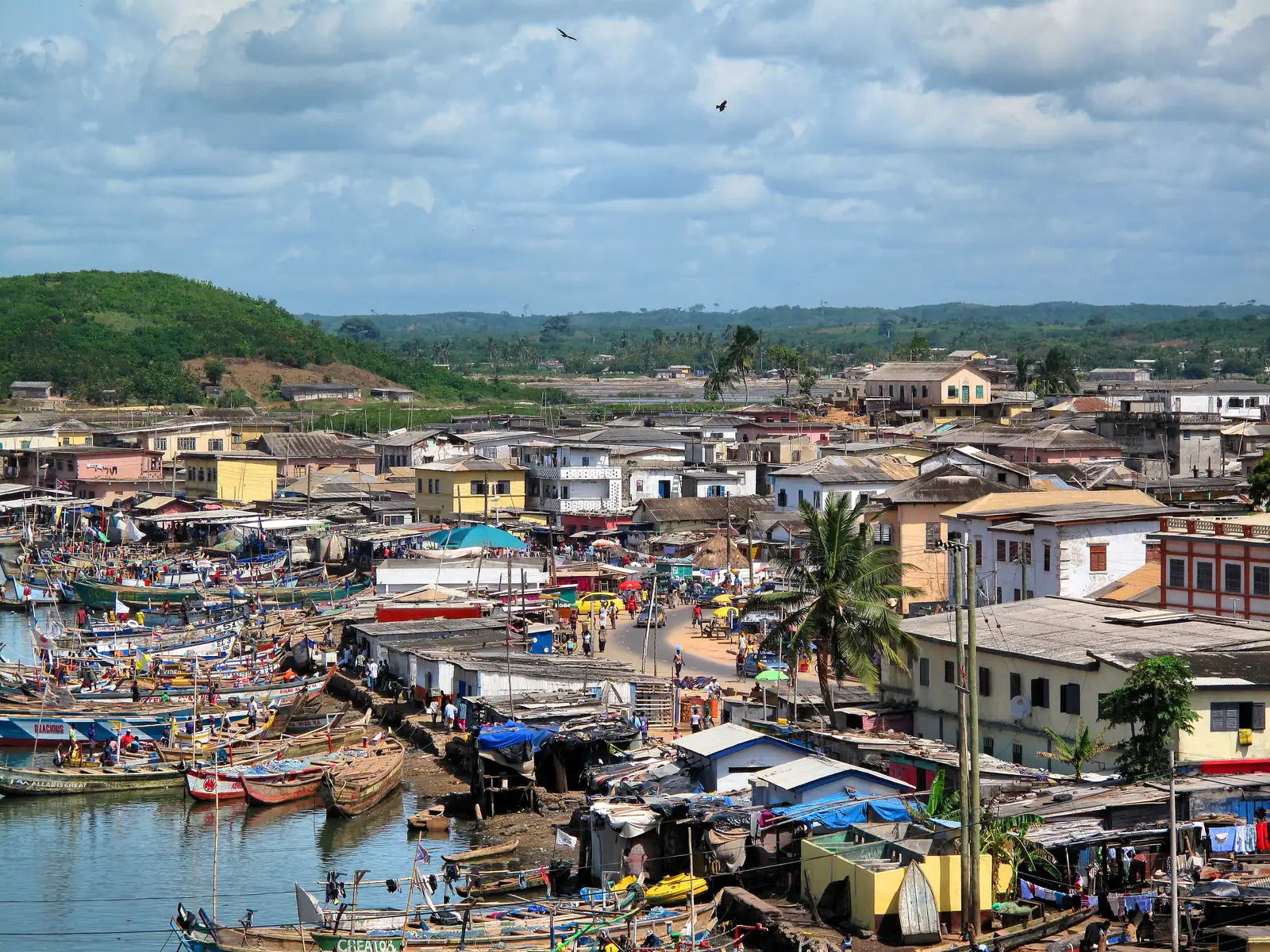
The fishing wharves at Elmina, below the castle. The town has been working this water since before the fort was built. Photo: Francisco Anzola, CC BY 2.0 via Wikimedia Commons
Two smaller things that make Takoradi easier than its neighbours. English is the official language, which is a real practical difference from Abidjan a few days later. And the currency is the cedi in a notably cash-friendly economy — the ship's own guidance about card-and-small-notes on this leg is right.
What I learned putting this page together is that the standard description of this port has quietly cost people something. Every guide frames Takoradi as a berth with a famous excursion 81 kilometres away, and a passenger who cannot face three hours in a vehicle concludes there is nothing here. That is not true. There is a component of the same World Heritage Site twenty kilometres east, and a second one in the next town, and a third out along the coast — because the inscription was never about two buildings. Reading the listing properly turned a port with one option into a port with three, and it took ten minutes. I would rather a page did that work than repeat what everybody already says.
Cruise Port Guide
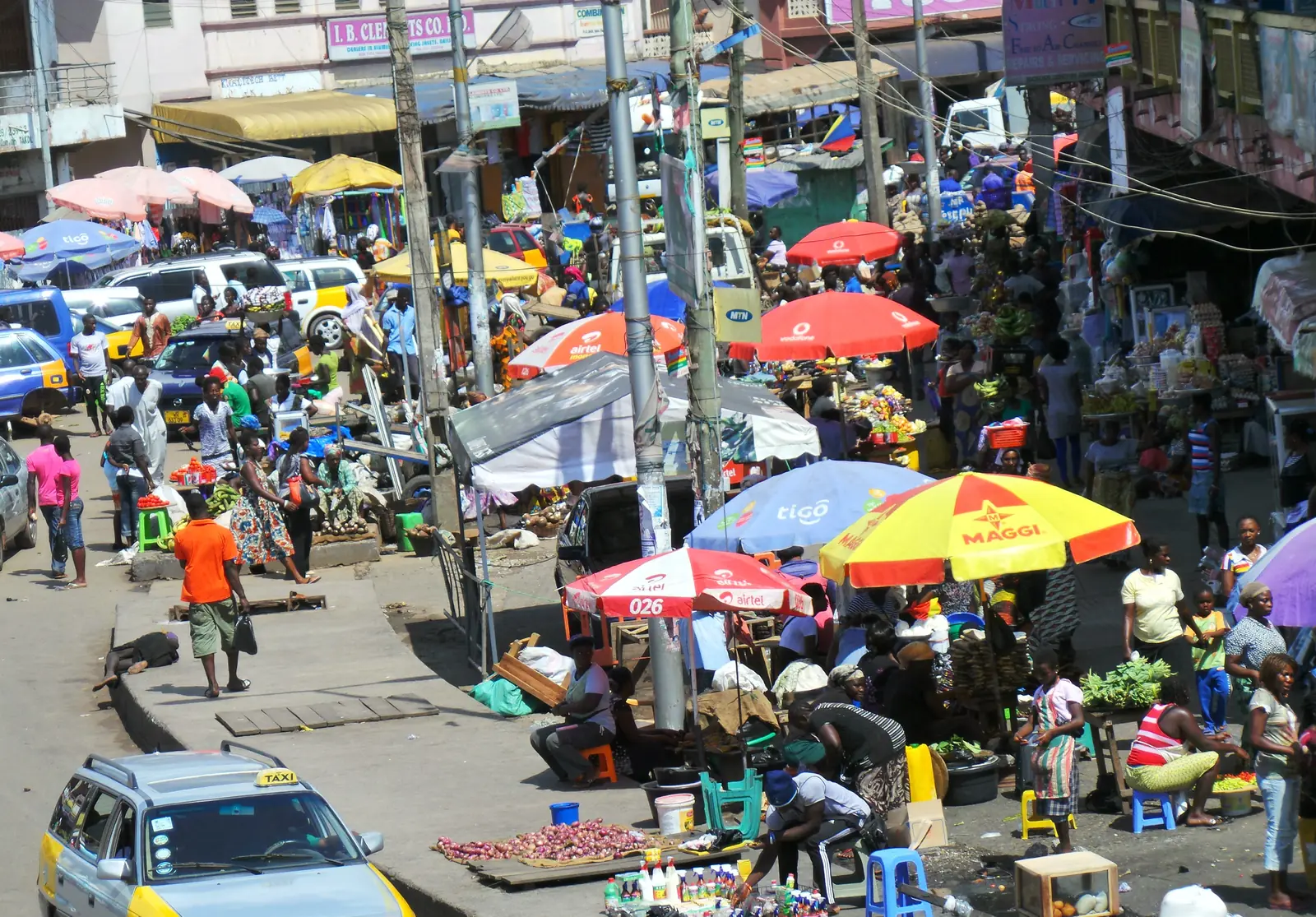
Market Circle, about 1.5 km from the harbour gate — Takoradi's own landmark, and the nearest thing to a walk-off attraction if the gate allows it. Photo: Kghansah1, CC BY-SA 4.0 via Wikimedia Commons
This is a berthed call, and the numbers are comfortable. Cruise ships use the General Multipurpose Berths (1–6) inside Takoradi's commercial harbour, with 8 to 11.5 m alongside. Holland America's 285-metre Zuiderdam berthed here on 25 March 2023 with 2,272 passengers — one of three cruise calls totalling 3,790 passengers inside a month.
There is no passenger terminal. You are alongside a working cargo quay in a harbour operated since April 2023 by YILPORT Takoradi Port Management Company, a joint venture of YILPORT Holding and Ibis Tek, whose plans include dredging to a maximum draft of 16.5 m.
The open question is whether you may walk out. No published source addresses it, and it is not a hypothetical concern on this leg — at Abidjan, a few days later, the berth sits inside a closed customs enclosure and port regulation requires a pass from the Port Commander for any person or vehicle. Assume organised transport until the line tells you otherwise, and ask them in writing.
Getting Around Takoradi
Cape Coast Castle, 81 km and about an hour and a quarter east. Two and a half hours of driving before you have stood anywhere. Photo: Antorsu10, CC BY-SA 4.0 via Wikimedia Commons
The day is a decision about one road. Cape Coast is 81 km east, about 1 h 12 min each way in free-flowing traffic, with Elmina a further 15 minutes on. That is two and a half hours of driving as a floor, and it is the single fact that shapes everything else.
The nearer options are real and under-reported. Fort San Sebastian at Shama is about 20 km east; Fort Orange at Sekondi is in the twin town next door; Market Circle is roughly 1.5 km from the harbour gate. All three are short runs rather than expeditions.
Take the ship's transport or a pre-arranged guide. With no passenger terminal, an unresolved question about walking out of a cargo enclosure, and a hard all-aboard at the end of a long road day, this is not a port to improvise in. A guaranteed return matters more here than the guiding does.
Language and money.English is Ghana's official language — the one call on this leg where that is true, and a genuine relief after Abidjan. The currency is the Ghana cedi, and Ghana is markedly more cash-friendly than the southern African calls: carry small notes as well as a card.
Takoradi Port Map
Excursions & Experiences
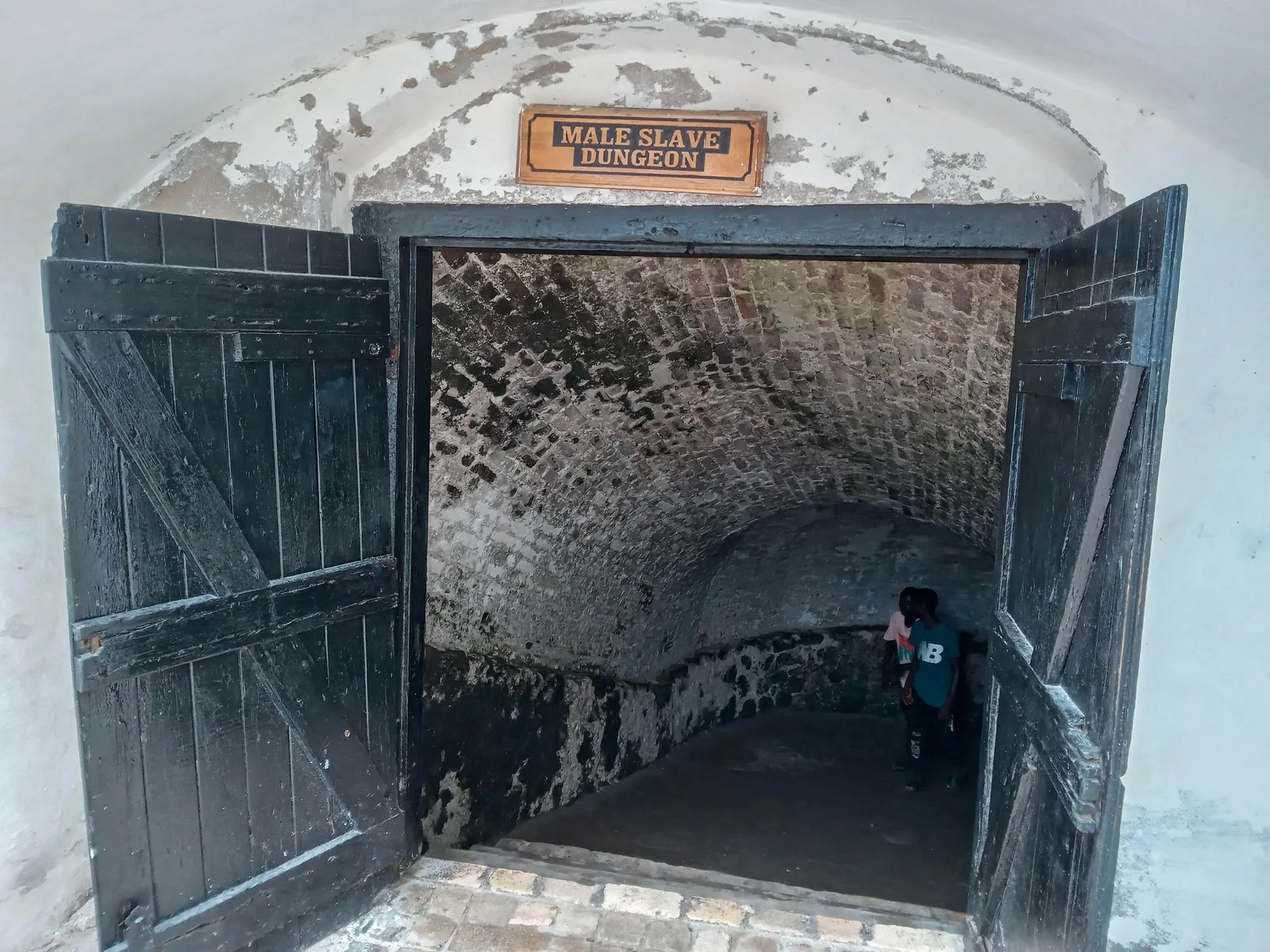
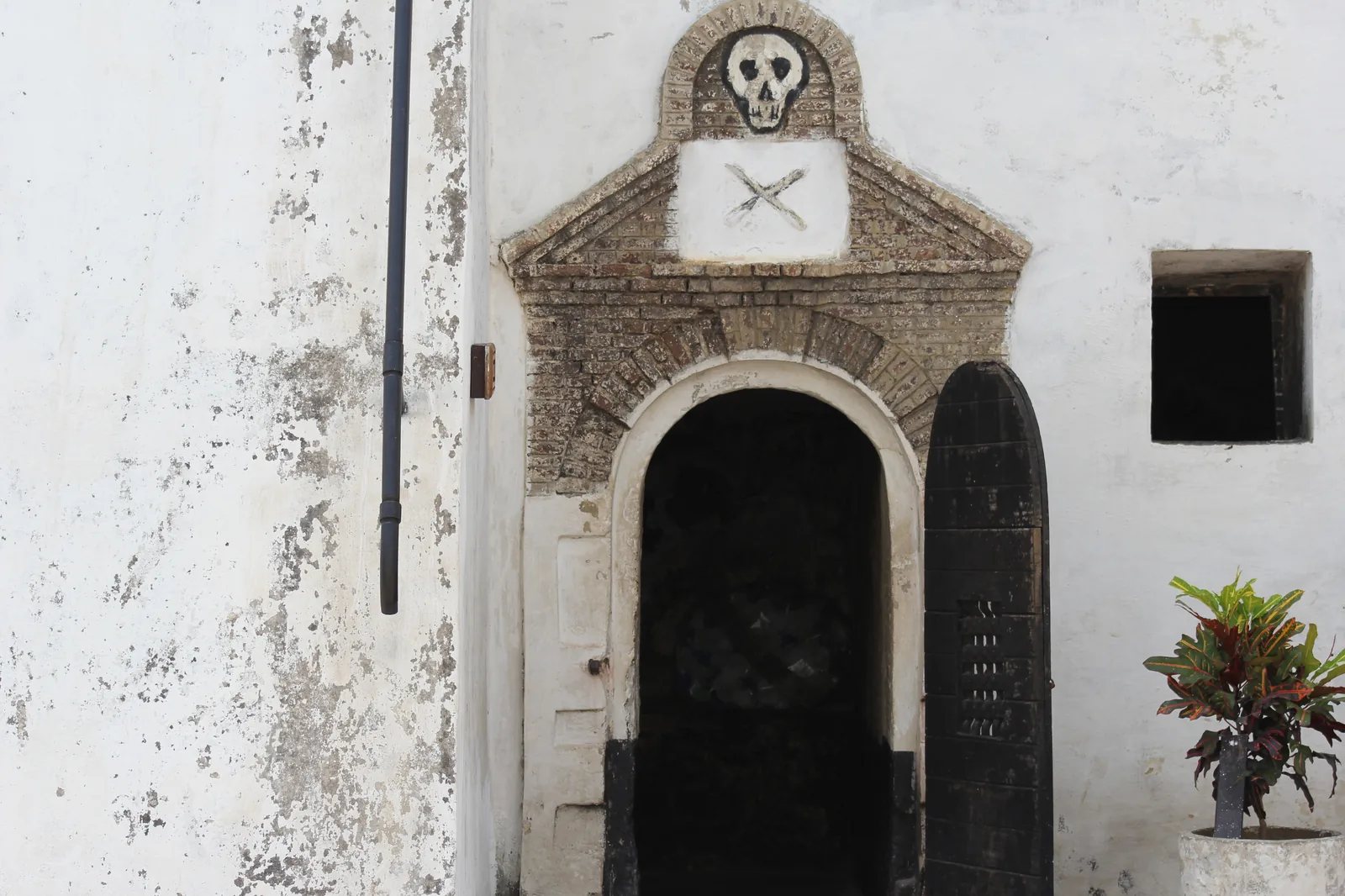
The male dungeon at Cape Coast Castle. Entry is GH₵80 for a non-Ghanaian adult, and both castles are guided. Photo: Antorsu10, CC BY-SA 4.0 via Wikimedia CommonsThe condemned cell at Elmina, where captives who resisted were left to die. UNESCO inscribed this coast under criterion (vi) — the one used for places associated with events of outstanding universal significance. Photo: Flixtey, CC BY-SA 4.0 via Wikimedia CommonsKakum's canopy walkway — seven bridges across 350 m, after a 20-minute uphill walk. It is 30 km beyond Cape Coast, which makes castles-plus-Kakum about 220 km of driving. Photo: daSupremo, CC BY-SA 4.0 via Wikimedia Commons
There is one thing here that matters more than the rest, it is 81 km away, and it takes the whole day. Everything below is arranged around that fact.
Cape Coast and Elmina — the full day
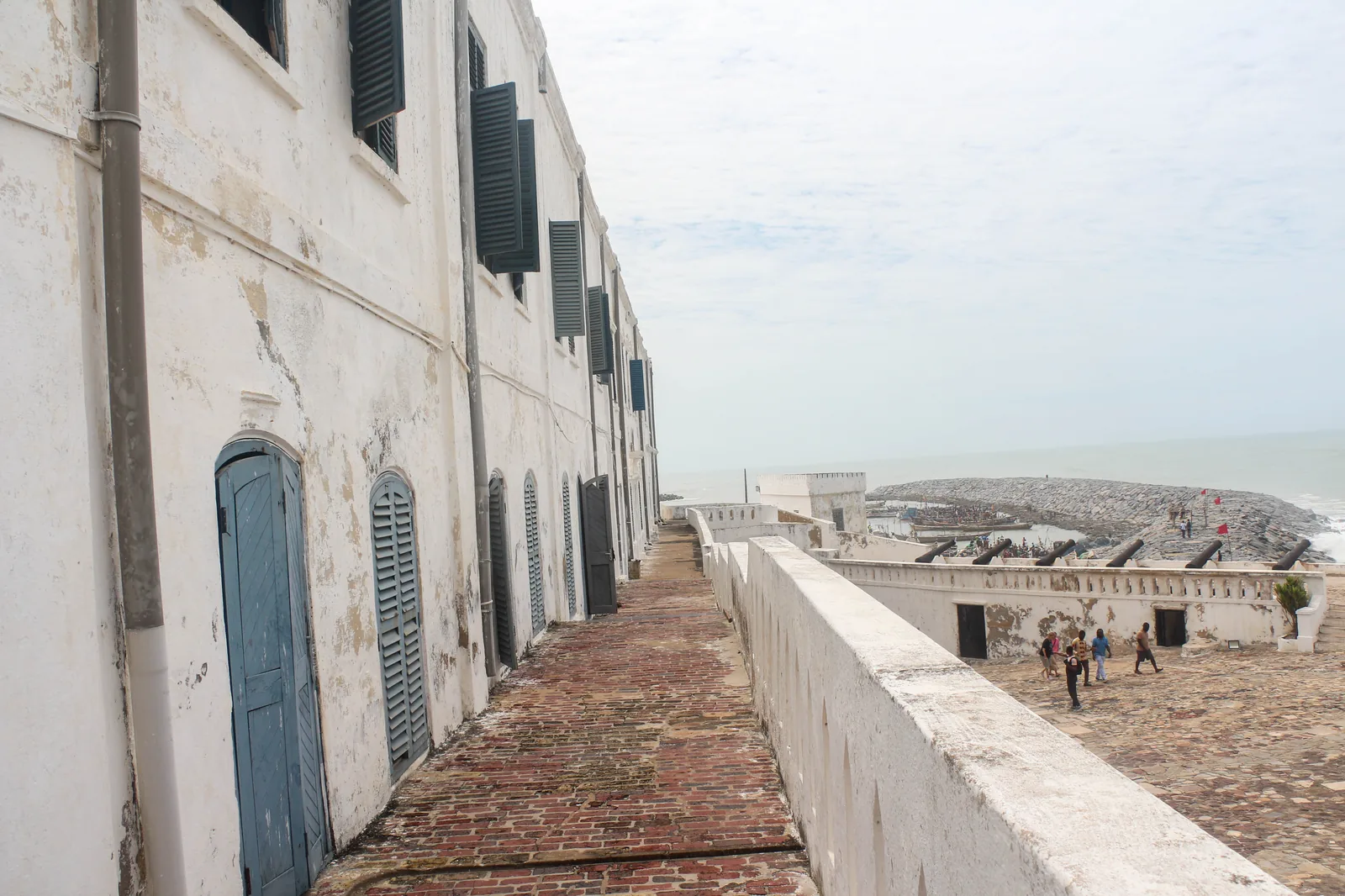
Cape Coast Castle, built by the Swedes in 1653 as Carolusburg and in British hands from 1664. The male and female dungeons, the condemned cell, and the Door of No Return. Guided; entry GH₵80 for a non-Ghanaian adult under the Ghana Museums and Monuments Board's published schedule.
Elmina Castle — St George's, São Jorge da Mina, founded by the Portuguese in 1482: the first European trading post on the Gulf of Guinea and the oldest European building still standing south of the Sahara. Dutch from 1637, rebuilt 1770–75. Fifteen minutes from Cape Coast, and the same entry fee.
The time cost is the whole point. 81 km each way, about 1 h 12 min in free-flowing traffic, plus two castles that ask for unhurried time. Budget the entire day and pair them with nothing. These are not a stop on a circuit.
Hours are widely given as 09:00–17:00 daily at both — though the Ghana Museums and Monuments Board publishes its fees without publishing its hours, so treat that as indicative and confirm through the ship.
The same World Heritage Site, 20 km from the ship
Fort San Sebastian at Shama, about 20 km east — Portuguese, from the 1520s (sources give 1523 and 1526), and one of the oldest European forts in sub-Saharan Africa. It is a component of the same 1979 UNESCO inscription as Cape Coast and Elmina, which covers three castles and fifteen forts along this coast, not two buildings.
Fort Orange at Sekondi, Dutch from 1642 and now a lighthouse, in the twin town next door — another component of the same property. Whether it admits visitors at all is unverified given its working lighthouse function.
Fort Metal Cross at Dixcove, British from the 1690s, out past Busua Beach roughly 30 km west — the same inscription again.
This is a real alternative, not a consolation. If three hours in a vehicle is not something you can do, you are not thereby shut out of this coast's history. No mainstream port description says so.
Closer to the berth
Market Circle, Takoradi's circular central market, about 1.5 km from the harbour gate and the town's own landmark.
Busua Beach, about 30 km west in the Ahanta West district — the region's beach, with Fort Metal Cross at Dixcove immediately adjacent, which makes the two a natural pairing.
Not feasible on a port day
Kakum National Park together with the castles. Kakum is 30 km past Cape Coast, so the pair is about 220 km of driving. Its canopy walkway — seven bridges across 350 m, reached by a 20-minute uphill walk, GH₵130 for a foreign visitor, open daily from 06:00 — is worth a day of its own and is not one you have. Excursions selling both exist; ask hard about the timing before booking.
Nzulezo, the stilt village near Beyin, about 90 km west and reached by canoe. A long day that pairs with nothing.
Accra. Not on the table from here.
On booking. This is a port to take a ship excursion or a pre-arranged private guide, and the reason is not access — the castles cost GH₵80. It is that you berth in a working cargo enclosure with no passenger terminal, the walk-out question is unresolved, and the main excursion is 81 km each way against a hard all-aboard. What you are buying is a guaranteed return. Going independent here is possible for someone who arranges a driver in advance; it is not a port to work out on the quayside. If Kakum matters to you, book ahead and satisfy yourself the timing is real.
On what this day is for. It is worth saying plainly that Cape Coast and Elmina are not sightseeing. They are the dungeons through which millions of people were taken onto the Atlantic, and the guides at both sites treat them accordingly. Take the day, take it quietly, and do not plan an afternoon of anything else around it.
History & Heritage
Elmina's front. Portuguese 1482, Dutch from 1637, rebuilt 1770–75 — and 171 years older than Cape Coast Castle. Photo: Noahalorwu, CC BY-SA 4.0 via Wikimedia Commons
The Portuguese reached this coast in the 1470s and built São Jorge da Mina at Elmina in 1482 — the first European trading post on the Gulf of Guinea, put up to hold a monopoly on the region's gold, and the oldest European building still standing anywhere south of the Sahara. Fort San Sebastian at Shama, twenty kilometres from where the ship berths, followed in the 1520s.
Over the next three centuries the coast filled with fortifications as the Portuguese, Dutch, Swedes, Danes, Brandenburgers and British competed for the trade — and as the trade itself shifted from gold to people. The Dutch took Elmina in 1637 and reconstructed it between 1770 and 1775. Cape Coast Castle was built by the Swedes in 1653 as Carolusburg and passed to the British in 1664, becoming the headquarters of British administration on the Gold Coast.
UNESCO inscribed the result in 1979 under criterion (vi) as Forts and Castles, Volta, Greater Accra, Central and Western Regions — three castles and fifteen forts, built between 1482 and 1786, strung along the coast between Keta and Beyin. It is one property, not a collection of separate listings, and reading it that way is what puts a World Heritage component within twenty minutes of the berth.
The dungeons at Cape Coast and Elmina, and the doorways both sites call the Door of No Return, are what the inscription is finally about. Criterion (vi) is the one UNESCO uses for places associated with events and traditions of outstanding universal significance — which is the polite formulation for what happened in those rooms.
Food & Drink Ashore
Ghanaian food is worth ordering rather than avoiding. Jollof rice, banku and tilapia, waakye, red-red, fufu with light soup, and kelewele — fried plantain with ginger and pepper. Takoradi and Sekondi are fishing towns and the grilled fish is the local strength.
On a castle day you will eat where the tour stops, and that is fine — the Cape Coast and Elmina area is well set up for it. What matters more than the menu is water: this is 27–31 °C with humidity Weather Spark records as 100% muggy in eleven months of twelve, and you will spend hours of the day in transit.
Money. Ghana cedi, and a notably cash-friendly economy — carry small notes as well as a card. English is the official language, so ordering is straightforward in a way it will not be at the next port.
Know Before You Go
Yellow fever vaccination is required of everyone aged 9 months and over, with documented evidence at the port of entry and vaccination at least 10 days before arrival. Your certificate is valid for life under the 2016 amendment to the International Health Regulations, in force since 11 July 2016 — but Ghana's own consular documentation still carries pre-2016 language about a ten-year limit. Carry the card and do not buy an unnecessary booster.
A visa is required of US, Canadian and Australian passport holders; Ghana offers them no visa-free entry. ECOWAS nationals enter visa-free for 90 days. How a cruise passenger arriving by ship satisfies the requirement — eVisa, visa on arrival, or a ship's-agent collective shore pass — is not addressed by any Ghanaian government source we could reach. Ask the line's documentation desk in writing.
Whether you may walk out of the port is unresolved. This is a working cargo harbour with no passenger terminal. Abidjan, a few days later on the same leg, does not permit it. Assume organised transport until told otherwise.
The castles are a full day and should not be paired. 81 km each way, about 1 h 12 min free-flow, two castles that ask for unhurried time. Kakum is 30 km further again — about 220 km of driving if you attempt both.
Plan for heat and humidity, not for rain. Highs 27–31 °C every month, humidity recorded as 100% muggy in every month but January, and a call in late April or early May on the ramp into the wet season — April 117 mm across 17.5 wet days, May 211 mm across 23.
Malaria prophylaxis is a medical decision, not a packing decision. Consult a travel clinic well before sailing, as for the whole West African leg.
Depth Soundings Ashore
Elmina's export gate. The 1979 inscription covers three castles and fifteen forts built between 1482 and 1786 — the property is the whole chain, not the two famous buildings. Photo: Kurt Dundy, CC BY-SA 3.0 via Wikimedia Commons
Things about this call that only make sense once someone says them:
Cape Coast and Elmina are not two World Heritage Sites. They are two components of one 1979 inscription — Forts and Castles, Volta, Greater Accra, Central and Western Regions — covering three castles and fifteen forts built between 1482 and 1786 between Keta and Beyin.
Which puts a component of that property 20 km from the berth. Fort San Sebastian at Shama is the same inscription as the famous pair. So are Fort Orange at Sekondi and Fort Metal Cross at Dixcove. The 81 km run is not the only way to stand on this coast's history.
Elmina is older than anything comparable. Founded 1482, it is the oldest European building still standing south of the Sahara — 171 years older than Cape Coast Castle.
You berth here, and that is not the hard part. 8–11.5 m alongside, and the 285 m Zuiderdam did it in March 2023. The hard part is 81 km of road and a hard all-aboard.
Your yellow fever certificate cannot expire, whatever the printed date says — the 2016 IHR amendment made every ICVP certificate lifetime-valid. Ghana's own published consular text has not been updated, which is a paperwork problem rather than a medical one.
English is the official language here, which after Abidjan and before Cape Verde is a bigger practical difference to a port day than it sounds.
Practical Information
Currency: the Ghana cedi (GHS). Cards work in formal businesses and at the castles; markets, taxis and small vendors are cash-first, so carry small notes. Always pay in cedis rather than in whatever currency a card machine offers you.
Language: English is the official language of Ghana — the only call on this leg where that is so, and a genuine practical relief.
Heat and humidity are the day's real constraint. Highs of 27–31 °C and lows of 23–26 in every month, sea 24–28, and humidity recorded as 100% muggy in every month except January. Light long sleeves, a hat, high-factor sunscreen, and considerably more water than seems reasonable — most of it drunk in a vehicle.
Accessibility. The berth is the easy part: you arrive alongside by gangway rather than by tender, which is a real advantage over the two ports before this one. After that it is hard. Minimal walking: not much is available — there is no passenger terminal and the walk-out question is unresolved, so a low-mobility passenger's realistic options are a seated coach tour or a ship day. Moderate: Market Circle, or Fort San Sebastian at Shama as a short drive with a modest walk. High energy: the castles, which involve stairs, uneven historic floors, low doorways and unlit dungeons, and Kakum's canopy walkway, which needs a 20-minute uphill forest walk before you reach seven suspension bridges. Neither castle should be assumed step-free.
What it costs: the sites themselves are cheap — GH₵80 for a non-Ghanaian adult at Cape Coast or Elmina, GH₵40 at a fort, GH₵130 for Kakum's canopy walkway. The money in this port day goes on the vehicle, and what a ship excursion buys is a guaranteed return across 162 km of round trip rather than admission.
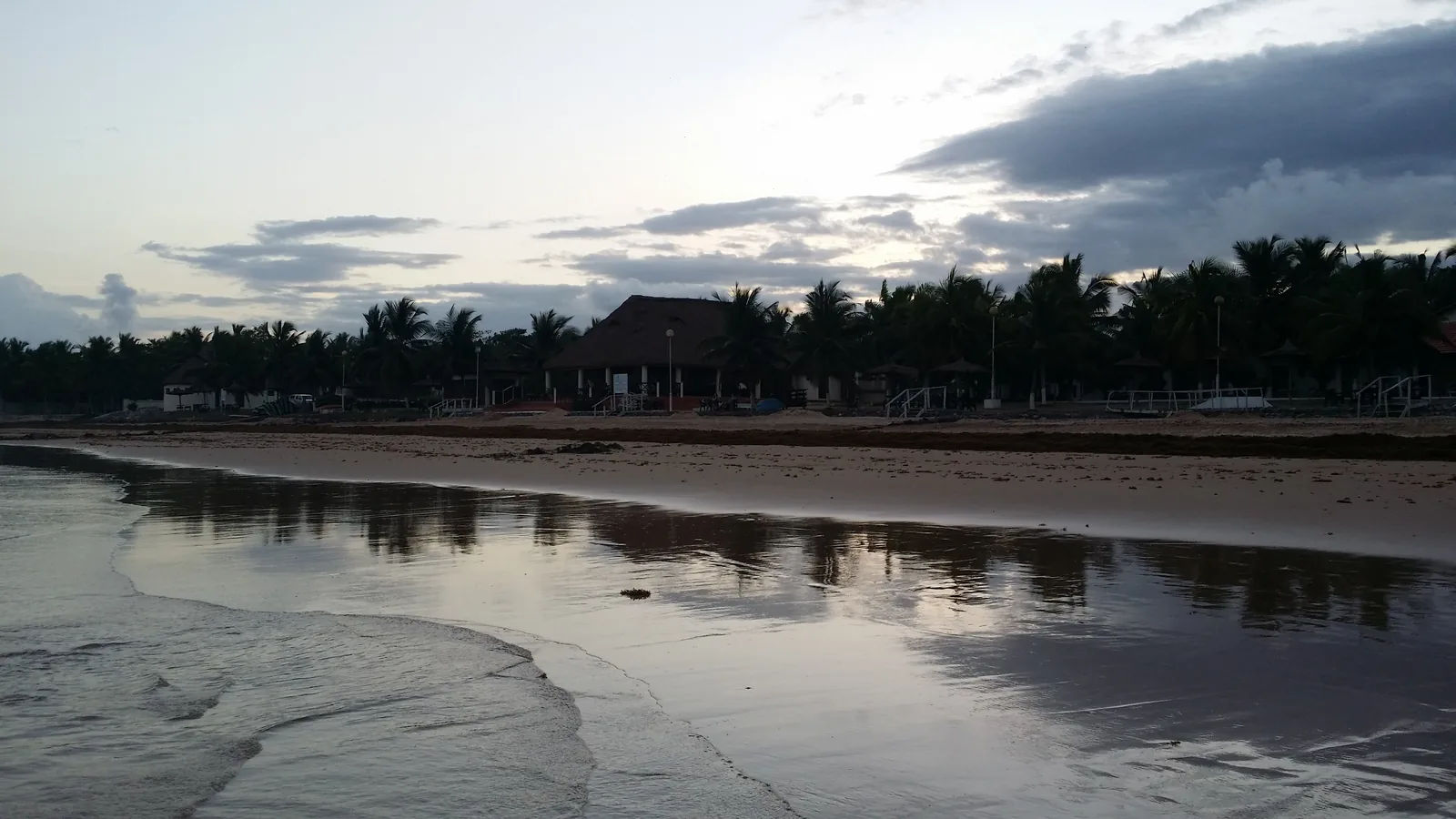
Busua Beach, about 30 km west — with Fort Metal Cross at Dixcove alongside it, another component of the same World Heritage property. Photo: Tom Lubbe, CC BY-SA 3.0 via Wikimedia Commons
Credits
Every image on this page comes from Wikimedia Commons under the license noted and is credited to its creator below. In the Wake does not claim authorship of these images; when we can add our own photographs from a future visit, we will.
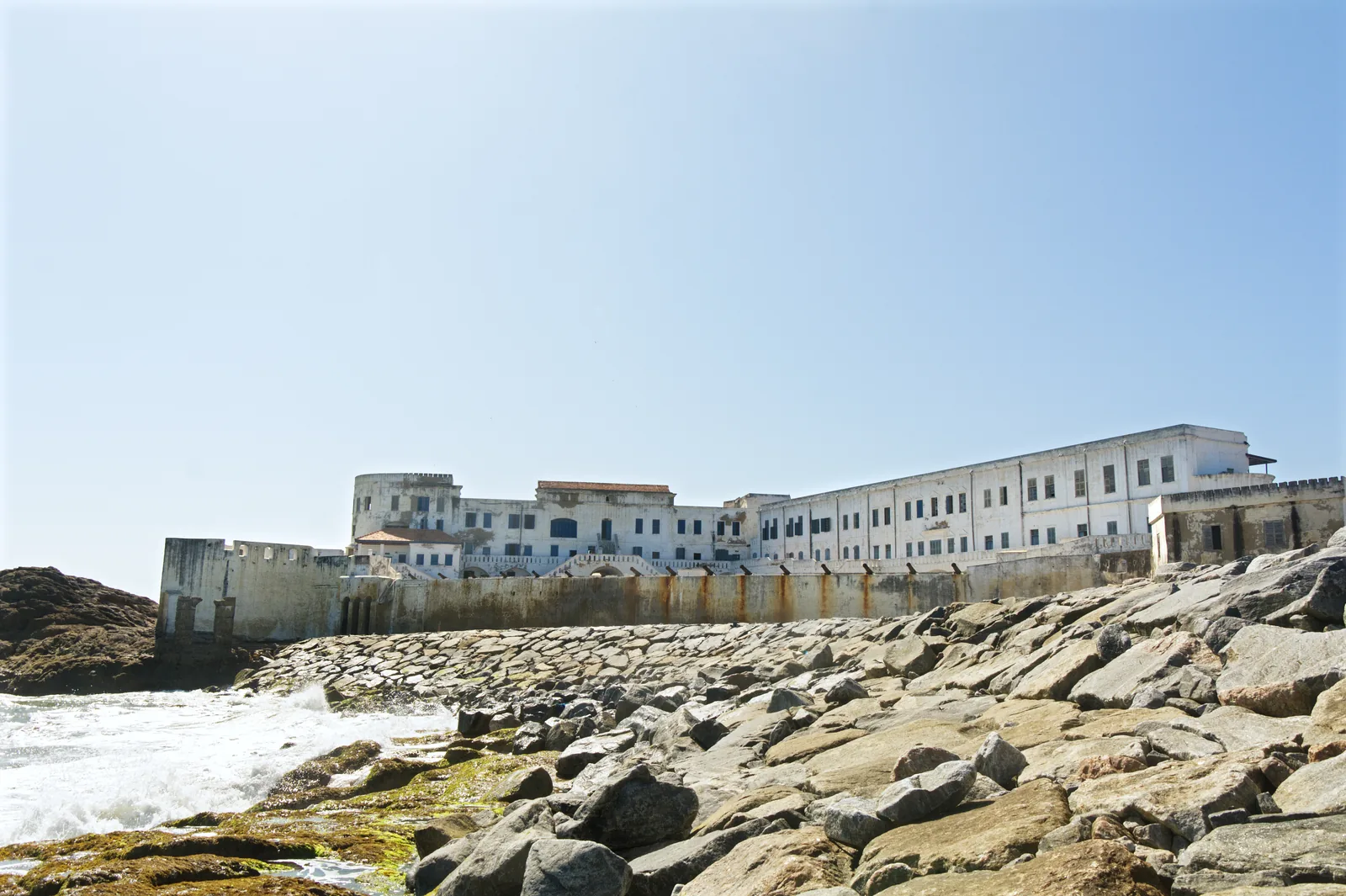
Cape Coast Castle in daylight (page header image) — Bright Kwame Ayisi, CC BY 4.0
Fort San Sebastian at Shama — Esthee2010, CC BY-SA 4.0
Elmina Castle from the water — Damien Halleux Radermecker, CC BY-SA 2.0
The Door of No Return at Cape Coast Castle — Antorsu10, CC BY-SA 4.0
The fishing wharves at Elmina — Francisco Anzola, CC BY 2.0
Market Circle, Takoradi, from above — Kghansah1, CC BY-SA 4.0
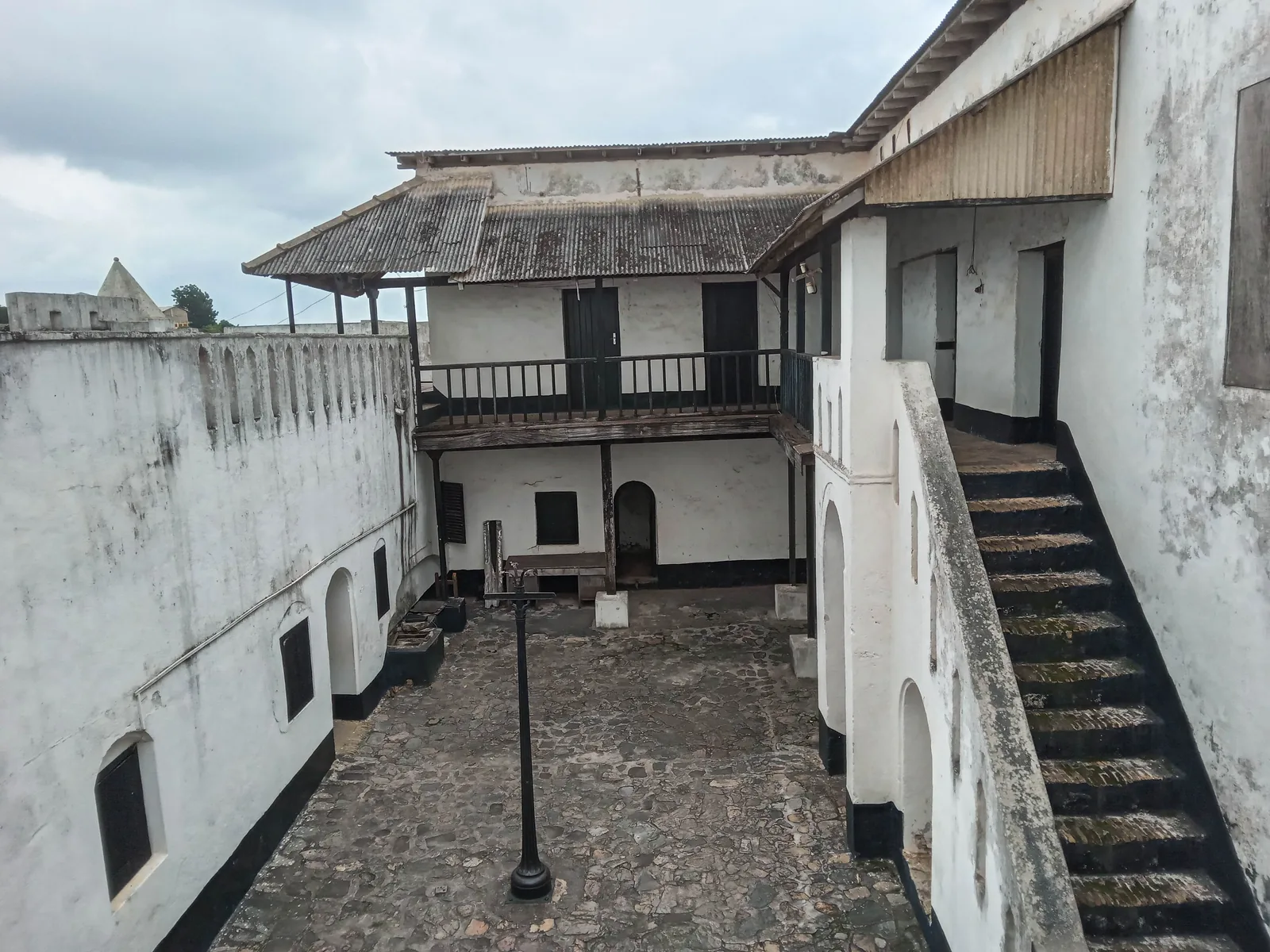
Cape Coast Castle walls and courtyard — Antorsu10, CC BY-SA 4.0
The male slave dungeon at Cape Coast Castle — Antorsu10, CC BY-SA 4.0
The condemned cell at Elmina Castle — Flixtey, CC BY-SA 4.0
The canopy walkway at Kakum National Park — daSupremo, CC BY-SA 4.0
The front of Elmina Castle — Noahalorwu, CC BY-SA 4.0
The slave export gate at Elmina Castle — Kurt Dundy, CC BY-SA 3.0
The female dungeons at Cape Coast Castle — Esthee2010, CC BY-SA 4.0
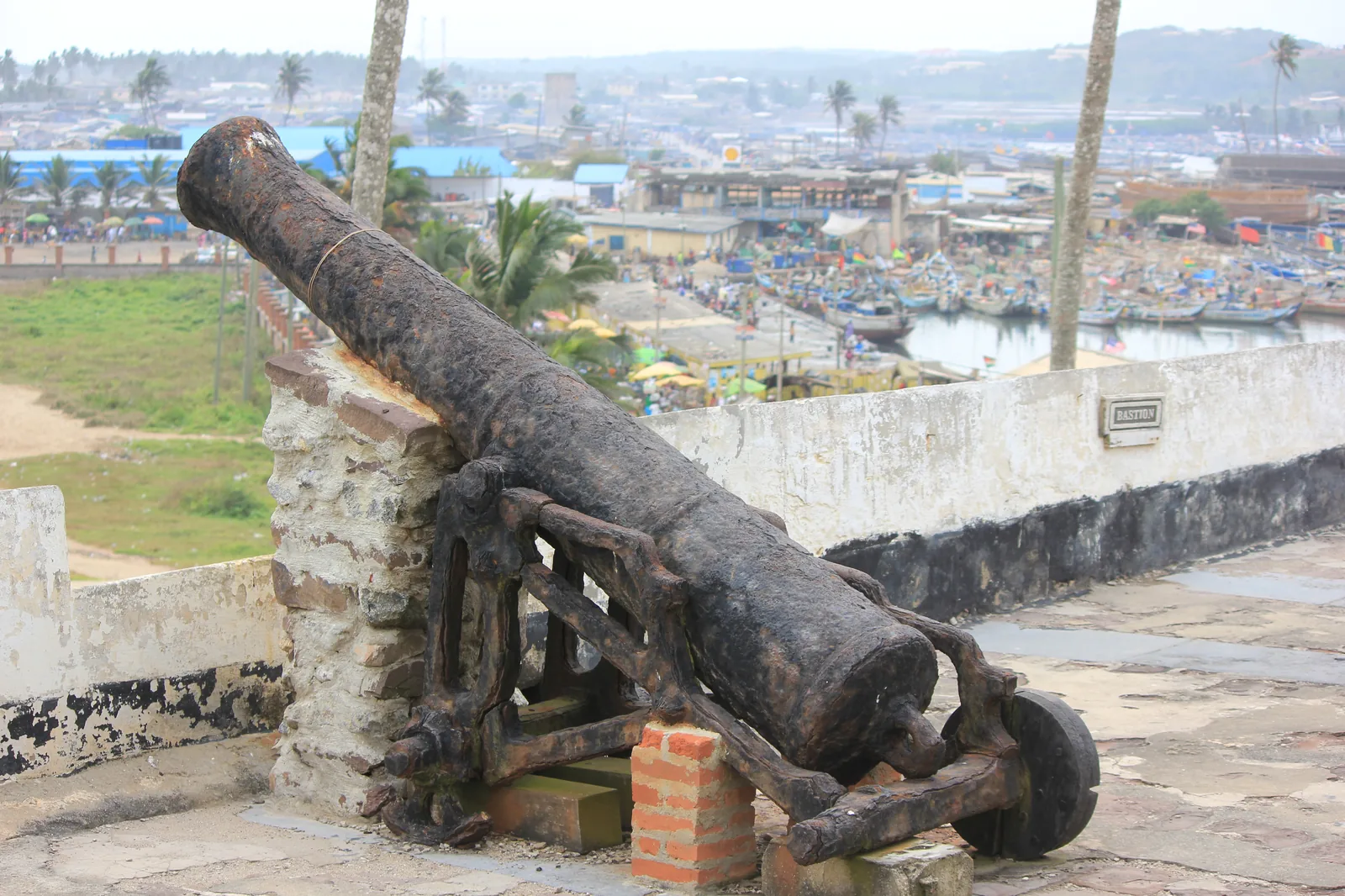
Cannon on the ramparts of Elmina Castle — Benggriff, CC BY-SA 3.0
Busua Beach on an overcast day — Tom Lubbe, CC BY-SA 3.0
Frequently Asked Questions
What is the best time of year to visit Takoradi?
December to February — the dry season runs from the end of October to 21 March, and January is the driest month by a wide margin. Temperature will not help you choose: highs sit between 27 and 31 °C in every month of the year and lows between 23 and 26. A world-cruise call falls in late April or early May instead, on the ramp into the wet season, with April averaging about 117 mm across 17.5 wet days and May 211 mm across 23.
What should I pack for the weather here?
Far more water than seems reasonable, and most of it drunk in a vehicle — the castle day is 162 km of round trip. Light long sleeves rather than sunscreen alone, five degrees north of the equator; a hat, sunglasses and high-factor sunscreen; a light rain layer for the wet season but not a heavy one in this humidity; and insect repellent with DEET or icaridin. Malaria prophylaxis is a separate decision for a travel clinic well before sailing, not a packing choice.
Will rain concerns affect my day in Takoradi?
Less than you might fear, and for an unusual reason: most of the day is spent in a vehicle. The wet season runs 21 March to 31 October and peaks in June at about 241 mm across 22.5 wet days, and a world-cruise call in late April or early May carries roughly a three-in-five to three-in-four chance of rain. But with 81 km each way to the castles and the sites themselves substantially indoors, rain costs you much less here than it would on a walking day. <strong>Heat and humidity are the real constraint</strong> — Weather Spark records 100% "muggy" days in every month except January.
Does Takoradi have a storm season, and can this call be cancelled?
There are no tropical cyclones on this coast — five degrees north of the equator is too close for them to form — so there is no hurricane season in the usual sense. What there is instead is a long wet season from late March to the end of October, peaking in June, and light southerly winds that never really let up on the humidity. And unlike the two ports before it on this leg, <strong>this is a berthed call rather than a tender one</strong>, which removes the commonest reason a port day evaporates. Takoradi is among the more reliable calls on the voyage.
Do cruise ships dock at Takoradi, or is this a tender port?
<strong>You berth alongside.</strong> Cruise ships use the General Multipurpose Berths (1–6) inside the commercial harbour, with 8 to 11.5 m alongside; Holland America's 285-metre Zuiderdam berthed here on 25 March 2023 with 2,272 passengers, one of three cruise ships totalling 3,790 passengers in a single month. There is <strong>no passenger terminal</strong> — you are on a working cargo quay in a harbour operated since April 2023 by YILPORT Takoradi Port Management Company.
Can I walk out of the port on my own?
<strong>This is genuinely unresolved and should not be assumed either way.</strong> No published source addresses whether Takoradi permits passengers to walk out of the harbour enclosure. It is not an idle question on this itinerary: at Abidjan, a few days later, the berth sits inside a closed customs enclosure and port regulation requires a pass from the Port Commander for any person or vehicle, so nobody walks out at all. Plan on organised transport, and ask the line's shore-excursion desk directly before you build a day around walking.
Are Cape Coast and Elmina really two World Heritage Sites?
No — and the correction is worth having, because it changes what is reachable. They are <strong>two components of a single 1979 inscription</strong>, <em>Forts and Castles, Volta, Greater Accra, Central and Western Regions</em>, listed under criterion (vi) and covering <strong>three castles and fifteen forts</strong> built between 1482 and 1786 along the coast between Keta and Beyin. The property is the whole chain. Which means there is a component of the same World Heritage Site <strong>20 km from the berth</strong> — Fort San Sebastian at Shama — plus Fort Orange at Sekondi next door and Fort Metal Cross at Dixcove out west.
How long does the castle trip take, and can I add anything to it?
Cape Coast is <strong>81 km east, about 1 h 12 min each way</strong> in free-flowing traffic, and Elmina is 15 minutes further on. That is two and a half hours of driving as a floor, plus two castles that ask for unhurried time — so <strong>budget the entire day and pair them with nothing</strong>. Kakum National Park is 30 km <em>beyond</em> Cape Coast, which makes castles-plus-Kakum roughly 220 km of driving. Excursions selling both exist; ask hard about the timing before you buy one.
What if I cannot face three hours in a vehicle?
You are not shut out of this coast's history, whatever the standard port descriptions imply. <strong>Fort San Sebastian at Shama is about 20 km east and is part of the same 1979 UNESCO inscription</strong> — Portuguese, from the 1520s, and one of the oldest European forts in sub-Saharan Africa. <strong>Fort Orange at Sekondi</strong> is in the twin town next door (though whether it admits visitors, given that it now functions as a lighthouse, is unverified), and <strong>Fort Metal Cross at Dixcove</strong> sits beside Busua Beach about 30 km west. Add Market Circle, 1.5 km from the harbour gate, and there is a real day here.
How old is Elmina Castle?
It was founded by the <strong>Portuguese in 1482</strong> as São Jorge da Mina — the first European trading post on the Gulf of Guinea, built to hold a monopoly on the region's gold, and <strong>the oldest European building still standing anywhere south of the Sahara</strong>. The Dutch took it in 1637 and reconstructed it between 1770 and 1775. Cape Coast Castle is 171 years younger: built by the Swedes in 1653 as Carolusburg and in British hands from 1664.
Do I need a visa and vaccinations for Ghana?
<strong>Yellow fever vaccination is required</strong> of everyone aged 9 months and over, with documented evidence at the port of entry and vaccination at least 10 days before arrival — you will be carrying that certificate for Abidjan anyway. Note one paperwork trap: <strong>your certificate is valid for life</strong> under the 2016 amendment to the International Health Regulations, in force since 11 July 2016, and revaccination cannot be required as a condition of entry — but Ghana's own consular documentation still carries pre-2016 language about a ten-year limit. Carry the card and do not buy an unnecessary booster. <strong>A visa is required</strong> of US, Canadian and Australian passport holders; how a passenger arriving by ship satisfies that is not addressed by any Ghanaian government source we could find, so ask the line in writing.
Is this call suitable if I have limited mobility?
The berth is the easy part, and genuinely better than the two calls before it — you arrive alongside by gangway rather than by tender. After that it is hard. There is no passenger terminal and the walk-out question is unresolved, so a low-mobility passenger's realistic options are a seated coach tour or a ship day. <strong>The castles involve stairs, uneven historic floors, low doorways and unlit dungeons, and should not be assumed step-free.</strong> Kakum's canopy walkway needs a 20-minute uphill forest walk before seven suspension bridges. The nearer forts and Market Circle are the gentler options, and Fort San Sebastian is a short drive with a modest walk.




.jpg)


